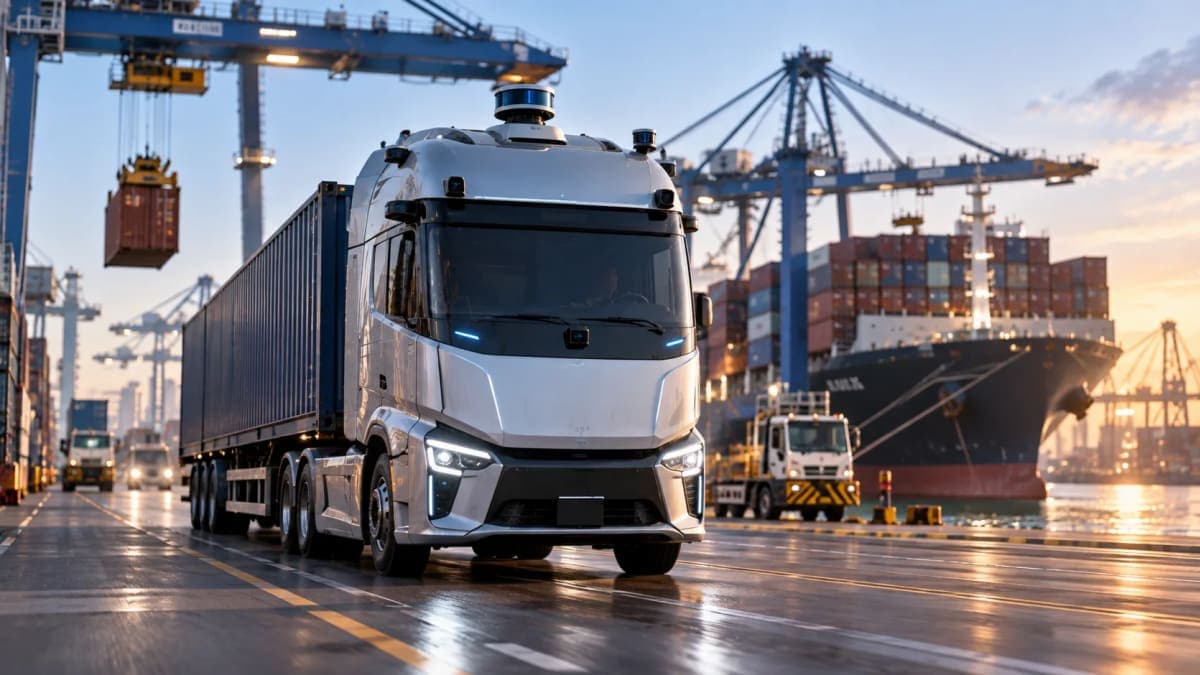
Autonomous driving is moving beyond robotaxis.
Pony.ai has unveiled a new Level 4 autonomous battery-electric heavy-duty truck developed with GAC Commercial Vehicle, bringing its latest self-driving technology into a vehicle designed for freight corridors, port operations and other commercial logistics work.
The truck made its global debut on September 14 at IAA Transportation 2026 in Hannover, Germany.
More important than the unveiling itself is what Pony.ai says comes next: volume production is scheduled to begin later in 2026.
The vehicle is one model in Pony.ai's fourth-generation Robotruck family and is built on GAC Commercial Vehicle's T9 battery-electric heavy-truck platform.
Its intended applications include long-haul freight, dedicated logistics routes and port transportation.
Those operating environments could prove crucial to the commercial case for autonomous trucking.
Unlike a robotaxi navigating unpredictable city streets, a freight truck can potentially spend much of its working life moving repeatedly between known logistics hubs, terminals and ports.
That makes autonomous freight a different — and potentially more controlled — challenge.
What exactly has Pony.ai unveiled?
The truck combines Pony.ai's Gen-4 Level 4 autonomous-driving system with GAC Commercial Vehicle's battery-electric T9 platform.
Pony.ai says the vehicle uses a fully redundant drive-by-wire chassis.
Redundancy extends across steering, braking, communications, power supply, computing and sensing systems.
The autonomous-driving hardware includes:
9 lidars, 3 millimetre-wave radars and 13 cameras.
Together, Pony.ai says these provide 360-degree sensing without blind spots.
The truck also shares its domain controller with Pony.ai's seventh-generation Robotaxi platform.
That last detail matters.
Instead of developing completely separate computing architectures for passenger and freight vehicles, Pony.ai is attempting to reuse technology across multiple autonomous-vehicle businesses.
What does Level 4 actually mean?
The phrase “driverless truck” requires some qualification.
Level 4 automation does not mean a vehicle can necessarily drive itself everywhere, under every road and weather condition.
It means the automated driving system can perform the driving task without requiring human intervention within its defined operational design domain.
That distinction makes ports and dedicated logistics routes particularly interesting.
A truck travelling repeatedly between known logistics hubs faces a more constrained operating environment than a vehicle expected to drive autonomously across arbitrary roads.
Pony.ai's deployment strategy reflects that reality.
The company says the new T9-based truck is intended for long-haul freight, dedicated-route logistics and port transportation.
Ports may be where the business case becomes clearest
Pony.ai is already testing that model commercially in China.
In its second-quarter results, the company said its Gen-4 driverless Robotrucks had begun commercial deployment at Mawan Port in Shenzhen through a partnership with China Merchants Port.
The autonomous vehicles operate in mixed-fleet logistics alongside trucks driven by humans.
That is important because ports combine several characteristics that are attractive for autonomous freight.
Routes can be repetitive. Container movements are highly structured. Vehicles can operate for long periods. And the geography is substantially more constrained than open-ended urban driving.
In other words, autonomous trucks do not necessarily need to solve every road-driving problem before they can become commercially useful.
They need to solve particular logistics problems economically and reliably.
Pony.ai claims a 70% reduction in autonomous-driving hardware cost
One of the most consequential numbers in the announcement concerns cost rather than autonomy.
Pony.ai says the bill-of-materials cost of its autonomous driving kit has fallen by 70% compared with the previous generation.
Reducing hardware cost is crucial because a technically successful autonomous vehicle can still fail commercially if the sensors, computers and redundant systems make it too expensive.
Pony.ai is trying to solve that problem partly by sharing technology with its Robotaxi operation.
The new Robotruck uses the same domain controller as its Gen-7 Robotaxis.
The company has therefore moved toward a platform strategy in which advances and production scale in one autonomous-driving business may potentially reduce costs in another.
But investors and fleet operators should distinguish between two types of numbers.
The 70% autonomous-driving-kit BOM reduction is a company-reported comparison with its previous generation.
Pony.ai's additional claims that transportation cost per ton-kilometre could fall 30% and energy consumption could decline 10% are forward-looking expectations.
They are not independently established operating results from a large fleet of these new trucks.
Why combine autonomy with electric power?
The truck is not merely autonomous.
It is battery-electric.
That creates two different attempts at changing freight economics in the same vehicle.
Electrification targets energy use and emissions at the vehicle level.
Autonomy targets labour utilisation, vehicle operation and potentially fleet productivity.
Pony.ai says its energy-management algorithms combined with the T9's 0.4 drag coefficient are expected to reduce energy consumption by approximately 10% compared with conventional trucks.
Whether that advantage is achieved in commercial operations will depend on factors including routes, payloads, weather, charging, traffic and driving conditions.
But the combination points toward a broader change underway in commercial transport:
the next generation of trucks may increasingly be software-defined and electric at the same time.
This isn't Pony.ai's first Robotruck
The new model is part of a much longer autonomous-freight programme.
Pony.ai says it began Robotruck development in 2018.
Its SEC annual filing shows that the company operated 210 Robotrucks as of March 31, 2026, including both Level 2++ intelligent trucks and Level 4 driverless vehicles.
Its Robotruck operations cover commercially active transportation routes in China.
The company has also been generating actual revenue from the business.
Robotruck services produced $13.3 million in revenue during the second quarter of 2026, up 40% year-on-year from $9.5 million.
Pony.ai attributed the increase mainly to growth in freight transportation services supported by its collaboration with Sinotrans.
That gives the new truck an important context.
This is not simply an autonomous concept vehicle appearing at a trade show.
It is being introduced into an existing commercial Robotruck business.
Pony.ai is building more than one kind of autonomous truck
The company is also expanding at the other end of commercial transport.
In April 2026, Pony.ai launched a driverless light truck, using the same safety architecture and fail-operational redundancy approach as its Robotaxi platform.
That means its commercial-vehicle strategy now stretches across both heavy-duty and light-duty applications.
The potential use cases are different.
Heavy trucks fit long-distance freight, bulk commodities and ports.
Light commercial vehicles can address urban logistics and delivery.
If the underlying autonomous-driving platform can be reused across both, Pony.ai potentially spreads development costs across a broader vehicle base.
Why unveil a Chinese Robotruck in Germany?
The location of the launch may be as significant as the truck.
Pony.ai chose IAA Transportation in Hannover for the global debut while simultaneously signalling plans to take its Robotruck business beyond China.
The company says it intends to enter Europe and the Middle East over the next two years.
Reuters independently reported that Pony.ai is already in discussions with European governments and ports regarding testing permissions.
Europe is attractive partly because autonomous trucking could address locations where commercial drivers are expensive or difficult to recruit.
But the regulatory challenge is substantial.
Autonomous-driving rules differ between jurisdictions, and approval to test a vehicle does not automatically mean approval to operate a large driverless commercial fleet.
That makes Pony.ai's international timeline an ambition rather than a guaranteed deployment schedule.
Robotrucks could follow a different path from robotaxis
Much of the public autonomous-driving debate has focused on passenger vehicles.
Freight may develop differently.
A robotaxi must deal with passengers, dense urban traffic, pickups, drop-offs, pedestrians, cyclists and a huge variety of street environments.
A Robotruck operating between a port and logistics centre can potentially have a much narrower operating domain.
That does not make autonomous trucking easy.
Heavy vehicles introduce their own safety challenges because of their size, stopping distance, payload and consequences in a collision.
But it means commercial deployment does not necessarily require solving universal autonomy first.
A company can target increasingly specific operating domains:
port → dedicated logistics corridor → hub-to-hub freight → broader highway networks.
That gradual expansion may prove more commercially practical than attempting unrestricted autonomous driving immediately.
China is also exporting an increasingly crowded electric-truck industry
Pony.ai is not entering Europe in isolation.
Reuters reports that Chinese manufacturers including BYD, Farizon, Sany, Sinotruk, Windrose and SuperPanther are among the companies pursuing opportunities in Europe's electric-truck market.
Pony.ai's proposition is somewhat different because its pitch combines Chinese electric commercial-vehicle manufacturing with Level 4 autonomous-driving technology.
The competitive question therefore extends beyond:
Can Chinese manufacturers sell electric trucks internationally?
It increasingly becomes:
Can Chinese companies export autonomous freight systems as well?
The answer will depend as much on regulation, safety validation, fleet economics and local partnerships as on the underlying vehicle technology.
The partnership model may be Pony.ai's most important strategy
Another notable aspect of the T9 project is how quickly it moved.
Pony.ai and GAC Commercial Vehicle signed their strategic cooperation agreement on April 16, 2026.
The companies say they completed testing and validation for the new model within five months before its September launch.
Rather than becoming a truck manufacturer itself, Pony.ai supplies autonomous-driving technology while working with established vehicle manufacturers.
GAC contributes the underlying commercial-vehicle engineering and manufacturing platform.
Pony.ai contributes the autonomous system.
That partnership approach could make expansion easier than developing an entirely proprietary heavy truck.
It also mirrors the broader strategy Pony.ai uses across its autonomous-driving businesses.
JantaScope Analysis: The biggest question isn't whether the truck can drive itself
The technology naturally attracts attention, but the commercial question is more demanding.
For logistics companies, a Robotruck ultimately has to outperform the economics and reliability of a conventional truck.
That means the key metrics are not simply the number of lidars or whether the vehicle qualifies as Level 4.
Fleet operators will care about:
cost per kilometre, energy consumption, vehicle utilisation, charging downtime, maintenance, insurance, safety, regulatory compliance and the amount of human supervision still required.
This is why Pony.ai's projected 30% reduction in transport cost per ton-kilometre could eventually matter more commercially than the autonomous-driving label itself.
But it is also why that figure needs scrutiny.
It remains a company expectation.
Large-scale real-world operations will determine whether those economics can actually be achieved.
Ports and dedicated freight corridors are likely to provide one of the earliest serious tests.
Pony.ai already has Gen-4 trucks operating commercially at Shenzhen's Mawan Port.
Now it is preparing another model for volume production and signalling international expansion.
The transition that matters is therefore no longer simply:
prototype → autonomous truck.
It is:
autonomous truck → mass-produced fleet → commercially viable logistics operation.
That is the much harder test — and the one that could determine whether autonomous freight becomes a significant business rather than another impressive demonstration.