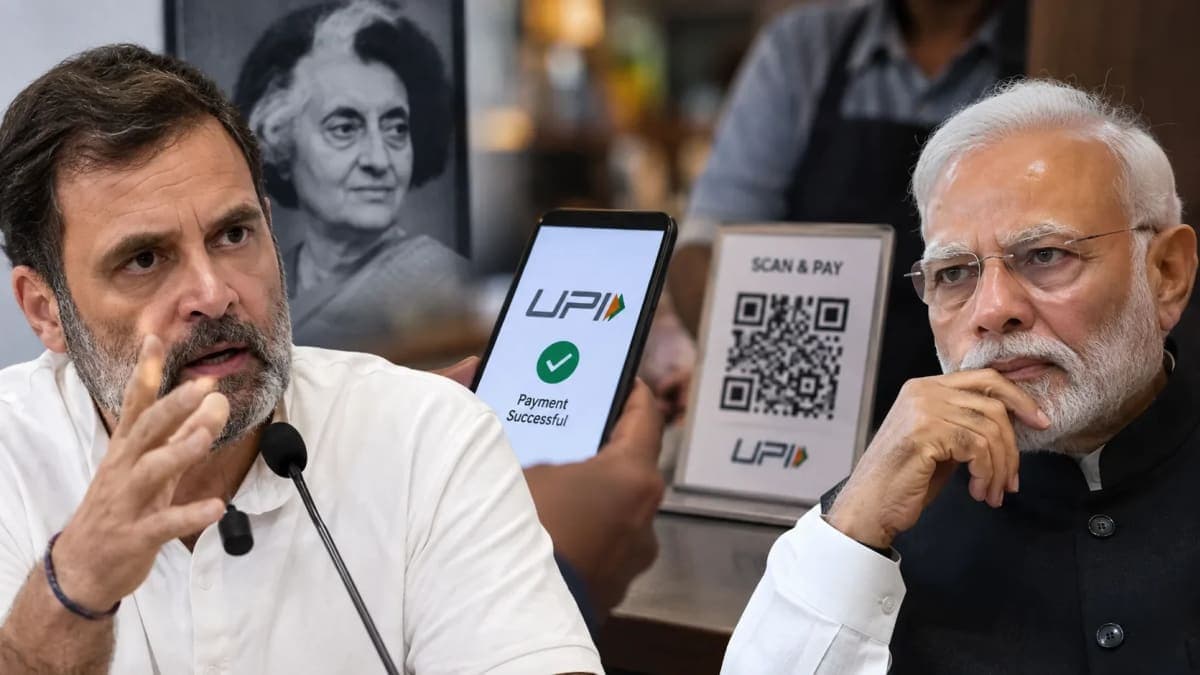
New Delhi, September 16, 2026: Leader of the Opposition in the Lok Sabha Rahul Gandhi on Wednesday intensified his criticism of the Centre over newly announced charges on certain Unified Payments Interface (UPI) merchant transactions, demanding that Prime Minister Narendra Modi withdraw the decision.
Gandhi described the Merchant Discount Rate, or MDR, as a “UPI tax” and accused the Modi government of acting under pressure from the United States. His remarks came as the new payment framework triggered a wider political and industry debate over how India should fund the rapidly expanding UPI ecosystem.
In a video message, Gandhi directly appealed to Modi to reverse the move.
“Modiji, please stop lying down in front of the US. And please roll back the UPI tax,” Gandhi said, according to reports.
Gandhi’s description of the measure as a “tax” is a political characterisation. The announced mechanism is an MDR — a transaction fee associated with merchant payments — rather than a conventional government tax.
What Rahul Gandhi alleged
Gandhi alleged that the policy would ultimately impose a financial burden on Indians and claimed that the government had taken the decision to benefit American interests.
He also linked the UPI issue with his broader criticism of the Modi government’s dealings with US President Donald Trump.
According to Gandhi, the government had effectively decided to transfer a substantial economic benefit to American interests through its approach to digital payments.
These are allegations made by Gandhi and should not be treated as established evidence that US pressure caused the UPI policy change.
Rahul Gandhi invokes Indira Gandhi
During his attack, Gandhi also invoked former Prime Minister Indira Gandhi to contrast what he portrayed as her willingness to resist international pressure with the current government’s approach.
His reference added a historical and political dimension to the UPI dispute, framing the controversy not simply as a question of digital-payment pricing but also as one involving economic sovereignty and relations with the United States.
Gandhi urged Modi to “have a spine” and stand up to what he described as pressure from Washington.
The government’s stated rationale for the new MDR framework, however, is tied to the financial sustainability of the UPI infrastructure rather than the political explanation advanced by the Congress leader.
What exactly is changing for UPI payments?
Under the newly announced framework, a 0.4% Merchant Discount Rate will apply to eligible merchant UPI transactions above ₹2,000 from October 15, 2026.
Importantly, the MDR applies to qualifying merchant payments rather than ordinary person-to-person transfers.
The framework also contains different provisions for certain categories. Railways, fuel and telecom payments will attract a flat ₹5 MDR, while charges on transactions above ₹75,000 will be capped at ₹300.
Capital-market payments will have an MDR of 0.02%, subject to a ₹300 ceiling.
Small merchants receiving up to ₹1 lakh per month through QR-based UPI payments are exempt under the framework.
Will customers have to pay extra?
For ordinary UPI users, this is the most important distinction in the controversy.
The government has barred banks and UPI service providers from directly passing the MDR charge on to consumers.
That means a customer making an eligible merchant payment is not supposed to see a separate UPI fee added directly to the transaction under the announced rules.
The MDR is instead part of the merchant-side payment system.
This distinction is significant because political criticism has frequently referred to the measure as a “UPI tax”, potentially creating the impression that every UPI user will automatically be charged for making a payment.
That is not what the announced framework says.
Why has an MDR been introduced?
The government’s move represents a major shift for India's UPI ecosystem after years in which zero-MDR policies helped accelerate adoption of the payment network.
The new framework is intended to provide funding for infrastructure, cybersecurity and customer-service requirements across the digital-payment ecosystem.
Revenue generated through the MDR is expected to be distributed among participants including banks, payment applications and service providers.
The framework also provides for 5% of MDR collections to go into a fund intended to encourage UPI adoption among small merchants.
UPI's enormous scale explains why the debate matters
UPI has grown from a convenient payment option into one of the central pieces of India's retail-payment infrastructure.
In August 2026 alone, the network processed about 24 billion transactions worth approximately $311 billion, according to Reuters.
That scale makes even a relatively small merchant transaction charge economically significant.
The central policy question is therefore broader than whether UPI remains technically “free” for consumers. Policymakers and the payments industry must also address how banks, payment applications and infrastructure providers finance a system handling billions of transactions every month.
Political battle over UPI is likely to continue
The MDR announcement has transformed what was largely an industry debate over payment-system economics into a political confrontation.
Gandhi and the Congress are presenting the move as a retreat from India's zero-cost digital-payment model and alleging that foreign pressure influenced the decision.
The announced framework, meanwhile, keeps person-to-person UPI payments outside the merchant MDR structure and prevents providers from directly charging consumers the merchant fee.
As the October 15 implementation date approaches, attention is likely to focus on how merchants respond to the new cost structure and whether the changes affect payment behaviour.
For consumers, the key takeaway remains straightforward: the new framework introduces charges on specified merchant-side UPI transactions, but it does not announce a general fee on every UPI transfer.