GalaxEye gets government backing for next-generation satellite technology
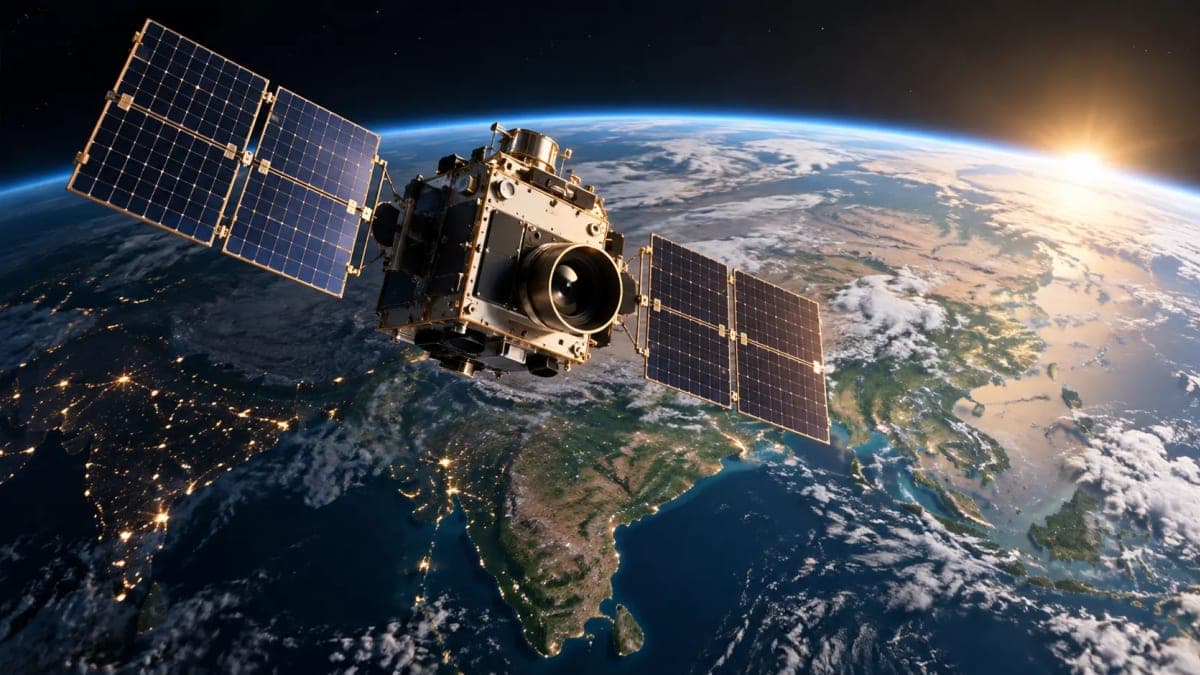
Indian spacetech startup GalaxEye Space Solutions has secured ₹63.84 crore in financial support from the Technology Development Board (TDB) to develop its next-generation multisensor Earth-observation satellite technology.
TDB, which operates under the Department of Science and Technology (DST), has signed an agreement with the Bengaluru-based company under the Centre's Research, Development and Innovation (RDI) Fund. The support will be provided through Optionally Convertible Debentures (OCDs) rather than as a conventional grant.
The entire project has an approved cost of ₹247.69 crore, meaning the ₹63.84 crore government-backed financing represents only part of the planned development programme.
The agreement was officially announced by the Ministry of Science and Technology on September 24, 2026.
What is GalaxEye developing?
At the centre of the project is GalaxEye's indigenous OptoSAR technology.
The proposed satellite is designed to combine two different Earth-observation technologies on a multisensor platform:
Synthetic Aperture Radar (SAR), which can collect imagery through cloud cover and without relying on daylight.
Electro-Optical (EO) imaging, which provides detailed visual information but can be limited by clouds and illumination conditions.
By combining data from both sensors, GalaxEye aims to produce a more continuous and information-rich view of the Earth's surface than either system can provide independently.
The target is imaging resolution finer than 0.5 metres, according to the government's announcement.
Why combining radar and optical imaging matters
Traditional optical Earth-observation satellites work much like highly sophisticated cameras. They can produce detailed images, but clouds, darkness and poor illumination can restrict what they see.
SAR works differently. It uses radar signals and can operate during the day or night and through cloud cover.
GalaxEye's approach seeks to combine these complementary capabilities, allowing optical detail and radar-based all-weather observation to be collected within a unified system.
This is particularly relevant for applications where consistent observation matters and waiting for clear skies may not be practical.
Project targets sub-0.5-metre imagery
According to the Department of Science and Technology, the proposed system is intended to support applications including wide-area surveillance, long-range surveillance, human and vehicle detection, and target classification.
The system is also being designed to operate across different weather and lighting conditions.
These capabilities could make multisensor Earth-observation data relevant across strategic and commercial fields, although the specific performance targets still need to be demonstrated as the technology progresses toward operational deployment.
GalaxEye aims to move technology from TRL-6 to TRL-9
One of the most important aspects of the agreement is not simply building another satellite but maturing the underlying technology.
The project aims to move GalaxEye's system from Technology Readiness Level 6 (TRL-6) to TRL-9.
In practical terms, this means taking a technology that has already reached an advanced demonstration stage and carrying out the engineering, testing and validation required for it to become a proven operational system.
The distinction is important because the ₹63.84 crore support does not mean the project's technical objectives have already been achieved. The financing is intended to help GalaxEye complete the work needed to reach that stage.
TDB says focus is on taking indigenous technology towards commercialisation
TDB Secretary Rajesh Kumar Pathak said India's space sector is reaching a stage where developing and deploying sophisticated technologies domestically will become increasingly important.
He said the RDI Fund is intended to help technology-intensive projects bridge the gap between advanced development and deployment.
According to Pathak, the GalaxEye agreement reflects TDB's effort to strengthen indigenous capabilities in emerging space technologies and help move them towards commercialisation.
GalaxEye's promoters, meanwhile, said the support would accelerate the development and validation of OptoSAR and help move the technology towards TRL-9 and subsequent deployment.
GalaxEye already tested OptoSAR concept with Drishti
The new government-backed project builds on technology GalaxEye has already been developing.
In May 2026, the company launched its first satellite, Drishti, aboard a SpaceX rocket. The satellite was designed to capture both optical and radar imagery of the same location, demonstrating the central concept behind GalaxEye's OptoSAR architecture.
Inc42 reported that communication with Drishti was subsequently lost in July following an anomaly linked to a geomagnetic solar storm. The company is now targeting two additional OptoSAR satellite launches over the next two years while strengthening its internal engineering and reliability capabilities.
That history adds context to the latest agreement: the RDI-backed programme is aimed at progressing the technology from demonstration towards a system capable of operational deployment.
Part of India's ₹1 lakh crore RDI push
GalaxEye's financing sits within a much larger government effort to increase private-sector participation in research and development.
The Union Cabinet approved the ₹1 lakh crore RDI Fund on July 1, 2025, with the Department of Science and Technology serving as the nodal ministry.
The scheme follows a two-tier funding model. A special-purpose fund under the Anusandhan National Research Foundation (ANRF) serves as custodian of the corpus, while capital is channelled through second-level fund managers rather than being invested directly into companies by the first-level fund.
This structure is intended to provide long-term financing for private-sector research, development and commercialisation in strategic and emerging technologies.
According to Inc42, TDB has approved 22 projects with a combined project cost of ₹4,744 crore, involving ₹2,192 crore of RDI support.
Why the GalaxEye project matters
The significance of the agreement goes beyond its ₹63.84 crore value.
For India's private space sector, a major challenge is turning technically promising prototypes into reliable systems that can operate commercially. The GalaxEye programme specifically targets that gap by funding development between TRL-6 and TRL-9.
If the planned technical milestones are achieved, GalaxEye's combination of radar and optical sensing could provide high-resolution imagery under conditions where conventional optical satellites face limitations.
At the same time, the government's announcement describes development targets, not capabilities that should be treated as already proven at full operational scale. The next phase of engineering, testing and validation will determine whether the technology reaches its intended TRL-9 performance.
Sources
The primary source for the financial and technical details is the Technology Development Board/Department of Science and Technology announcement published through the Press Information Bureau on September 24, 2026. Inc42 provided additional reporting on GalaxEye's funding history, Drishti mission and expansion plans.