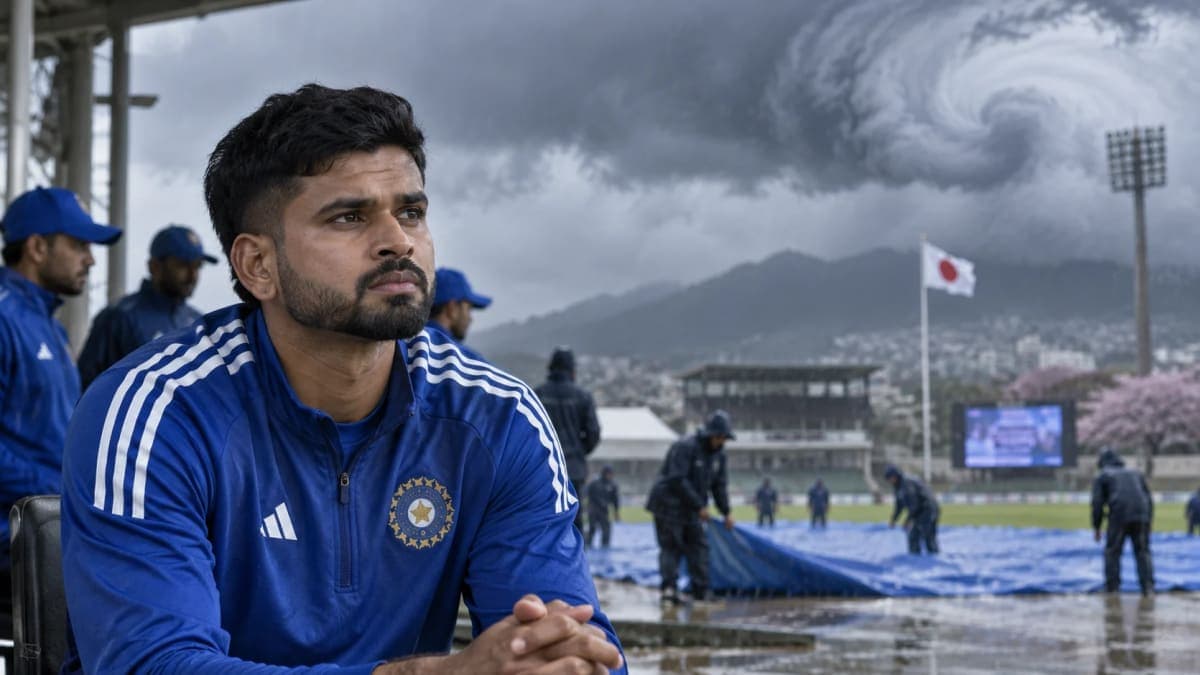
Typhoon Dujuan Disrupts India’s Build-Up to Historic Japan T20I
India’s preparations for their first-ever men’s T20 International against Japan have run into an unexpected weather challenge, with Typhoon Dujuan disrupting the team's planned training session ahead of Tuesday’s match in Sano.
Heavy rain and stormy conditions associated with the approaching typhoon prevented Shreyas Iyer-led India from completing their scheduled training on the eve of the one-off T20I. That leaves the visitors with limited opportunity to familiarise themselves with conditions at the Sano International Cricket Ground before the landmark fixture.
The match is scheduled for September 22 at Sano International Cricket Ground in Tochigi Prefecture and will be the first international cricket meeting between the two countries’ senior men’s teams. The BCCI and Japan Cricket Association had confirmed the fixture earlier this month.
Shreyas Iyer Admits India Are Entering Unfamiliar Territory
The weather disruption has added another variable for India as they prepare to play at a venue and against an opponent unfamiliar to the senior side.
Speaking ahead of the match, captain Shreyas Iyer acknowledged that India do not have first-hand knowledge of the local playing conditions, saying they “don’t know” exactly what conditions they will encounter. Despite the disrupted preparation, he expressed enthusiasm about the significance of the fixture.
The uncertainty is particularly relevant because the Japan match is more than a standalone international. Both teams are using it as preparation for the men’s cricket competition at the 2026 Asian Games in Aichi-Nagoya. India will enter the Asian Games directly at the quarter-final stage, while Japan will begin in the group stage.
Typhoon Also Affecting Asian Games Schedule
India’s cancelled training session is part of a wider weather disruption in Japan.
Typhoon Dujuan is approaching Japan’s Pacific coast, bringing the threat of heavy rainfall and strong winds. Asian Games organisers have already postponed an equestrian eventing competition because of the expected conditions.
That makes the weather an important factor surrounding Tuesday’s cricket fixture, although the India-Japan T20I remains scheduled to take place at Sano at the time of writing.
Why India vs Japan Is More Than a Warm-Up
While India will view the contest as preparation for the Asian Games, the match represents a major milestone for Japanese cricket.
Japan have never previously faced a Full Member nation in a senior men’s international. The Japan Cricket Association sees India's visit as an opportunity to introduce cricket to a much wider domestic audience in a country where baseball and football have significantly larger profiles.
Interest surrounding the fixture has also extended beyond the cricket field. Reuters reported that the event forms part of a broader effort to strengthen sporting ties between India and Japan, with government support and commercial backing accompanying Japan's push to grow cricket.
The sport has been building gradually in the country. JCA chief operating officer Alan Curr said registered player numbers have risen from roughly 3,000 in 2014 to 8,800, while the Japan Cup T20 competition has expanded from around a dozen teams to more than 80.
India Arrive as Reigning T20 World Champions
The difference in international experience between the two teams is substantial.
India enter the match as the reigning ICC Men’s T20 World Cup champions, while Japan will be facing a Full Member men's team for the first time at senior international level.
For Japan, therefore, the fixture offers exposure to elite international opposition ahead of the Asian Games. For India, it provides competitive preparation after an enforced weather-related interruption to their training.
BCCI Secretary Devajit Saikia described the fixture as a significant moment that takes India into new cricketing territory and creates an opportunity to expose the sport to a wider audience in Japan and East Asia.
Weather Adds Another Layer to Tuesday’s Historic Match
The central question for India now is how quickly Iyer's team can adapt without the training session it had expected.
Playing an unfamiliar opponent at an unfamiliar ground already presents a different preparation challenge. Typhoon Dujuan has now reduced India's opportunity to assess the venue beforehand.
For Japan, meanwhile, the significance extends beyond the result. Hosting the reigning T20 world champions gives the country's developing cricket system an unusually prominent international stage.
Weather permitting, the first India-Japan men's T20I will therefore serve two purposes: a competitive Asian Games tune-up and a landmark moment in Japan's efforts to expand the sport.