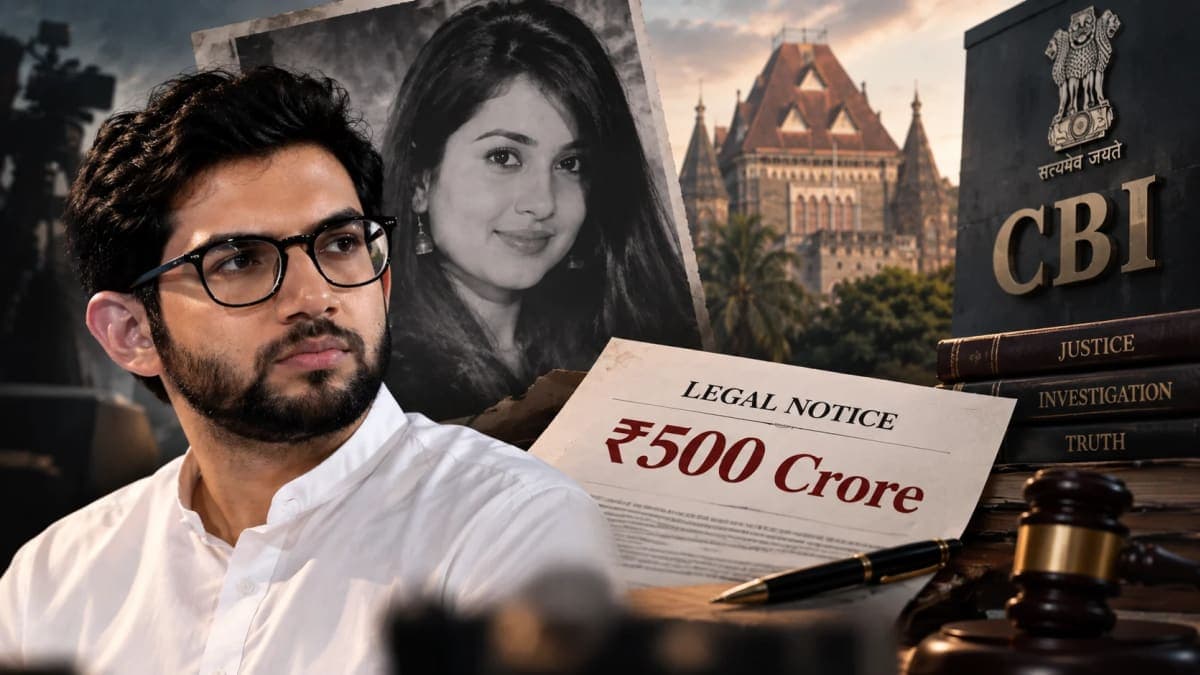
A fresh legal battle has opened around the death of celebrity manager Disha Salian, with her father Satish Salian sending a ₹500-crore defamation notice to Shiv Sena (UBT) leader Aaditya Thackeray and former Maharashtra home minister Anil Deshmukh.
The notice comes at a particularly significant point in the six-year-old case. The Central Bureau of Investigation (CBI) registered an FIR on September 14, 2026, following a Bombay High Court direction for an investigation into Salian’s death. Reports on the FIR say several people are mentioned as individuals whose roles or related allegations require investigation, but no individual has been named as an accused at this stage.
That distinction is critical. An FIR starts a criminal investigation; it does not establish that allegations in the complaint are true, nor does the inclusion or mention of a person establish criminal responsibility.
What does the ₹500-crore notice allege?
Satish Salian’s legal notice seeks ₹500 crore in compensation from Aaditya Thackeray and Anil Deshmukh over statements that, according to the notice, questioned his motives in pursuing a fresh investigation into his daughter’s death.
The notice alleges that representations made on Thackeray’s behalf portrayed Satish Salian as being used as a means to harass the politician and characterised the renewed legal action as politically motivated. Satish Salian disputes that characterisation and maintains that he is pursuing lawful remedies to determine the circumstances of his daughter’s death.
According to reports that quote the notice, Satish Salian is also demanding an unconditional written and public apology, retraction of the disputed statements and ₹500 crore in compensation. The Times of India reported that the recipients were given seven days to comply with the demands.
A legal notice demanding damages should not, however, be confused with a court awarding those damages. The ₹500-crore figure represents the compensation being demanded by Satish Salian; it is not a judicial finding that defamation occurred or that either recipient owes that amount.
Why has Aaditya Thackeray been drawn into the dispute?
Aaditya Thackeray has repeatedly rejected attempts to associate him with Disha Salian’s death.
After the CBI registered its FIR, Thackeray issued a public statement on September 16 saying: “I have never met Disha Salian, nor did I have any acquaintance with her.”
He characterised efforts to connect him with the case as politically motivated character assassination and called for the investigation to proceed impartially and without political interference.
The ₹500-crore notice, in turn, challenges statements concerning Satish Salian’s motives for pursuing the case.
The result is therefore two distinct disputes operating simultaneously: a criminal investigation into Disha Salian’s death, now being conducted by the CBI, and a defamation dispute concerning statements about her father and his pursuit of that investigation.
Neither should be treated as proof of the claims being made in the other.
What has actually changed in the Disha Salian case?
The biggest substantive development is not the ₹500-crore demand itself but the beginning of a fresh CBI investigation.
Disha Salian, 28, died on June 8, 2020, after falling from a residential building in Mumbai’s Malad area. Mumbai Police initially registered an Accidental Death Report. Six days later, actor Sushant Singh Rajput was found dead at his Bandra residence. The proximity of the two deaths generated intense public speculation, including claims attempting to connect the cases.
Years later, Satish Salian approached the Bombay High Court seeking a fresh investigation into his daughter’s death.
On September 2, 2026, the High Court directed an investigation, after which the CBI registered its FIR on September 14. Published accounts of the FIR say it incorporates allegations from Satish Salian’s complaint and identifies various people and officials whose roles or the allegations concerning them require examination.
Crucially, the High Court also indicated that no person should be treated as an accused unless sufficient material emerges against that person.
That safeguard matters because the case has spent years at the intersection of criminal allegations, celebrity coverage and Maharashtra politics.
What the CBI FIR does — and does not — establish
An important source of confusion in coverage of the case is the phrase that someone has been “named” or “mentioned” in an FIR.
The CBI’s registration of an FIR means allegations have formally entered the investigative process. According to reporting on the document, it calls for examination of several allegations and the roles of multiple people, including politicians, celebrities, police personnel and others connected with the handling of the original case.
But the FIR does not establish that those allegations occurred as described.
It also does not mean every person referred to in the document is an accused.
The investigation must now test the claims against documentary evidence, witness testimony, forensic material and other records. The Times of India reported that investigators are expected to scrutinise documents, question relevant witnesses and police personnel, examine the scene and conduct technical analysis.
For readers, that distinction is especially important when encountering social-media posts or headlines that present allegations in an FIR as established findings.
The defamation dispute is legally separate
The timing of Satish Salian’s notice makes the story appear inseparable from the CBI investigation, but legally the questions are different.
The CBI must determine whether evidence supports criminal allegations concerning Disha Salian’s death and the handling of the original inquiry.
The defamation dispute instead centres on what was said about Satish Salian, the context in which those statements were made, whether they harmed his reputation and what legal defences may be available to those who made or authorised the statements.
Satish Salian’s notice represents his legal position, not a court judgment.
Likewise, Aaditya Thackeray’s denial represents his position and should not itself be presented as an investigative finding.
This separation is important because developments in one proceeding do not automatically prove claims in the other.
Why the next stage matters more than political claims
For years, the Disha Salian case has generated competing political allegations and extensive television and social-media discussion. The CBI investigation creates a more formal test: claims can now be examined against evidence rather than repeated through political exchanges.
Thackeray has publicly supported an impartial fresh inquiry while denying knowing Salian. Satish Salian, meanwhile, has maintained through his legal proceedings that his efforts are aimed at securing an investigation into his daughter’s death.
The most consequential developments from here will therefore be investigative and judicial rather than rhetorical: what evidence the CBI obtains, whether investigators identify sufficient material against any person, and how courts deal with subsequent proceedings.
Until then, allegations contained in complaints, petitions or political statements should remain clearly labelled as allegations.


