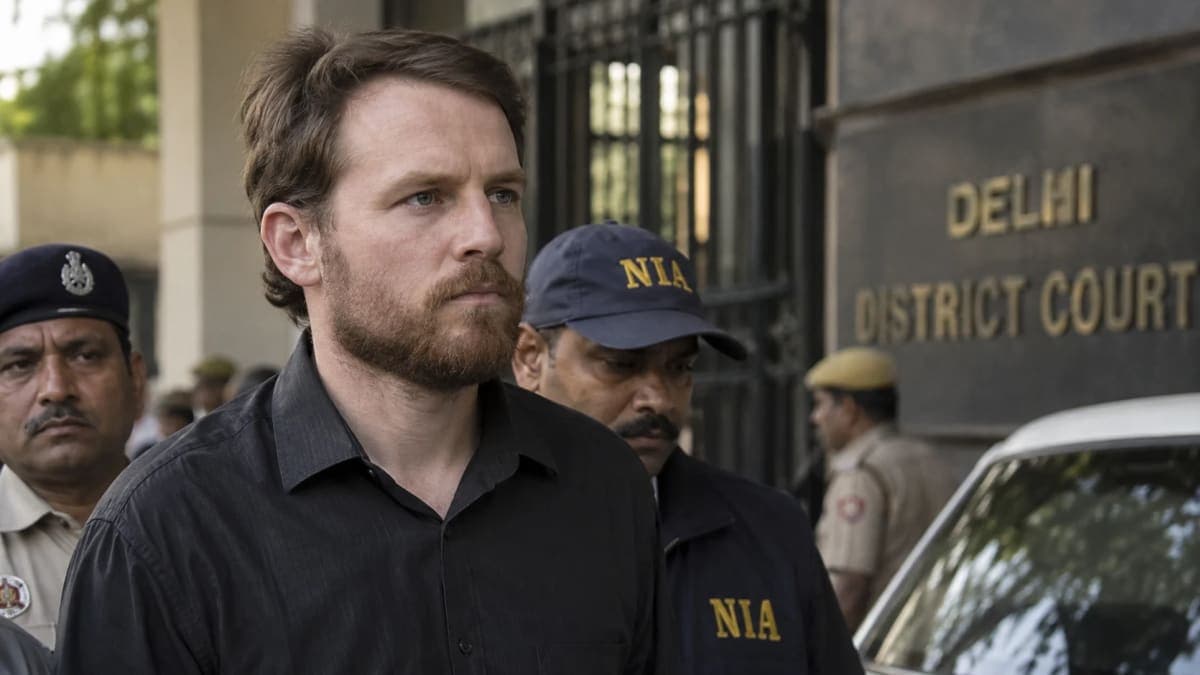
A US national arrested by India’s National Investigation Agency in an alleged terror-conspiracy case has approached a Delhi court for bail, opening a significant new phase in a case that began with serious national-security allegations but has so far produced a chargesheet under immigration law rather than India’s principal anti-terror statute.
Matthew Aaron Van Dyke moved the special NIA court for bail on September 17, 2026. Special Judge Prashant Sharma issued notice to the National Investigation Agency (NIA) and directed it to respond by September 18, according to court-source reporting by PTI.
The bail application comes nine days after the NIA filed its chargesheet against Van Dyke and six Ukrainian nationals. The agency invoked Sections 21 and 23 of the Immigration and Foreigners Act, 2025, but did not invoke the Unlawful Activities (Prevention) Act, or UAPA, in that chargesheet.
That distinction is central to understanding the case.
Van Dyke and the other accused were originally arrested as part of an investigation registered under Section 18 of the UAPA, which deals with conspiracy, attempt, abetment and facilitation connected with terrorist acts. The absence of UAPA offences from the first chargesheet does not, however, mean that the anti-terror investigation has formally ended. The NIA has told the court that further investigation into possible UAPA offences remains underway.
What the NIA has actually charged Van Dyke with
The September 8 chargesheet names Van Dyke along with Ukrainian nationals Petro Hurba, Taras Slyviak, Ivan Sukmanovskyi, Marian Stefankiv, Maksim Honcharuk and Viktor Kaminskyi.
Van Dyke was arrested at Kolkata airport in March. Three Ukrainian nationals were arrested at Lucknow airport and another three at Delhi airport.
The chargesheet invokes Sections 21 and 23 of the Immigration and Foreigners Act, 2025.
Under the law, Section 21 covers a foreigner entering an area of India without the passport, visa or other travel authorisation legally required for that entry. It carries a maximum punishment of five years’ imprisonment, a fine of up to ₹5 lakh, or both. Section 23 covers matters including overstaying, remaining without valid travel documents and violating visa conditions, and can carry up to three years’ imprisonment, a fine of up to ₹3 lakh, or both.
The Immigration and Foreigners Act itself came into force on September 1, 2025 and consolidated the legal framework governing entry, exit, stay and movement of foreigners in India.
According to reporting based on the NIA chargesheet, investigators concluded that the accused had entered India with valid travel documents but allegedly travelled into Mizoram without obtaining the required Protected Area Permit. The agency further alleges that they crossed illegally into Myanmar and subsequently returned to India through an unauthorised entry point.
These are prosecution allegations and have not been established as findings of guilt by a court.
Why the case originally became a terror investigation
The allegations made during the investigation went considerably beyond immigration violations.
During remand proceedings in March, the NIA alleged that members of the group travelled through India into Myanmar and were connected with ethnic armed organisations there.
The agency alleged that training involving drone warfare, drone operations, drone assembly and jamming technology had been provided to Myanmar-based armed groups. It also investigated whether there were connections between the accused and proscribed Indian insurgent organisations.
When extending NIA custody in March, Special Judge Prashant Sharma said the case raised questions requiring investigation, including why the accused had travelled to Myanmar, what their objective was in using drones, whether they had provided drone training and whether Indian or rebel-group members were linked to them. The court described the case as sensitive in nature.
Those observations justified further investigation at that stage; they were not findings that the accused had committed the alleged offences.
The investigation subsequently expanded.
In September, the NIA told a Delhi court that information had been received concerning the possible involvement of Ukrainian and US nationals in a drone attack on a civilian aircraft in Myanmar. The court permitted investigators to question Van Dyke and Viktor Kaminskyi in Tihar Jail on September 2 and 3.
Again, the allegation concerning the aircraft remains an investigative claim. Publicly available material reviewed by JantaScope does not establish that a court has determined Van Dyke participated in such an attack.
Why the missing UAPA charges matter
The most consequential development came with the September 8 chargesheet.
Despite the case having begun as a UAPA investigation, the NIA did not include a UAPA offence in the chargesheet currently before the court.
The agency instead stated that it needed additional time to establish and verify the complete facts concerning possible UAPA offences. It cited, among other issues, the examination of drones, accessories and numerous digital devices.
Special Public Prosecutor Rahul Tyagi told the court that the UAPA investigation had been kept open and that a supplementary chargesheet could be filed if further investigation established an offence under the anti-terror law.
This creates an unusual procedural position.
The accused remain connected to an ongoing national-security investigation, but the offences actually contained in the first chargesheet are immigration offences.
Reports on the chargesheet also state that Sections 21 and 23 are compoundable offences, meaning the law provides a mechanism under which specified immigration violations can be settled through the designated authority subject to statutory conditions. The Foreigners Regional Registration Officer has been designated for compounding specified offences.
That legal difference is likely to be relevant to arguments surrounding continued custody and bail, although the court will decide Van Dyke’s application on the submissions and record before it.
What the bail plea changes — and what it does not
Van Dyke’s bail application does not determine whether the NIA’s broader allegations are correct.
Instead, the immediate legal question is whether his continued detention is justified under the circumstances now before the special court.
The defence can point to a concrete development: after months of investigation and custody, the NIA’s first chargesheet does not invoke UAPA.
The prosecution, meanwhile, has already made clear that it considers the anti-terror investigation unfinished and retains the option of filing a supplementary chargesheet if further evidence supports UAPA offences.
The distinction also explains why headlines describing Van Dyke simply as being “charged with terrorism” would now be misleading.
He was arrested and investigated in a case registered under the UAPA, and serious terror-related allegations have been presented by the NIA during the investigation. But as of September 17, the chargesheet publicly reported before the Delhi court invokes Sections 21 and 23 of the Immigration and Foreigners Act rather than UAPA.
What happens next
The immediate development to watch is the NIA’s response to Van Dyke’s bail application, which the court directed the agency to submit by September 18.
Separately, the wider investigation remains important because the NIA has explicitly reserved the possibility of adding UAPA offences through a supplementary chargesheet.
The case therefore now runs on two tracks: the immigration offences already placed before the court and the unresolved national-security investigation concerning the far more serious allegations that triggered the arrests in March.
Until further evidence is filed and tested judicially, those allegations should remain clearly distinguished from established charges and from any eventual finding of guilt.


