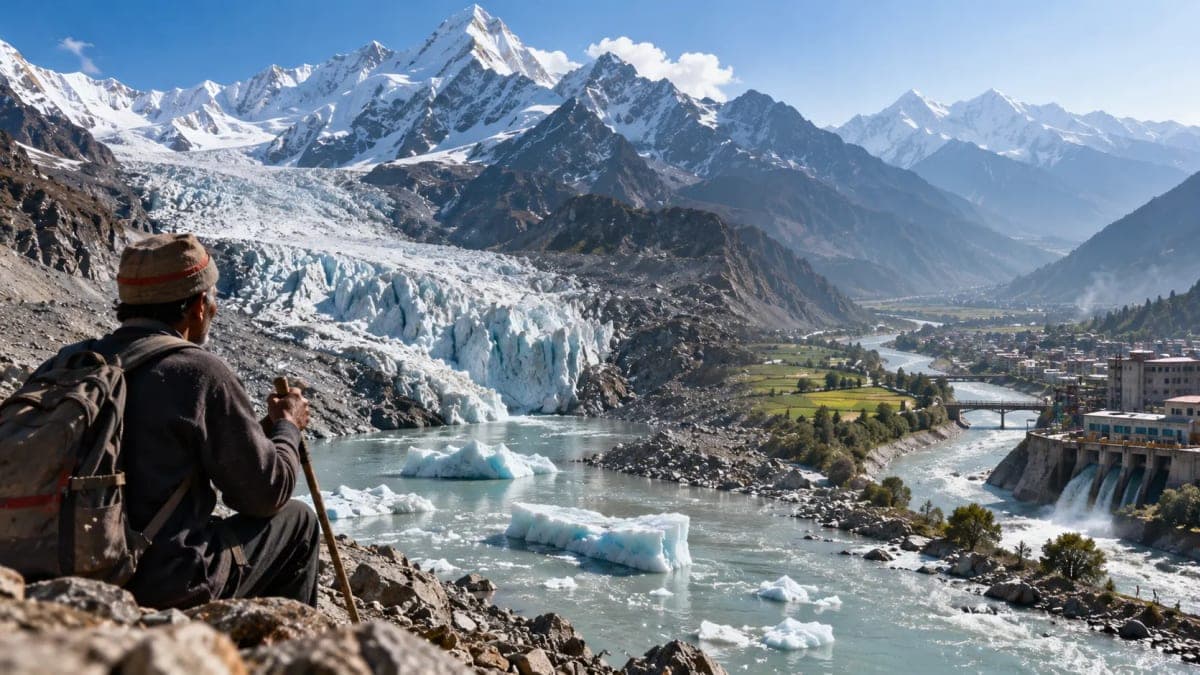
India’s Himalayan glaciers are often discussed as a distant climate-change problem — disappearing ice high in mountains that most Indians will never visit.
Economically, however, the Himalayas are much closer than they appear.
A new assessment estimates that ₹64.8 lakh crore of economic activity, equivalent to about 21.5% of India’s FY2023-24 GDP, is directly or indirectly dependent on the Himalayan system. That includes activity supported by Himalayan-fed water in agriculture, manufacturing, hydropower and services, along with wider supply-chain effects.
That figure needs careful interpretation. It does not mean melting glaciers are forecast to erase 21.5% of India's GDP. Rather, it measures the scale of economic activity exposed to disruption if the mountain system that supplies water, energy and other ecosystem services becomes increasingly unstable.
And the latest scientific evidence suggests that instability is growing.
The Himalayas are losing ice faster
The September 2026 Prosperous and Resilient Himalayas assessment, published by Systemiq and developed with the Integrated Mountain Initiative, says the Himalayas underpin more than one-fifth of India's GDP.
That economic warning sits alongside increasingly strong scientific evidence of glacier decline.
ICIMOD reported in March 2026 that glacier ice-loss rates across the Hindu Kush Himalaya have doubled since 2000. Its multidecadal assessment of satellite observations found that glacier area across the region declined by around 12% between 1990 and 2020.
Earlier ICIMOD research found glaciers disappeared 65% faster during 2011-2020 than during the preceding decade.
India's own government has documented the retreat.
In a July 2025 parliamentary response, the Ministry of Earth Sciences said the mean retreat rate of Hindu Kush Himalayan glaciers was estimated at 14.9 metres per year, although rates differ substantially between regions. It cited average retreat rates of about 12.7 metres annually in the Indus basin, 15.5 metres in the Ganga basin and 20.2 metres in the Brahmaputra basin.
This variation matters. The Himalayas are not one giant block of ice behaving uniformly. Some glaciers respond differently depending on altitude, snowfall, temperature, debris cover and geography.
The direction of the broader regional trend, however, is clear: ice reserves are shrinking.
Why does disappearing ice become an economic problem?
Think of glaciers as enormous natural water-storage systems.
Snow accumulates at high elevations and ice stores water across seasons and years. Meltwater then contributes to rivers, including during periods when rainfall is limited.
The Himalayan and Hindu Kush mountain systems feed major river basins including the Indus, Ganga and Brahmaputra.
That connects a glacier hundreds of kilometres away to an irrigated field, a hydropower installation, a manufacturing plant or a city relying on a river system downstream.
The economic pathway therefore looks something like this:
Glacier and snow change → altered river flows → water uncertainty → agricultural, energy and industrial disruption → wider economic effects.
Importantly, glaciers are not the only source of these rivers. Monsoon rainfall, groundwater, seasonal snow and other hydrological processes are crucial. The degree of dependence on glacier melt differs significantly between basins.
That is why saying “India's rivers will disappear when glaciers melt” would be scientifically misleading.
The real concern is changes in the amount, timing and reliability of water.
The dangerous paradox of ‘peak water’
Accelerated melting can initially produce more meltwater.
That may sound reassuring, but it is temporary.
As warming causes a glacier to lose ice faster, additional water enters rivers. Eventually, however, the glacier becomes too depleted to maintain that increased contribution.
Scientists describe the turning point as “peak water” — the stage at which glacier runoff reaches a maximum and subsequently declines.
ICIMOD's assessments indicate that water availability in parts of the Hindu Kush Himalayan region is expected to peak around the middle of this century before declining.
For an economy, this creates two different adaptation challenges.
Before peak water, greater or more variable flows can compound flooding and infrastructure risks. After peak water, reduced meltwater contributions can intensify seasonal water shortages.
India therefore has to prepare not simply for “less water”, but for a less predictable water system.
There is also a more immediate threat: glacial lakes
As glaciers retreat, depressions can fill with meltwater and create or enlarge glacial lakes.
Some can become dangerous when water is held behind unstable ice, moraine or loose geological material. Failure can release enormous quantities of water downstream in what is known as a Glacial Lake Outburst Flood, or GLOF.
India's Central Water Commission already monitors glacial lakes and water bodies using satellite data because warming, glacier shrinkage and lake expansion can alter flood risk.
The Ministry of Earth Sciences has specifically pointed to substantial expansion of the Samudra Tapu and Gepang Gath glacial lakes in Himachal Pradesh's Chandra Basin between 1971 and 2022.
The problem is therefore both long-term and immediate: India must adapt to changing water availability over decades while simultaneously improving protection against sudden mountain disasters.
Why ₹64.8 lakh crore should not be called a predicted loss
This distinction is critical.
The new Himalayan assessment arrives at its roughly 21.5% figure by considering three layers of economic dependence.
First is economic activity within Himalayan states themselves.
Second is downstream activity — including agriculture, manufacturing, hydropower and services — dependent on Himalayan-fed water and associated groundwater recharge.
Third are induced economic effects, including supply chains and spending generated by those activities.
That makes ₹64.8 lakh crore a measure of economic exposure or dependence, not a damage estimate.
Actual GDP losses from climate-driven Himalayan change would depend on the severity and timing of water disruption, adaptation investment, infrastructure resilience, crop choices, technological changes and many other factors.
The distinction may sound technical, but it prevents a dramatic statistic from becoming a misleading headline.
One unusually powerful lever: cut black carbon
Reducing global greenhouse-gas emissions remains essential to limiting long-term glacier loss.
But there is another intervention that can potentially produce more local and faster benefits: reducing black carbon.
Black carbon is the soot produced by incomplete combustion. Sources include diesel engines, biomass burning, household fuels and industrial processes such as brickmaking.
Unlike carbon dioxide, black carbon creates an additional problem when transported towards snow-covered mountains.
Once dark particles settle on bright snow and ice, the surface reflects less solar radiation and absorbs more heat, accelerating melting.
World Bank research concluded that fully implementing existing South Asian black-carbon policies could reduce deposition in the region by about 23%, while additional technically and economically feasible measures could reduce emissions substantially further.
The Bank highlighted more efficient brick kilns, cleaner cooking and cleaner fuels among potential interventions.
This creates an important climate-policy opportunity for India: reducing soot can simultaneously improve air quality and reduce a contributor to accelerated snow and ice melt.
Why brick kilns deserve attention — but are not the whole solution
The new Himalayan assessment specifically highlights industrial black-carbon emissions and proposes modernising brick production, upgrading viable kilns and retiring inefficient facilities.
The attraction is straightforward.
Cleaner combustion means less fuel is required and fewer soot particles are emitted. That can lower local particulate pollution while reducing the amount of light-absorbing material potentially transported towards Himalayan snow.
But focusing only on brick kilns would be insufficient.
Black carbon comes from multiple sectors, including transport, household combustion, industry, crop-residue burning and fires. Atmospheric pollution also crosses state and national borders.
Effective action therefore requires an airshed approach: reducing emissions across the geographic region from which pollution is transported towards the Himalayas rather than treating individual cities as isolated pollution problems.
The bigger lesson for India
Glacier loss exposes a weakness in how climate risk is usually discussed.
A melting glacier does not appear on a company's balance sheet. Neither does an unstable mountain lake or a declining snowpack.
But their effects can eventually appear everywhere — in irrigation costs, crop yields, electricity supply, damaged roads, insurance losses, government disaster spending and industrial water availability.
That is why the “20% of GDP” finding is useful when interpreted correctly.
It does not predict an economic collapse.
It demonstrates how deeply India's economy depends on natural infrastructure that conventional GDP accounting rarely recognises.
The policy response therefore has two tracks.
India cannot independently stop global warming, so it needs long-term adaptation: stronger glacier and lake monitoring, better early-warning systems, water storage and efficiency, resilient infrastructure and smarter land-use planning.
But black carbon presents a more immediate opportunity.
Reducing soot from brick kilns, transport, household fuels and other combustion sources will not save Himalayan glaciers on its own. Carbon dioxide-driven warming remains the fundamental long-term problem.
What black-carbon control offers is something unusually valuable in climate policy: an intervention India and its neighbours can act on now that can deliver cleaner air today while potentially slowing one contributor to Himalayan ice loss.
For a mountain system supporting economic activity equivalent to more than a fifth of India's GDP, that is not simply environmental protection.
It is economic risk management.


