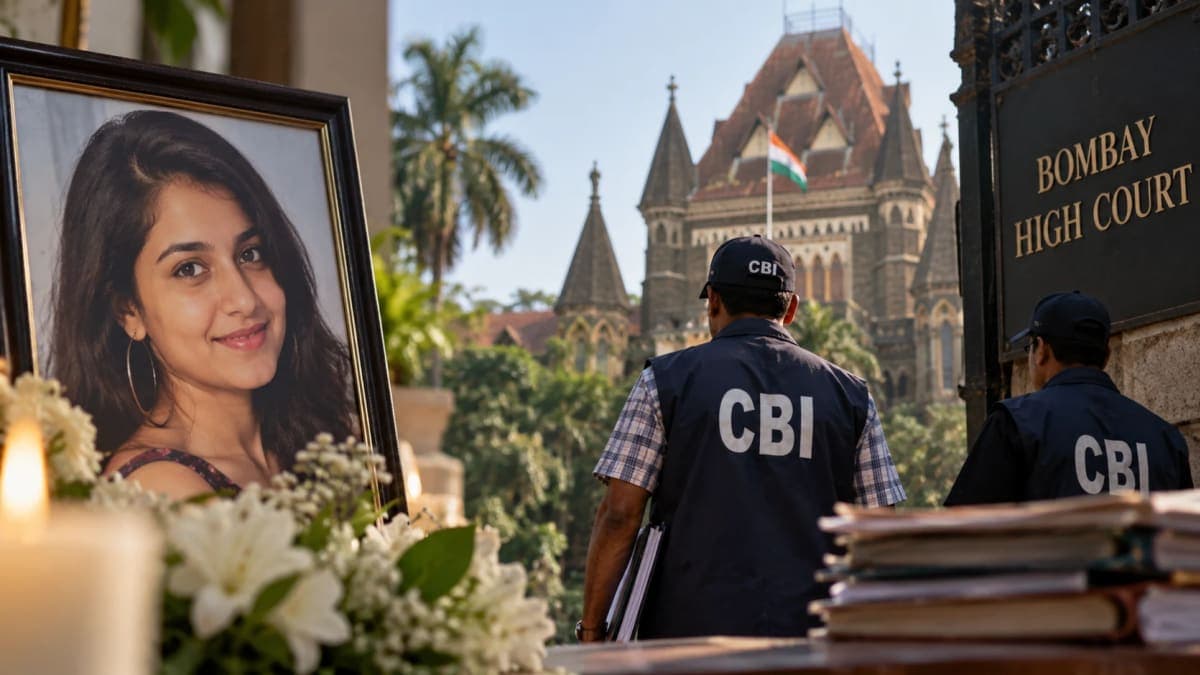
More than six years after celebrity manager Disha Salian died in Mumbai, the Central Bureau of Investigation has registered an FIR and begun a fresh investigation into the circumstances surrounding her death.
The development has generated political claims, allegations of murder and rape, and competing narratives about what happened in June 2020. But the immediate legal reason for the CBI's FIR is considerably clearer: the Bombay High Court ordered the agency to register it after identifying what it described as serious discrepancies in the earlier investigation.
The court did not conclude that Disha was murdered, nor did it declare any politician, celebrity or police officer guilty. Instead, it found that the circumstances required investigation through the normal criminal-investigation framework rather than remaining confined to an accidental-death inquiry.
That distinction is crucial to understanding what the new FIR does — and does not — establish.
What happened in June 2020?
Disha Salian, a celebrity manager who had worked with people in the entertainment industry, died after falling from a high-rise apartment in Mumbai's Malad area in the early hours of June 9, 2020.
Mumbai Police initially investigated the death through an Accidental Death Report, or ADR, under Section 174 of the Code of Criminal Procedure.
Her death subsequently became the subject of intense speculation, particularly after actor Sushant Singh Rajput died days later.
For years, allegations and counter-allegations circulated around Disha's death. Those claims should not be confused with established investigative findings.
The decisive legal development came when her father, Satish Salian, approached the Bombay High Court seeking a fresh investigation and alleging that his daughter had been sexually assaulted and murdered and that the matter had subsequently been covered up.
Those remain allegations requiring investigation.
Why did the High Court order an FIR?
On September 2, 2026, a Bombay High Court bench of Justices Sarang V Kotwal and Ranjitsinha R Bhonsale directed the CBI to register an FIR and investigate Disha's death.
The court concluded that the earlier investigation contained multiple “glaring discrepancies” and said it “raises more questions than it answers.”
The distinction between an ADR inquiry and an FIR-based investigation was central to the judgment.
According to the court, police had sufficient opportunity over several years to investigate but had not registered an FIR and instead continued proceedings under Section 174 CrPC. In the circumstances before it, the bench considered that approach inadequate.
The court therefore directed a separate agency — the CBI — to conduct what it described as a proper and substantive investigation.
The unanswered questions that concerned the court
The High Court did not base its decision on one sensational allegation. It examined a series of apparent inconsistencies in the existing records.
One concerned the spot panchnama.
According to the court's examination of the record, police arrived shortly after the incident, but the spot panchnama was conducted more than nine hours later. The court considered the unexplained delay significant.
Another issue involved the timing of the Accidental Death Report.
Disha's death was recorded at approximately 2.25 am and the ADR at 3.07 am. But the ADR referred to statements from her parents indicating they had no suspicion about the death, even though her father reportedly reached the hospital only around 4 am.
The court questioned how his statement could have been reflected in an earlier document.
Perhaps one of the most unusual circumstances concerned CCTV footage.
The High Court noted evidence showing police personnel at the residential building between approximately 1 am and 2.14 am — before Disha's death was officially recorded.
The existing investigation, according to the court, did not adequately explain who those officers were, why they were present or what they were doing.
These observations do not establish misconduct. They identify questions the CBI has now been asked to investigate.
Medical and forensic records also raised questions
The High Court also examined aspects of the injuries and forensic evidence.
Witness accounts reportedly indicated that Disha had fallen on her face and that blood was coming from her head.
However, the court noted questions concerning the injuries documented in the medical records.
The internal examination recorded fractures involving the skull and ribs. At the same time, the court noted the apparent absence of fractures to facial bones, the mandible or the comparatively delicate nasal bone.
The bench said it found this difficult to reconcile with the reported circumstances of the fall but explicitly recognised that the matter required expert medical opinion.
That qualification matters: the judges were identifying an issue requiring forensic examination, not making their own medical determination about the cause or manner of death.
Another issue concerned the amount of blood found on certain articles examined by forensic authorities. The court noted that an Assistant Chemical Analyzer had indicated more blood might ordinarily have been expected in the stated circumstances.
There was also a discrepancy involving forensic samples.
The postmortem documentation referred to particular swabs, while material reportedly received by the forensic laboratory consisted of slide smears. Doctors attributed this to a clerical error, but the court considered the discrepancy significant enough to require investigation.
Why Disha's phone and laptop matter
Digital evidence is another important part of the High Court's reasoning.
Disha's mobile phone and laptop were not seized during the June 9 spot panchnama. According to the record discussed by the court, they were taken from the custody of a friend on June 17 — eight days later.
The court regarded those devices as potentially important evidence.
For investigators, digital devices can potentially establish communications, movements, timelines and contacts. Whether recoverable material from these particular devices ultimately changes the case is something the CBI investigation will have to determine.
What exactly did the CBI do?
Following the High Court order, the CBI recorded a fresh statement from Satish Salian on September 12.
The agency subsequently registered the FIR on September 13 and formally began investigating the death.
Reports citing officials say provisions concerning alleged criminal conspiracy, gang rape, murder, disappearance of evidence and alleged wrongdoing by public servants are among the matters covered by the FIR.
That does not mean those crimes have been proven.
An FIR begins a criminal investigation into allegations of cognizable offences; it is not a judicial finding that the alleged offences occurred.
This is particularly important in this case because several public figures have been mentioned in allegations surrounding Disha's death.
Is Aaditya Thackeray an accused in the CBI case?
This requires careful wording.
Some reports initially described Shiv Sena (UBT) leader Aaditya Thackeray and others as accused in the FIR. However, PTI subsequently reported, citing officials, that the CBI registered the case without naming anyone as an accused.
The High Court had specifically instructed investigators not to name any person as an accused unless sufficient grounds emerged during the investigation.
More recent reporting indicates that the FIR mentions Aaditya Thackeray, actor Sooraj Pancholi, Dino Morea, Rhea Chakraborty and others as people whose alleged roles or connections require examination, while none had been named as an accused at that stage.
That is an important legal difference.
Satish Salian and his lawyer have made serious allegations involving several individuals. Those are allegations, not established facts.
The CBI must independently determine whether evidence supports suspicion against any individual.
What the High Court did NOT decide
The High Court's ruling should therefore not be interpreted as a finding that Disha Salian was murdered.
It also did not conclude that allegations of sexual assault were established.
And it did not declare Aaditya Thackeray or any other person responsible for her death.
In fact, the court expressly cautioned that its observations were being made for determining whether an FIR and further investigation were necessary.
The CBI has been asked to investigate the circumstances independently and decide whether an offence was committed and whether evidence establishes involvement by any person.
If investigators ultimately conclude that no prosecutable offence is established, the High Court's directions allow the agency to submit the appropriate report before the competent court.
JantaScope analysis: why the FIR changes the case
The most consequential change is procedural rather than political.
For years, the case primarily existed as an accidental-death investigation surrounded by competing public allegations.
The High Court's order moves it into a formal FIR-based criminal investigation conducted by the CBI.
That gives investigators a framework to re-examine witnesses, medical and forensic evidence, digital devices, police records and the timeline surrounding Disha's death.
It does not predetermine what that investigation will find.
The central question is therefore no longer whether social-media theories or political allegations are persuasive. It is whether evidence capable of surviving investigative and judicial scrutiny can explain the discrepancies identified by the High Court.
That is ultimately why the CBI FIR matters.
Six years after Disha Salian's death, the Bombay High Court concluded that too many material questions remained unanswered for the matter to end with the previous inquiry.
The FIR begins the process of trying to answer them.


