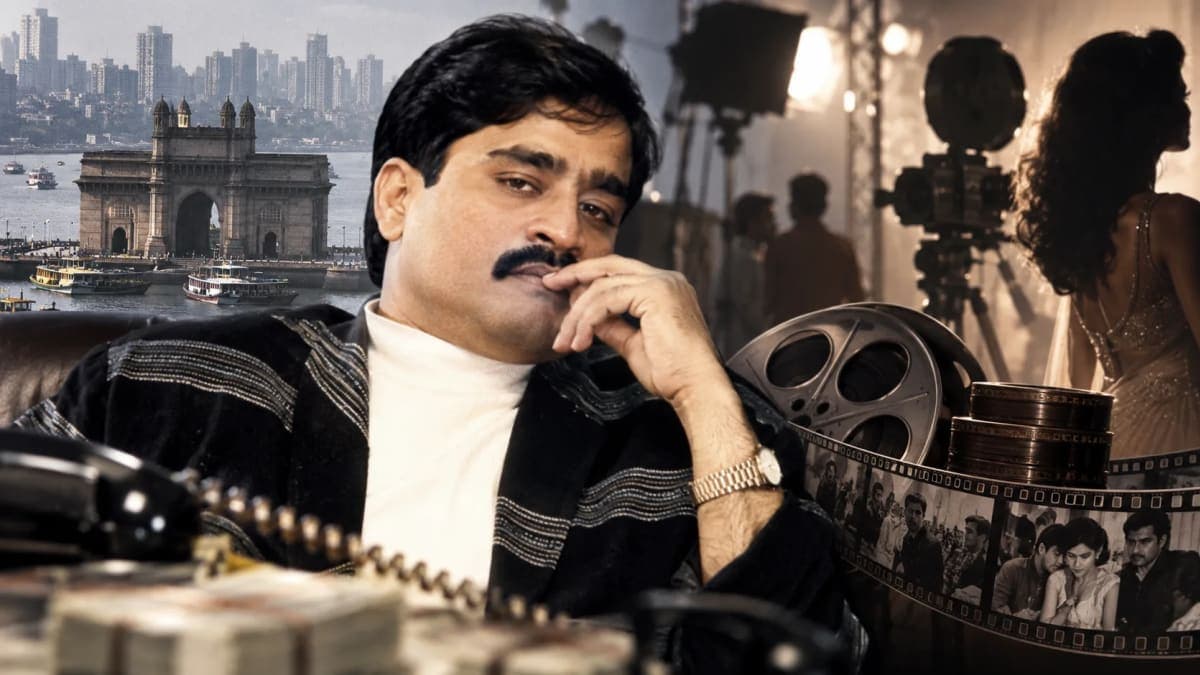
For decades, stories about Dawood Ibrahim and 1990s Bollywood have occupied a strange space between documented crime, celebrity gossip and urban legend.
The popular version is sweeping: the Mumbai underworld financed films, dictated casting, summoned stars to overseas parties and punished those who refused to cooperate.
Parts of that history are supported by court judgments, government records and criminal cases. Other parts remain allegations, recollections or claims repeated so often that they are sometimes presented as established facts.
So what can actually be verified?
The documentary record shows that organised crime did penetrate parts of Mumbai's film economy during this period. Extortion threats against film personalities were real. People connected to film financing were prosecuted in organised-crime cases. And the murder of T-Series founder Gulshan Kumar became one of the starkest examples of violence touching the entertainment business.
But the evidence also demands precision: “the underworld”, “D-Company” and “Dawood Ibrahim personally” cannot automatically be treated as interchangeable.
Start with what is firmly established about Dawood Ibrahim
Dawood Ibrahim Kaskar is not simply a figure from Bollywood folklore.
India has long named him as an accused wanted in connection with the March 12, 1993 Bombay serial bombings. In a 1997 judgment, the Supreme Court recorded that the attacks killed 257 people, injured 713 and caused property damage estimated at approximately ₹27 crore. A composite charge sheet named 198 accused, including 45 shown as absconders.
In 2003, the US Treasury designated Ibrahim a Specially Designated Global Terrorist, describing him as an Indian crime lord and citing his alleged terrorist and organised-crime activities.
He was also placed on the United Nations sanctions list in November 2003. The UN Security Council's current narrative summary states that he was listed for association with Al-Qaeda and related activities.
The Indian government stated in Parliament in 2015 that Ibrahim remained wanted in the 1993 serial-bombing case and that India had supplied Pakistan with information concerning reported addresses and passports while seeking his return.
These are documented matters.
The much more complicated question is what his criminal network was doing inside Bollywood.
Why was 1990s Bollywood vulnerable in the first place?
Understanding the financing system is essential.
For much of the 1990s, film production did not have the institutional financing structure familiar today. Movies could require large amounts of money upfront while returns were uncertain and dependent on distributors, theatres and box-office performance.
Formal bank finance was extremely limited.
The Comptroller and Auditor General later recorded that banks began financing films after the industry received formal “industry” status in May 1998.
That change matters enormously to the underworld story.
Before institutional finance became more accessible, producers often depended on private financiers and informal credit. Cash-heavy transactions and uncertain accounting created conditions in which illicit capital could potentially enter the business.
That does not establish that Bollywood as a whole was financed by organised crime.
Indeed, a 2001 parliamentary answer provides a much more careful description of what authorities believed they could establish.
What did the government officially say about a Bollywood-underworld nexus?
On July 24, 2001, the Union Home Ministry answered a Lok Sabha question explicitly titled “Bollywood Nexus With Underworld.”
Its wording deserves attention.
The government said it had not directed the CBI to conduct a general investigation into a nexus involving Bollywood stars, producers and financiers.
It then added that, according to information supplied by the Maharashtra government, a nexus between “some persons in the filmworld and the underworld” had been established.
The government identified producer Nazim Hassan Rizvi, assistant producer Rahim Allabux Khan and film financier and diamond merchant Bharat Shah as having been arrested. It said a charge sheet had been filed against them along with wanted gangster Chhota Shakeel and another person.
The same answer explained that giving the film sector industry status was intended to extend institutional financing to it, with IDBI and RBI developing guidelines allowing banks and financial institutions to fund film projects.
That is considerably more precise than saying “the underworld controlled Bollywood.”
There were established criminal connections involving particular individuals. That does not justify attributing those connections to an entire industry.
The Chori Chori Chupke Chupke case made the problem impossible to ignore
The most concrete turn-of-the-century example centred on Chori Chori Chupke Chupke, starring Salman Khan, Rani Mukerji and Preity Zinta.
Producer Nazim Rizvi and financier Bharat Shah were prosecuted in a case involving alleged links to Chhota Shakeel.
In 2003, a special court sentenced Rizvi and his assistant to six years' rigorous imprisonment for organised-crime offences involving extortion of film personalities.
Bharat Shah's legal outcome was materially different — a distinction frequently lost in retellings of the episode.
The court gave Shah the benefit of doubt and acquitted him of charges that he had underworld links or aided and abetted underworld activities. He was, however, sentenced to one year's imprisonment for failing to inform police about Rizvi's links with Shakeel and extortion attempts.
This distinction demonstrates why historical claims require case-by-case verification.
Being investigated, charged, convicted and acquitted are four different things.
Extortion was not just a movie plot
Court records also show that threats against people connected with filmmaking were a recognised reality.
A Bombay High Court judgment from the late 1990s records allegations that people in the film industry had for years received threats demanding protection or extortion money. The petitioner in that case claimed he had himself received threats from members of the Dawood Ibrahim gang.
That particular statement was an allegation before the court, rather than proof that every claimed threat occurred exactly as described.
But the wider phenomenon of organised-crime intimidation is supported by subsequent prosecutions and official statements.
Then came one of the decade's most shocking crimes.
Gulshan Kumar's murder: what the court actually established
T-Series founder Gulshan Kumar was shot dead outside a temple in Andheri, Mumbai, on August 12, 1997.
More than two decades later, the Bombay High Court examined the murder case in detail.
In its 2021 judgment, the court upheld Abdul Rauf Merchant's conviction for Kumar's murder, finding the prosecution had proved his role beyond reasonable doubt.
Contemporary reporting on the judgment described Merchant as an aide of Dawood Ibrahim. The High Court also convicted his brother Abdul Rashid Dawood Merchant after allowing the Maharashtra government's appeal against his earlier acquittal.
Another important result is often overlooked: the state unsuccessfully challenged the acquittal of music-industry executive Ramesh Taurani, and the High Court dismissed that appeal.
Again, the historical lesson is precision.
A famous murder linked to organised crime does not make every allegation made during its investigation true.
What about Bollywood stars attending Dawood's parties?
This is where the evidentiary picture becomes much weaker.
Photographs, anecdotes and interviews have for decades connected actors and other entertainment figures with overseas gatherings involving underworld personalities, particularly in Dubai and Sharjah.
But a photograph establishes that two people were in the same place. It does not by itself prove a criminal relationship, financing arrangement or voluntary association.
That distinction has become particularly relevant again after actor Mandakini recently addressed the famous photograph showing her near Dawood Ibrahim at a cricket match.
Mandakini says she had travelled to Dubai for a show and was not invited there by Ibrahim. According to her account, she attended the match and the photograph subsequently became the basis for rumours about their relationship. Her statement is evidence of her account of the incident, not independent proof of everything surrounding the encounter.
The responsible historical conclusion is therefore limited: the photograph exists and became controversial; stronger claims about a relationship require separate evidence.
Dawood, D-Company and “the underworld” are not synonyms
This is perhaps the biggest mistake in popular retellings.
Mumbai's organised-crime landscape included multiple gangs and figures whose alliances changed and sometimes became violently hostile.
Chhota Rajan, for example, had previously been associated with Dawood before their split. Chhota Shakeel remained identified by US authorities as a senior D-Company figure; the US Treasury later sanctioned him under its transnational-crime framework.
Consequently, evidence that “a gangster threatened an actor” cannot automatically be rewritten as “Dawood threatened the actor.”
Nor does evidence involving Chhota Shakeel automatically establish that Dawood personally ordered the particular act unless evidence demonstrates that connection.
That may make a headline less dramatic, but it makes the history substantially more accurate.
1998 changed the economics of filmmaking
The government's decision to grant film production industry status in 1998 is therefore more than an administrative footnote.
It helped make legitimate institutional financing possible.
The government's own 2001 explanation explicitly linked industry status with its objective of extending institutional finance to filmmaking.
That did not magically eliminate organised crime.
But it addressed one structural vulnerability: an industry requiring large amounts of capital no longer had to depend as heavily on opaque private financing.
Banks, corporations, satellite television revenues and eventually large studios transformed Hindi-film economics during the following years.
In that sense, the Bollywood-underworld story is not merely a gangster story.
It is also a story about what can happen when a major legitimate industry lacks transparent access to legitimate capital.
So what is the verified history?
Three conclusions survive scrutiny.
First, organised crime's involvement with parts of the Mumbai film industry was real, not merely a Bollywood legend. Government records, criminal prosecutions and court judgments establish specific cases involving threats, extortion and connections between film-world figures and organised criminals.
Second, claims about the scale of that influence are often exaggerated. There is no sound basis for saying that Dawood Ibrahim “controlled Bollywood” as a whole or financed every major star or film of the era.
Third, individual celebrity associations must be assessed individually. A photograph, attendance at an overseas event or decades-old gossip cannot substitute for evidence of financing, coercion or criminal collaboration.
The irony is that the mythology surrounding Dawood and Bollywood has become so powerful that it can obscure the genuinely serious history.
The verified story needs little embellishment: 1990s Mumbai had a film industry dependent heavily on private capital, organised-crime groups capable of violence and extortion, and celebrities operating in an environment where threats could have serious consequences.
That history is disturbing enough without turning every rumour into fact.


