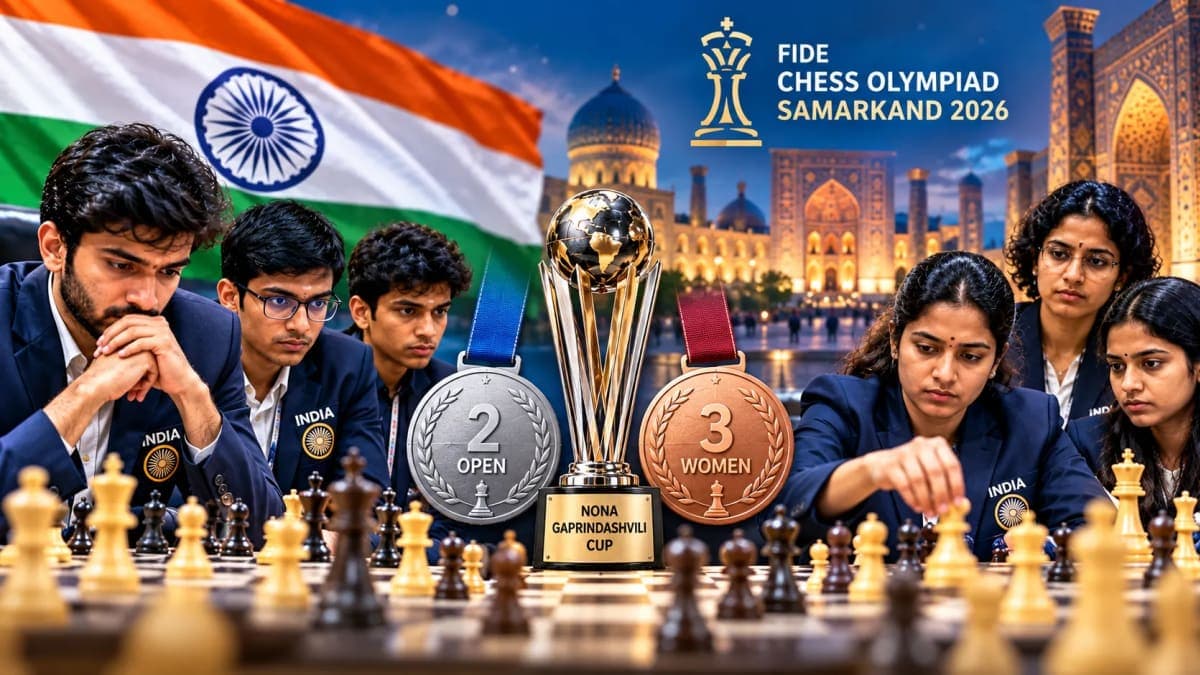
India Win Two Medals, but Gold Remains Out of Reach
India did not leave the 46th FIDE Chess Olympiad in Samarkand empty-handed.
The Open team secured the silver medal, while the Women’s team finished with bronze. India also retained the prestigious Nona Gaprindashvili Cup, awarded for the best combined performance across the Open and Women’s sections.
According to the official FIDE results, host nation Uzbekistan won the Open competition, with India finishing second and Germany taking third place. In the Women’s event, China claimed gold, Kazakhstan won silver and India secured bronze.
Yet the Indian camp’s reaction was about more than celebrating two medals.
Expectations were particularly high after India’s extraordinary performance at the 2024 Budapest Olympiad, where the country captured gold medals in both the Open and Women’s competitions. In Samarkand, India entered with an opportunity to defend both titles, but several decisive moments ultimately prevented a repeat of that historic double.
Where Did the Open Team Lose Ground?
India’s Open team lost only one match across the 11 rounds, but that defeat had a significant impact on the title race.
Hosts Uzbekistan defeated India 2.5-1.5 in the sixth round. Nihal Sarin had held a promising position during that encounter, but the game eventually turned against him and contributed to India’s only team defeat of the competition.
India recovered after that setback, but draws against Azerbaijan and later Hungary reduced the room for error in the battle for first place.
The final-round encounter against Hungary also ended in a draw.
India completed the tournament with 18 match points and secured silver ahead of Germany on tie-breaks. Uzbekistan finished with 20 points to take the title.
That narrow margin explains why the silver medal can simultaneously be viewed as a major achievement and a reminder of opportunities that could have changed the colour of India’s medal.
India’s Squad Depth Remained a Major Strength
One of the encouraging features of India’s campaign was the contribution from different boards.
World champion D Gukesh produced a strong tournament overall, while R Praggnanandhaa also contributed important points. India entered the competition with considerable strength throughout its lineup, with Gukesh and Nihal Sarin playing important roles in the team strategy.
However, the performances were not equally consistent in every round.
After the tournament, members of the Indian setup acknowledged that some favourable positions were not converted and that not every player was able to produce their best chess at the same time.
That provides an important contrast with India’s dominant 2024 campaign, when the Open team produced an exceptionally consistent run on its way to gold.
Fine Margins Also Defined the Women’s Campaign
India experienced a similar story in the Women’s section.
The team drew matches against strong opponents including China, Kazakhstan and Georgia, while a defeat against Poland proved costly in the medal race.
Savitha Shri played an important role in securing India’s bronze medal.
In the final round against Georgia, she fought through a difficult position and eventually secured a draw, helping India confirm its place on the podium.
Her individual performance was also recognised by FIDE, which awarded Savitha Shri the individual gold medal on the reserve board.
Women’s team captain Swayams Mishra indicated after the competition that India had opportunities against China and that results elsewhere in the tournament also influenced the final standings and subsequent pairings.
He also pointed to the physical and mental demands players face during a long Olympiad.
The 2024 Double Gold Changed Expectations
India’s 2026 performance is difficult to assess without considering what happened two years earlier.
At the Budapest Olympiad in 2024, India produced a historic campaign by winning gold in both the Open and Women’s competitions.
The Open team had been so dominant that it secured the title with a round to spare.
That extraordinary achievement inevitably changed expectations surrounding Indian chess.
Vidit Gujrathi reflected on that difference after the Samarkand campaign. While the team had reason to be proud of the silver medal, the mood was understandably different from 2024 because the previous Olympiad had represented an exceptional achievement that cannot easily be repeated every time.
For that reason, viewing the Samarkand campaign simply as a failure to defend two titles would provide an incomplete picture.
At the same time, focusing only on the two medals would overlook the critical moments that prevented India from challenging more strongly for gold.
India Still Finish as the Best Combined Nation
One particularly significant achievement from the campaign was India's retention of the Nona Gaprindashvili Cup.
The trophy is awarded to the nation with the best combined performance across the Open and Women’s sections of the Chess Olympiad.
India has now won the award at three consecutive Olympiads — in 2022, 2024 and 2026.
That consistency highlights a broader development in Indian chess.
India's international strength is no longer dependent on a single player or one exceptionally successful team. Both its Open and Women’s squads are now consistently competing for medals at the highest level.
Why Do These Results Matter for Indian Chess?
India’s Samarkand performance carries two different messages.
Winning silver and bronze shows that the country remains among the strongest chess nations in the world. At the same time, missing out on gold demonstrates how small margins can determine the outcome of an 11-round team competition.
A single defeat, a few draws or the failure to convert a winning position can significantly alter the final standings.
Perhaps the clearest indication of how far Indian chess has progressed is the reaction to the results themselves.
There was a time when an Olympiad medal represented a historic breakthrough for India. Now, even after winning two team medals, the discussion has shifted towards identifying where the country missed opportunities to win gold.
That change in expectations is itself evidence of India's growing stature in international chess.
The next Chess Olympiad is scheduled to take place in the United Arab Emirates in 2028. The lessons from Samarkand will give India an opportunity to examine how its considerable squad depth can be converted into greater consistency in decisive matches.


