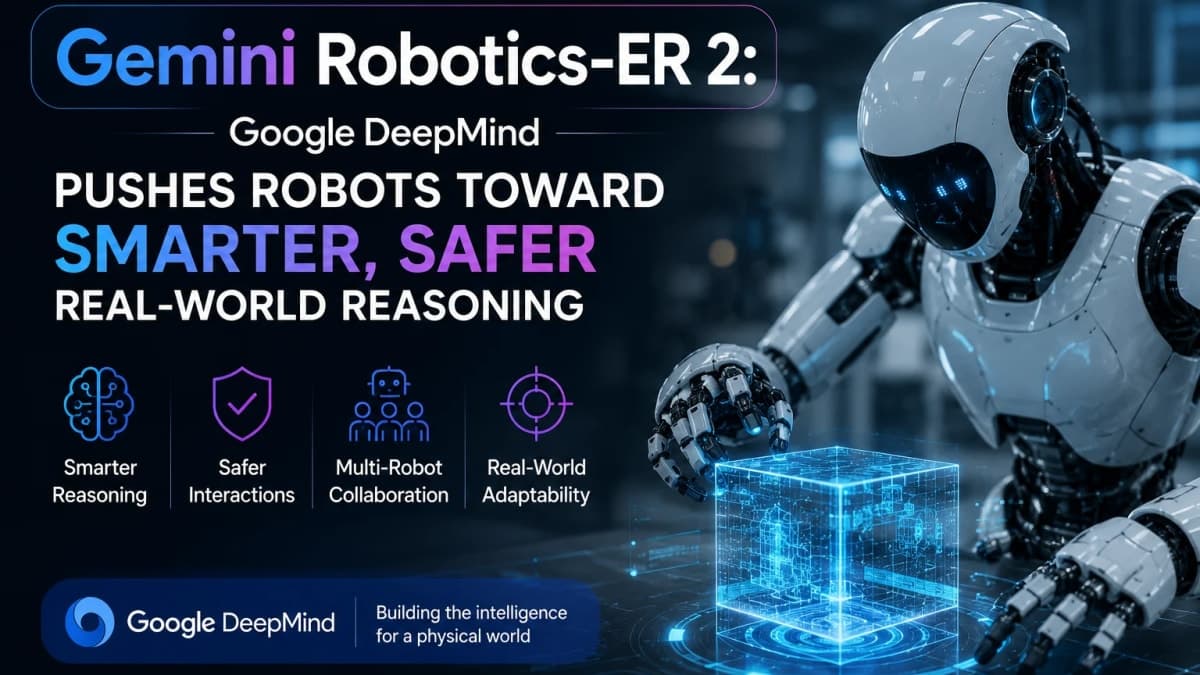
Google DeepMind is expanding its push to bring artificial intelligence out of screens and into the physical world with Gemini Robotics-ER 2, a new embodied-reasoning model aimed at making robots more capable of understanding situations, planning actions and completing complex real-world tasks.
Rather than serving primarily as the system that directly moves a robot's joints, Robotics-ER is designed to provide higher-level intelligence. It helps a machine interpret its surroundings, understand instructions and determine the sequence of actions needed to reach a goal. Gemini Robotics-ER 2 improves this reasoning layer for tasks that unfold over longer periods and involve multiple steps.
The development builds on Google DeepMind's earlier Gemini Robotics work. The original Gemini Robotics-ER was introduced as an embodied-reasoning model focused particularly on spatial understanding, perception, planning and connecting AI reasoning with robotic control systems.
Gemini Robotics-ER 2 Can Handle Longer Tasks
One of the important changes in Gemini Robotics-ER 2 is improved understanding of task progress and completion.
Real-world robotic jobs rarely consist of a single movement. A robot cleaning an area, organizing equipment or carrying out another multi-stage assignment must understand not only what action comes next but also whether individual steps have been completed and when the overall job is finished.
Google DeepMind says the new model is better at operating across extended tasks and recognizing when tasks begin and end. That capability could be important for moving robots beyond isolated demonstrations toward workflows where they must maintain context over a sequence of actions.
Different Robots Can Work Together
Another notable capability is multi-robot collaboration.
Gemini Robotics-ER 2 can help coordinate robots with different physical designs so they can contribute to the same broader task. In a demonstration described alongside the announcement, a humanoid robot and a dual-arm robotic system cooperate during a garage-cleaning scenario, with work divided between the machines.
This matters because future workplaces are unlikely to rely on only one universal type of robot. Warehouses, factories, laboratories and other facilities could instead contain specialized machines designed for different jobs.
A shared reasoning system capable of coordinating them could therefore become an important part of large-scale robotic automation.
Safety Gets Greater Attention
More capable robots also create a fundamental challenge: they must operate predictably when humans enter their working space.
Google DeepMind describes Gemini Robotics-ER 2 as its safest robotics model so far. The system has improved capabilities for detecting nearby people, activating safety mechanisms and bringing a robot to a safe stop when someone gets too close.
Safety has been a major part of DeepMind's robotics research from the beginning. Its earlier work emphasized a layered approach combining AI-level reasoning with conventional robotic safeguards such as collision avoidance, force limits and hardware-specific controllers.
That distinction remains important. AI reasoning can improve awareness and decision-making, but physical robotics still depends on reliable mechanical, software and operational safeguards.
Part of the Wider Gemini Robotics 2 Upgrade
Gemini Robotics-ER 2 arrives alongside advances in the broader Gemini Robotics 2 family.
Gemini Robotics 2 expands physical control to whole-body humanoid movement. Demonstrations show robots walking, crouching and stretching while simultaneously interacting with objects. The system also supports more sophisticated five-fingered hands, allowing demonstrations involving tasks such as manipulating bags and unscrewing a lightbulb.
This combination highlights two related but distinct problems in modern robotics: reasoning about what needs to happen and physically executing the required movements.
Gemini Robotics-ER 2 focuses heavily on the first problem, while action-oriented models translate decisions into robotic behavior.
Why Gemini Robotics-ER 2 Matters
Generative AI has made rapid advances in understanding text, images, audio and video. Robotics introduces a much harder requirement: AI decisions have consequences in a continuously changing physical environment.
A useful robot must recognize objects, understand where they are located, interpret human instructions, plan multiple steps, notice unexpected changes and determine whether an action is safe—all while interacting with physical hardware.
Embodied-reasoning systems such as Gemini Robotics-ER 2 attempt to connect these capabilities.
If such models continue improving, the potential applications extend well beyond humanoid demonstrations. Similar reasoning technology could eventually support robots used in manufacturing, logistics, research facilities, commercial environments and other settings requiring flexible physical automation.
A Major Advance, but Challenges Remain
The progress should not be interpreted as evidence that completely autonomous, general-purpose robots are ready for widespread deployment.
Robotic demonstrations take place under defined conditions, while real environments can introduce unpredictable objects, people and circumstances. Reliability also becomes especially important when AI-generated decisions lead directly to physical actions.
Movement speed is another area that still needs improvement, according to DeepMind's discussion of the new generation.
The significance of Gemini Robotics-ER 2 therefore lies less in replacing conventional robotics overnight and more in showing how increasingly capable AI reasoning can become part of robotic systems.
The longer-term test will be whether these capabilities remain dependable, safe and economically useful outside controlled demonstrations.
This article is based on reporting published by Google.