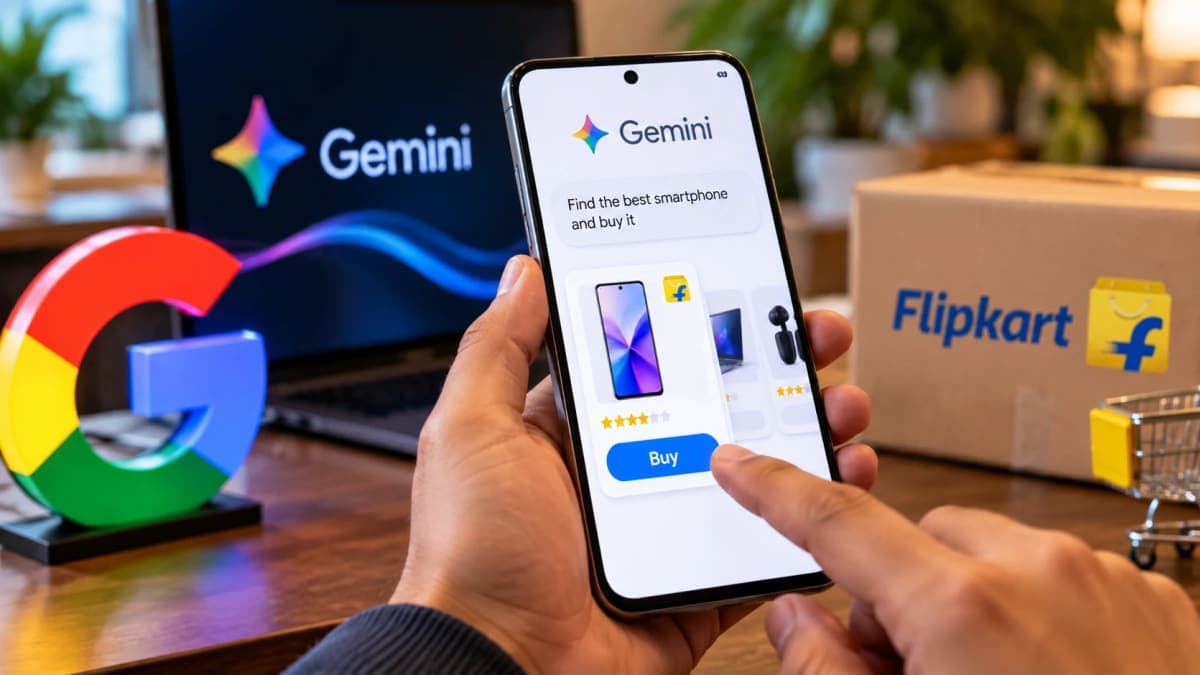
September 27, 2026: Google is testing a new shopping experience in India that lets some users move from AI-powered product discovery to purchasing selected products from Walmart-owned Flipkart through Gemini and AI Mode.
The experiment introduces a “Buy” button on eligible Flipkart product listings for a limited number of users, according to TechCrunch. The test currently covers a relatively small selection of products, including smartphones, electronics and mobile accessories.
For users included in the test, selecting the purchase option brings up a Flipkart-branded checkout experience, reducing the need to leave the AI-led shopping flow and separately navigate the marketplace.
The experiment is significant because Google has already turned Gemini and AI Mode into product-discovery and comparison tools in India. The new test pushes that experience further—from helping shoppers decide what to buy toward helping them actually complete a transaction.
What is Google testing with Flipkart?
TechCrunch reported that the feature has appeared for only some users in India.

Eligible Flipkart listings display a Buy option within Google's AI-powered experience. Other users continue to see conventional Flipkart product listings in Gemini and AI Mode without the new purchasing capability. TechCrunch
The test is also limited by product category. Smartphones, consumer electronics and mobile accessories are among the products currently involved.
Google has not announced a nationwide public launch of the Flipkart checkout feature.
A Google spokesperson told TechCrunch that the company routinely experiments with features intended to improve how people discover and interact with businesses, but Google did not provide detailed information about the specific test.
Flipkart checkout remains part of the experience
An important detail is where the transaction takes place.
According to TechCrunch, clicking the new purchase option presents users with a checkout experience branded by Flipkart. Google has not publicly specified the underlying technology powering this particular integration.
That makes the experiment somewhat different from Google's previously demonstrated agentic checkout system, where Google can facilitate a transaction using information such as a user's saved delivery address and payment method.
Google's current Gemini documentation says eligible merchant products can display a Buy button. For supported agentic checkout transactions, users can review their order details and pay using Google Pay, while order confirmation and subsequent merchant communication come directly from the seller. Google Help
Google has been building AI shopping in India
The Flipkart experiment is the latest step in a broader transformation of Google's shopping products.
Earlier in 2026, Google expanded shopping capabilities across Gemini and AI Mode in India.
Gemini can already display shoppable product listings, prices, comparisons and places to purchase products. Google says these results are powered by its Shopping Graph, which contains information on more than 50 billion product listings, with around 2 billion listings updated every hour.
Google has also upgraded shopping inside AI Mode in India.
Instead of requiring shoppers to construct traditional keyword searches and manually work through filters, AI Mode allows users to describe what they want conversationally.
Depending on the query, Google can return product images, pricing, inventory information, reviews and comparison tables.
The progression is important: Google's AI shopping tools initially concentrated on discovery and comparison, while agentic commerce aims to extend the process into checkout and purchasing.
What is agentic commerce?
The broader concept behind Google's strategy is commonly called agentic commerce.
Rather than simply giving shoppers links to products, an AI agent can potentially assist across multiple stages of a transaction—from understanding what the shopper wants and comparing products to interacting with a merchant and ultimately completing checkout.
Google has developed the Universal Commerce Protocol (UCP) as an open standard intended to allow AI agents and merchants to communicate across different stages of the shopping process.
Google says UCP can enable Gemini users' agents to securely complete checkout for eligible products, and the company has specifically identified Flipkart as a partner working on agentic shopping experiences for Indian consumers.
That existing partnership provides important context for the current Flipkart experiment, although Google has not confirmed that the limited test reported this week is itself powered by UCP.
Amazon products don't get the same Buy option in the test
The experiment also highlights how merchant participation could shape AI-driven shopping.
TechCrunch observed Amazon products appearing alongside Flipkart listings in Google's AI interfaces. However, those Amazon listings did not receive the same direct-purchase option during the test.
That does not necessarily mean Amazon products will remain excluded from future versions of the service. It shows that, at this stage, the direct checkout capability is not universally available across merchants whose products may appear in Google's AI shopping results.
Why India matters to Google's AI shopping strategy
India has become an important market for Google's experiments in AI-assisted commerce.
Google first introduced AI Mode in India as a Search Labs experiment in June 2025. The company said Indian users could ask longer, multi-part questions and use AI Mode for tasks including product comparisons.
Google subsequently expanded shopping features in the country across Gemini and AI Mode.
The company says its Gemini shopping experience in India supports both English and Hindi, while its conversational shopping experience in AI Mode launched in English with Hindi support planned subsequently.
The addition of purchasing capabilities therefore represents another stage in that evolution.
Instead of Google AI simply answering “Which phone should I buy?”, the longer-term model of agentic commerce is designed to reduce the steps between asking that question, choosing a product and completing the purchase.
Broader rollout reportedly planned for October
The current Flipkart purchasing experiment remains limited, but it may not stay that way for long.
Google plans to make the experience available more broadly later in October, ahead of India's major festive shopping period, according to a source cited by TechCrunch. TechCrunch
Google itself has not provided a detailed public rollout schedule, so the October expansion should be treated as reported information rather than a formally announced launch date.
The distinction matters for users: seeing Flipkart products inside Gemini or AI Mode does not currently guarantee that the Buy option will appear.
For now, Google's experiment offers an early look at how AI search, product discovery and e-commerce checkout could increasingly converge into a single conversational experience.
What this could change for online shopping
The Flipkart test illustrates a larger shift underway in online commerce.
Traditional online shopping usually requires consumers to search for a product, compare listings, visit a retailer, add an item to their cart and complete checkout.
AI shopping systems are attempting to compress several of those stages.
Google's existing tools can already interpret conversational requests, surface products and compare options. Adding merchant checkout means the AI interface can potentially remain part of the shopping journey much closer to the final transaction.
The unresolved question is how widely merchants will participate.
The difference between Flipkart and Amazon listings observed in the current experiment demonstrates that the usefulness of agentic shopping will depend not only on Google's AI capabilities but also on integrations with individual retailers.
For Indian consumers, the Flipkart test is therefore less a finished replacement for conventional e-commerce than an early demonstration of what shopping through AI assistants may increasingly look like.


