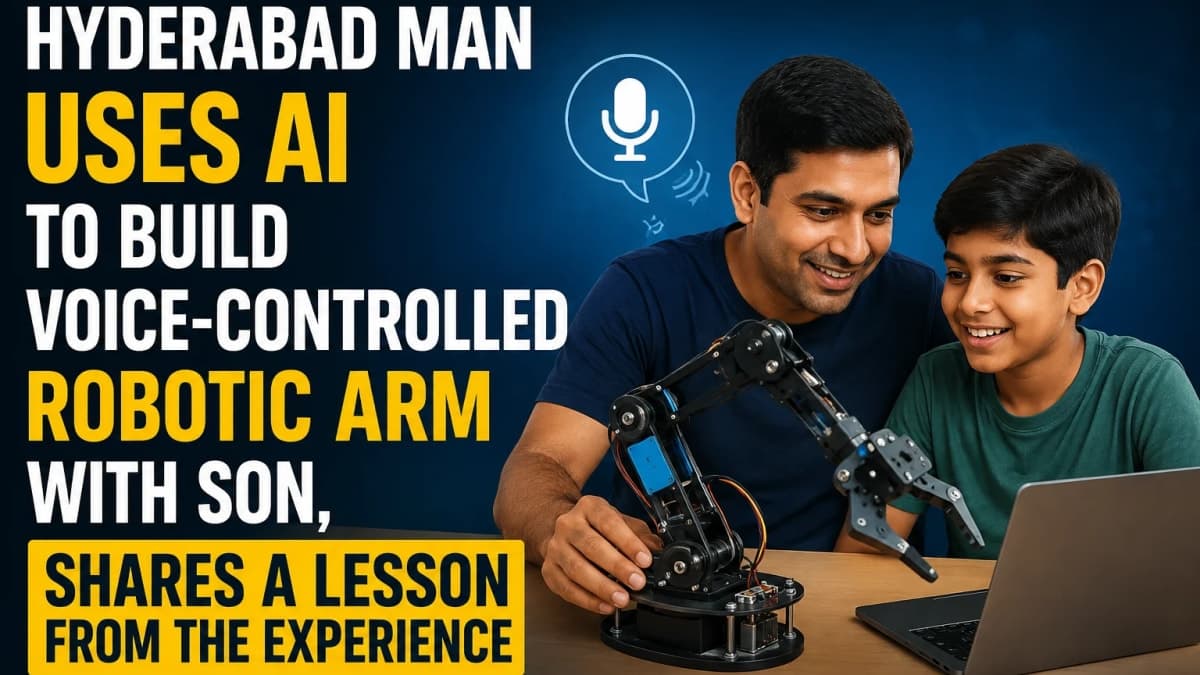
Hyderabad Man Turns AI Into a Hands-On Robotics Project With His Son
Artificial intelligence is increasingly moving beyond chatbots and digital productivity tools into practical, real-world experiments. One such example has emerged from Hyderabad, where a man used AI while working with his son to build a voice-controlled robotic arm.
The father-son project combined artificial intelligence, robotics and voice-based interaction, demonstrating how emerging technology can be used for practical experimentation rather than remaining limited to screens and software.
The man also shared a lesson from the experience, adding a broader learning dimension to what might otherwise have been viewed simply as a technology project.
Voice Commands Meet Robotics
A voice-controlled robotic arm is designed to respond to spoken instructions rather than relying exclusively on conventional physical controls.
Building such a system can involve several areas of technology, including software, electronics, mechanical components and voice-command processing. AI tools can potentially make experimentation more accessible by helping users understand concepts, troubleshoot problems or develop software needed for a prototype.
In this case, the notable aspect is also the collaborative nature of the project. Instead of treating AI as a ready-made solution, the father and son used technology as part of the process of creating something physical.
Why the Project Matters
Generative AI has made technical information and assistance easier to access for people outside traditional engineering environments. Tasks that previously might have required extensive searching through manuals, programming forums and documentation can increasingly be explored with AI-assisted guidance.
That does not eliminate the need to understand how a system works. Robotics projects still require testing, problem-solving and careful integration of hardware and software.
The Hyderabad project therefore reflects an emerging approach to AI: using the technology as an assistant during the learning and building process.
A Different Kind of Parent-Child Learning
The involvement of the man's son gives the project an educational dimension as well.
Hands-on projects can introduce children to concepts such as programming, electronics, robotics and logical problem-solving in a more tangible way than simply reading about them. Building something together can also encourage experimentation, where failures and adjustments become part of the learning process.
AI may lower some initial barriers by making explanations and technical guidance easier to obtain, potentially allowing families, students and hobbyists to attempt projects that once appeared too complicated.
AI Is Helpful, but Human Judgment Still Matters
Projects of this kind also illustrate an important limitation of AI-assisted building.
AI-generated instructions or code are not automatically correct. Suggestions may contain errors, misunderstand technical requirements or overlook safety considerations. Anyone working with electronic or mechanical systems still needs to verify information and test components carefully.
This makes AI most useful as a supporting tool rather than a replacement for human reasoning.
The value of such experiments lies not only in whether the final machine works, but also in understanding why it works, identifying mistakes and learning how to improve it.
From AI Conversations to Physical Creation
The voice-controlled robotic arm offers a small but meaningful example of how artificial intelligence can connect digital assistance with physical creation.
For parents and students, it points toward a potentially valuable way of approaching emerging technology: rather than simply consuming AI-generated content, users can employ AI to explore ideas, develop skills and create tangible projects.
The Hyderabad father-son experiment ultimately stands out because the story is not solely about a robotic arm. It is also about curiosity, collaboration and learning how to use a powerful new technology thoughtfully.