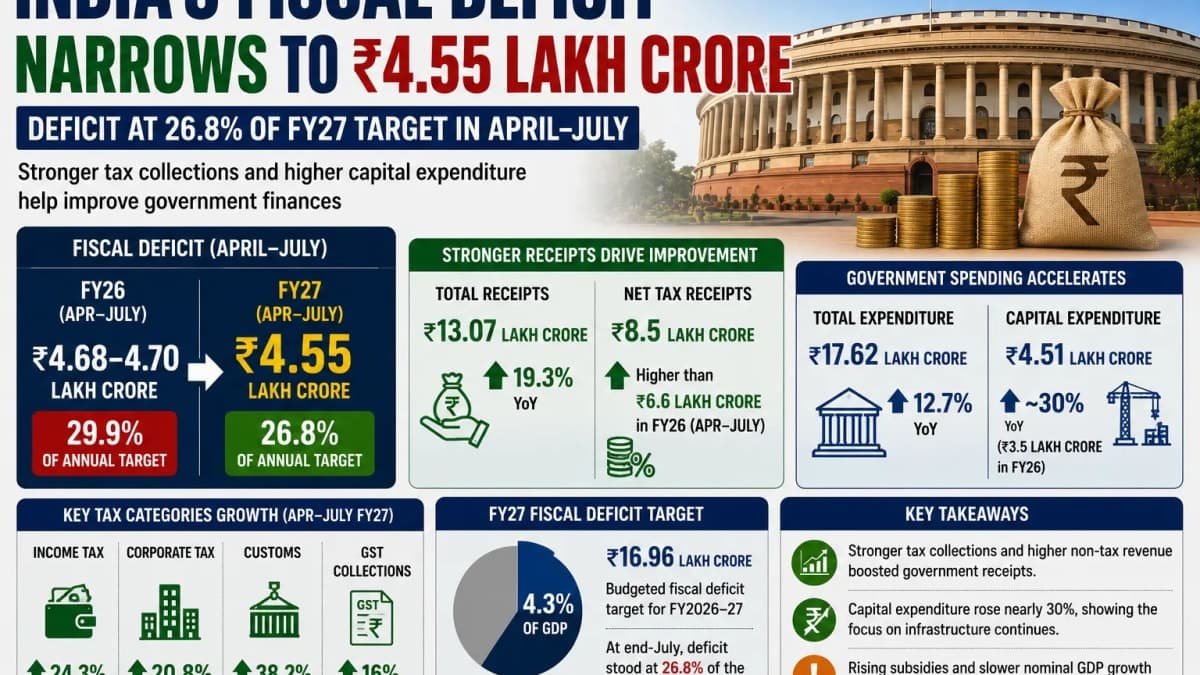
India’s central government recorded a fiscal deficit of ₹4.55 lakh crore during April–July 2026, keeping the budget gap below its level in the corresponding period last year despite a significant increase in public spending.
The deficit amounted to 26.8% of the government’s full-year Budget Estimate for FY2026-27, according to government data released on August 31.
During the corresponding four months of the previous financial year, the deficit stood at approximately ₹4.68–4.70 lakh crore, or 29.9% of that year’s annual target.
The latest numbers point to a relatively comfortable start to FY27, supported by stronger government receipts. Importantly, the improvement did not come at the expense of infrastructure spending: capital expenditure increased by nearly 30% year-on-year.
The government has budgeted a fiscal deficit of ₹16.96 lakh crore, equivalent to 4.3% of GDP, for the full financial year ending March 31, 2027.
What Does the ₹4.55 Lakh Crore Fiscal Deficit Mean?
A fiscal deficit arises when the government’s total expenditure exceeds its total non-borrowing receipts.
The ₹4.55 lakh crore figure therefore represents the gap accumulated by the Centre during the first four months of FY27.
The percentage of the annual target provides an important second measure.
At the end of July, the government had used 26.8% of its ₹16.96 lakh crore full-year deficit allowance.
That compares with 29.9% of the corresponding annual estimate at the same point a year earlier.
This does not guarantee that the government will meet its March target—the fiscal position can change considerably during the remaining eight months—but it provides the Centre with a relatively comfortable starting position.
Higher Tax Collections Strengthen Government Finances
The most important factor supporting the fiscal position was stronger revenue collection.
Net tax receipts increased to approximately ₹8.5 lakh crore during April–July, compared with around ₹6.6 lakh crore in the corresponding period last year.
That represents a substantial improvement in the government's tax inflows.
Separate analysis of the government data showed strong growth across several major revenue categories.
Income-tax collections increased 24.3%, while corporate-tax receipts grew 20.8%.
Customs revenue climbed 38.2%, while GST collections increased 16%.
Stronger revenue gives the government more room to finance expenditure without relying as heavily on additional borrowing.
Total Government Receipts Rise to ₹13.07 Lakh Crore
Overall government receipts reached approximately ₹13.07 lakh crore during April–July.
That represented an increase of about 19.3% year-on-year.
Non-tax revenue was also higher, rising to around ₹4.2 lakh crore, compared with approximately ₹4 lakh crore in the year-earlier period.
The faster growth in receipts is particularly important because government expenditure was also rising.
Instead of fiscal consolidation being achieved primarily through slower spending, the first four months show revenue growth absorbing a substantial portion of the additional expenditure.
Government Spending Climbs to ₹17.62 Lakh Crore
Total central government expenditure increased to approximately ₹17.62 lakh crore during April–July FY27.
That was about 12.7% higher than a year earlier, when expenditure stood at roughly ₹15.6 lakh crore.
Normally, a significant acceleration in government expenditure could widen the fiscal deficit.
That did not happen during this period because receipts expanded at a faster pace.
The result is an important feature of the latest fiscal numbers: India simultaneously recorded stronger government spending and a smaller fiscal deficit than during the comparable period last year.
Capital Expenditure Jumps Nearly 30%
Infrastructure and other long-term investment remained a major government priority.
Capital expenditure increased by nearly 30% year-on-year to approximately ₹4.5–4.51 lakh crore, compared with roughly ₹3.5 lakh crore during April–July last year.
Capital expenditure includes government investment in assets and infrastructure that can support economic activity over longer periods.
Unlike routine expenditure such as salaries or administrative costs, capital spending can create productive assets and potentially encourage additional private-sector investment.
By July, the Centre had already deployed roughly 37% of its full-year capital expenditure allocation.
That indicates relatively strong execution early in the financial year.
Why Higher Capex Alongside a Lower Deficit Matters
The combination of a narrower fiscal deficit and higher capital expenditure is arguably more significant than either number viewed independently.
Governments attempting fiscal consolidation can theoretically reduce deficits simply by cutting spending.
But reducing productive investment too aggressively can have consequences for infrastructure development and economic growth.
The April–July numbers instead show the Centre increasing capital expenditure while benefiting from stronger revenues.
If that combination persists, it would make the government's fiscal consolidation path easier to manage without sharply sacrificing public investment.
Whether it can persist through the entire year remains the key question.
FY27 Fiscal Deficit Target Stands at 4.3% of GDP
The Union government has set a fiscal deficit target of 4.3% of GDP for FY27, equivalent to approximately ₹16.96 lakh crore.
That follows a fiscal deficit of 4.4% of GDP in FY26.
The trajectory represents the government's continuing effort to gradually reduce the fiscal imbalance after deficits increased substantially during the pandemic period.
Reducing the deficit matters because persistent high government borrowing can increase debt-servicing costs and compete with private borrowers for capital.
However, fiscal consolidation also has to be balanced against expenditure priorities, including infrastructure, welfare programmes, defence and subsidies.
The government therefore faces a continuing trade-off between controlling borrowing and maintaining expenditure that supports economic activity and social objectives.
Subsidies Emerge as a Risk to Watch
Despite the favourable headline numbers, not every component of the fiscal accounts is moving in the same direction.
Union Bank Research highlighted higher subsidy expenditure as an area requiring monitoring.
Total subsidies increased by approximately 35% to ₹1.53 lakh crore during April–July.
Within that figure, urea subsidy expenditure rose 58% to ₹66,058 crore.
If subsidy requirements continue increasing faster than anticipated, they could consume some of the fiscal space created by stronger tax receipts.
The eventual outcome will depend partly on economic conditions and input costs during the remaining months of FY27.
Slower Nominal GDP Growth Could Complicate the 4.3% Target
Another issue is the denominator behind the government's fiscal-deficit-to-GDP target.
The government is targeting 4.3% of GDP, meaning nominal economic growth matters alongside the absolute rupee deficit.
If nominal GDP grows more slowly than assumed in the Budget, maintaining a deficit equivalent to 4.3% of GDP can become more challenging even if the government keeps its absolute borrowing under control.
Union Bank Research has said the ₹16.96 lakh crore deficit target currently appears achievable based on the April–July numbers.
However, the research also warned that slower nominal GDP growth could restrict fiscal space.
Continued tax growth and expenditure discipline will therefore become increasingly important as FY27 progresses.
Disinvestment Receipts Will Also Be Important
The fiscal outlook will not depend solely on taxes.
Non-debt capital receipts—including proceeds from government disinvestment—could become more important during the second half of the financial year.
If disinvestment receipts fall short of expectations, the government may need stronger performance elsewhere in its accounts to maintain the targeted deficit.
Conversely, stronger-than-planned non-tax and non-debt receipts could provide an additional buffer.
The April–July figures are therefore encouraging, but they represent only one-third of the financial year.
Is India’s Fiscal Deficit Improving?
Based strictly on the first four months, the answer is yes.
The absolute deficit fell from approximately ₹4.68–4.70 lakh crore to ₹4.55 lakh crore.
Relative to the annual target, it improved from 29.9% to 26.8%.
At the same time:
Government receipts increased 19.3%.
Total expenditure increased 12.7%.
Capital expenditure rose nearly 30%.
Net tax revenue climbed sharply to around ₹8.5 lakh crore.
Those numbers indicate that stronger revenue—not simply restrained government investment—was an important reason the deficit remained contained.
Why the Fiscal Deficit Matters to the Economy
Fiscal deficit data can appear abstract, but the numbers have broader economic implications.
A government finances its deficit primarily through borrowing.
The scale of that borrowing can influence government bond yields, interest rates and the amount of capital available to private companies.
A credible path toward lower deficits can also help contain the government's future interest burden.
At the same time, reducing the deficit too rapidly by sacrificing productive expenditure can weaken investment.
That is why the composition of the latest numbers matters.
The Centre has so far managed to keep the deficit relatively contained while significantly accelerating capital expenditure.
The Bigger Test Comes During the Rest of FY27
Four months of favourable fiscal data do not settle the outcome for the full year.
The government still has eight months of FY27 expenditure and revenue collection ahead.
Tax collections will need to remain resilient, while subsidy expenditure and other spending pressures will have to be managed.
Disinvestment and other non-debt capital receipts will also influence the final numbers.
External economic conditions could create additional uncertainty.
For now, however, the Centre has entered the remaining two-thirds of FY27 from a comparatively comfortable fiscal position.
At ₹4.55 lakh crore, the April–July deficit is lower than a year ago despite significantly higher infrastructure spending.
If strong revenue growth continues and expenditure pressures remain manageable, the government appears positioned to remain within reach of its ₹16.96 lakh crore—or 4.3% of GDP—fiscal deficit target for FY27.