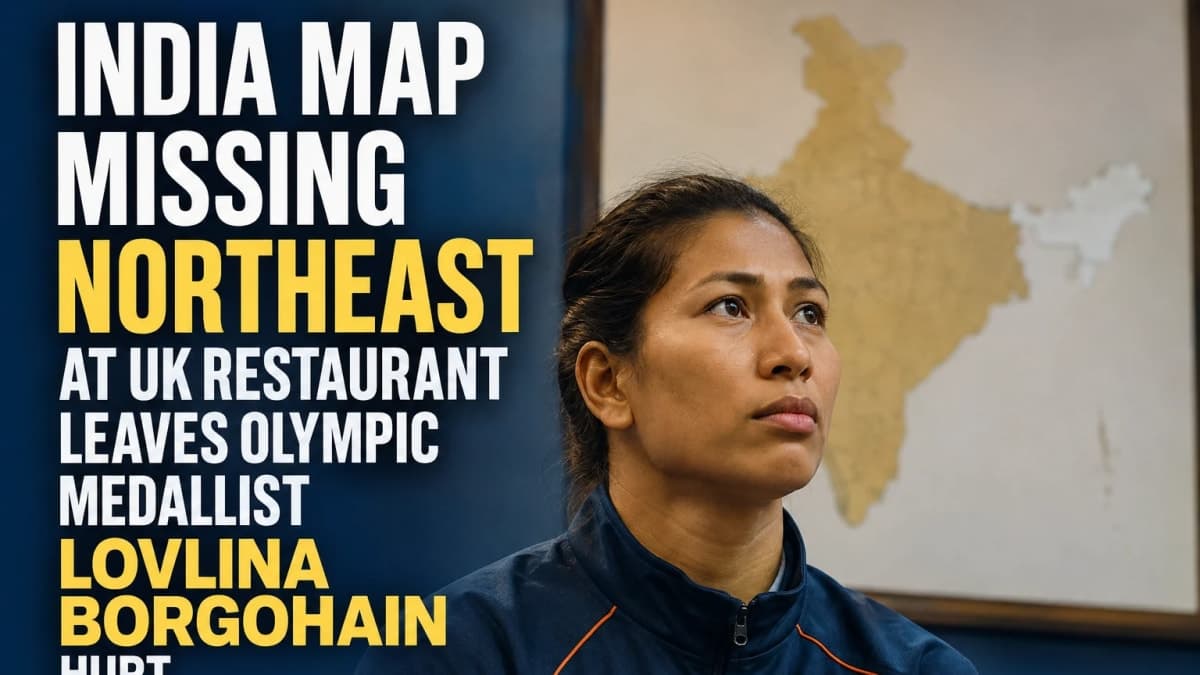
India Map at UK Restaurant Leaves Lovlina Borgohain Hurt
Indian Olympic medallist Lovlina Borgohain was left hurt after coming across a map of India displayed at a restaurant in the United Kingdom that did not include the northeastern part of the country.
The incident has put the spotlight on the importance of representing India's geography accurately, particularly when maps of the country are displayed internationally.
Borgohain, who comes from Assam in Northeast India, has represented the country on one of the world's biggest sporting stages. Her reaction therefore carries particular significance, as the omitted region is also her home and an integral part of India's geographical and cultural landscape.
Why the Missing Northeast Matters
Northeast India is a geographically distinctive region with a diverse collection of communities, languages, cultures and traditions. Its absence from a representation of the Indian map can consequently carry meaning beyond a simple visual error.
Maps are often used as symbols of national identity. When a significant region is missing, people from that area may see the omission as a failure to recognise their place within the broader national picture.
For someone such as Borgohain, who has represented India internationally while carrying strong roots in the Northeast, encountering such an incomplete representation can understandably have a personal dimension.
Lovlina Borgohain's Connection With Northeast India
Borgohain's sporting journey has made her one of the prominent athletes associated with Assam and Northeast India.
Her success at the international level has also contributed to greater visibility for athletes emerging from the region. The episode involving the map therefore touches on a wider conversation about how Northeast India is understood and represented both within the country and abroad.
Accurate Representation Has Wider Importance
The incident illustrates why organisations displaying national maps should pay attention to geographical accuracy.
In an international setting, maps can shape how visitors understand another country. An incomplete depiction can create misconceptions while also causing offence or disappointment among people whose regions have been excluded.
At the same time, without additional information about how the map came to be displayed, it would be premature to conclude that the omission was intentional. It could have resulted from an inaccurate design, outdated material or another error.
The distinction between intent and mistake is important when assessing such incidents.
A Broader Question of Recognition
Borgohain's reaction highlights how geographical representation can intersect with questions of belonging and recognition.
Northeast India has produced prominent figures across sport, culture and other fields, with Borgohain herself becoming an internationally recognised representative of Indian boxing.
An inaccurate map displayed abroad may appear to be a relatively small visual mistake, but for people whose home region disappears from that representation, the impact can be considerably more personal.
The episode ultimately serves as a reminder that accuracy matters when national geography is represented publicly, particularly in international spaces where such images may influence how people perceive a country and its regions.


