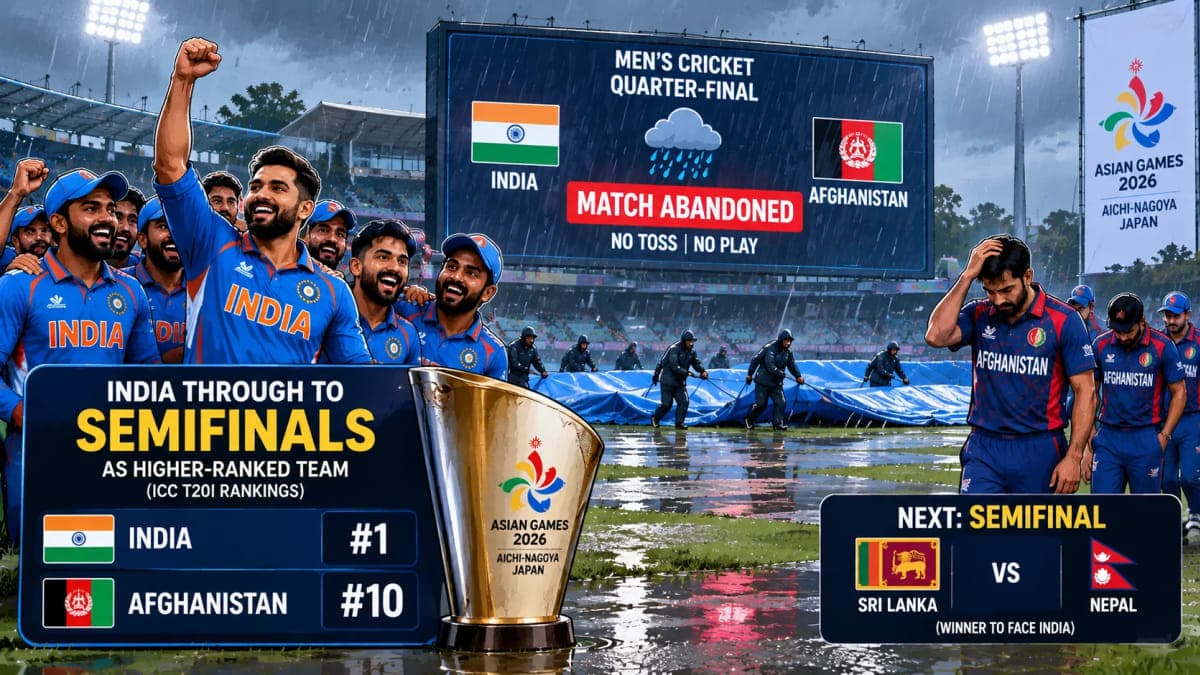
India’s defence of their Asian Games men’s cricket gold medal took an unusual turn on Monday, September 28, 2026, as their quarter-final against Afghanistan was abandoned without even a toss because of persistent rain in Nisshin, Japan.
The match at Korogi Sports Park was scheduled to begin at 10:30 AM IST, with the toss set for 10 AM. However, relentless rain and an unplayable outfield prevented the teams from taking the field. Eventually, officials abandoned the contest without a ball being bowled.
India nevertheless advanced to the semi-finals—not because they defeated Afghanistan, but because the tournament’s knockout rules favoured the higher-ranked team when no result was possible. India entered the contest as the No. 1 side in the ICC Men’s T20I rankings, compared with Afghanistan at No. 10.
Rain Prevents Even the Toss
There was effectively no cricket to report from the second men’s quarter-final.
Rain had already affected conditions in Nisshin before Monday’s matches, and another spell of persistent rain kept the ground under covers on match day. The India-Afghanistan toss could not take place, and the outfield remained unsuitable for play.
Officials waited for conditions to improve, but the match was eventually called off.
The official result was therefore an abandoned match without a ball bowled, rather than a tie, no-result after play, or an Indian victory on the field.
Why Did India Qualify Instead of Afghanistan?
The answer lies in the competition’s knockout regulations.
When a knockout fixture cannot produce a result, the higher-ranked side advances. India’s superior ICC T20I ranking therefore became decisive.
India were ranked No. 1, while Afghanistan were No. 10, meaning India received the semi-final berth.
This distinction is important when describing the result: India did not beat Afghanistan. The quarter-final was abandoned, and India progressed under the tournament rule governing washed-out knockout matches.
Afghanistan’s Asian Games campaign consequently ended without getting an opportunity to challenge India on the field.
Pakistan-Hong Kong Quarter-final Suffered the Same Fate
India-Afghanistan was not the only quarter-final disrupted by the weather.
Earlier on Monday, the first quarter-final between Pakistan and Hong Kong, China was also abandoned without a ball being bowled.
That match had been scheduled for 5:30 AM IST, but persistent rain prevented even the toss. Pakistan advanced as the higher-ranked team.
The two washouts created the unusual situation of the first two men’s cricket semi-final places being decided without any quarter-final action.
Who Will India Face in the Semifinal?
India will face the winner of the Sri Lanka vs Nepal quarter-final in the semi-finals.
For India, that creates another unusual feature of this Asian Games campaign: their first actual match of the tournament could come in the semi-finals.
As one of the leading teams in the competition, India entered directly at the knockout stage. With their quarter-final then washed out, the defending champions have reached the last four without playing a competitive match.
India Are Defending Asian Games Champions
India entered the 2026 competition as defending champions after winning the men’s cricket gold medal at the 2023 Asian Games in Hangzhou.
There is also an interesting parallel between that tournament and Monday’s washout.
India faced Afghanistan in the 2023 gold-medal match, but rain prevented that final from being completed. India were awarded the gold on the basis of their higher ranking.
Three years later, weather has again prevented an India-Afghanistan Asian Games knockout match from producing an on-field result—with India once more benefiting from their higher ranking.
Qualification Is an Advantage, but It Creates a Different Challenge
Advancing without playing clearly saves India from the risk of quarter-final elimination. It also means the squad enters the semi-final without having accumulated match-day workload.
But there is a trade-off.
The abandoned quarter-final would have provided India with valuable competitive exposure to the conditions in Japan before the medal rounds. Instead, their first completed match could be a knockout semi-final where the stakes are immediately high.
Whether the lack of match practice matters will only become clear once India take the field. It should therefore be treated as a factor to watch rather than an assumed advantage or disadvantage.
What the Result Means for Afghanistan
For Afghanistan, the outcome is considerably harsher.
Their elimination was determined by weather and the tournament’s ranking rule rather than by a cricketing result against India. They had no opportunity to overturn India’s ranking advantage on the field because the match never started.
That is one reason the wording of the result matters: saying Afghanistan “lost to India” would be inaccurate.
The record shows an abandoned quarter-final, with India advancing as the higher-ranked side.
The Bigger Issue: Weather Is Shaping the Knockout Stage
Monday’s two abandoned quarter-finals demonstrate how heavily weather can influence a short-format knockout competition.
T20 cricket normally needs relatively little playing time compared with longer formats, but sustained rain and a waterlogged outfield can still eliminate the possibility of even a shortened contest.
With both Pakistan and India advancing through ranking-based rules, the weather has already had a direct impact on the composition of the semi-final field.
That puts additional attention on conditions for the remaining quarter-finals and medal matches.
Conclusion
India are officially through to the Asian Games 2026 men’s cricket semi-finals, but there was no victory over Afghanistan to celebrate on the field.
Persistent rain at Korogi Sports Park prevented the toss and ultimately forced the quarter-final to be abandoned without a single delivery. India advanced because their No. 1 ICC T20I ranking placed them ahead of 10th-ranked Afghanistan under the tournament’s knockout rules.
The defending champions will now meet the winner of Sri Lanka vs Nepal in the last four.
For India, the unusual consequence is clear: their first cricketing action of the 2026 Asian Games could come with a place in the gold-medal match already at stake.


