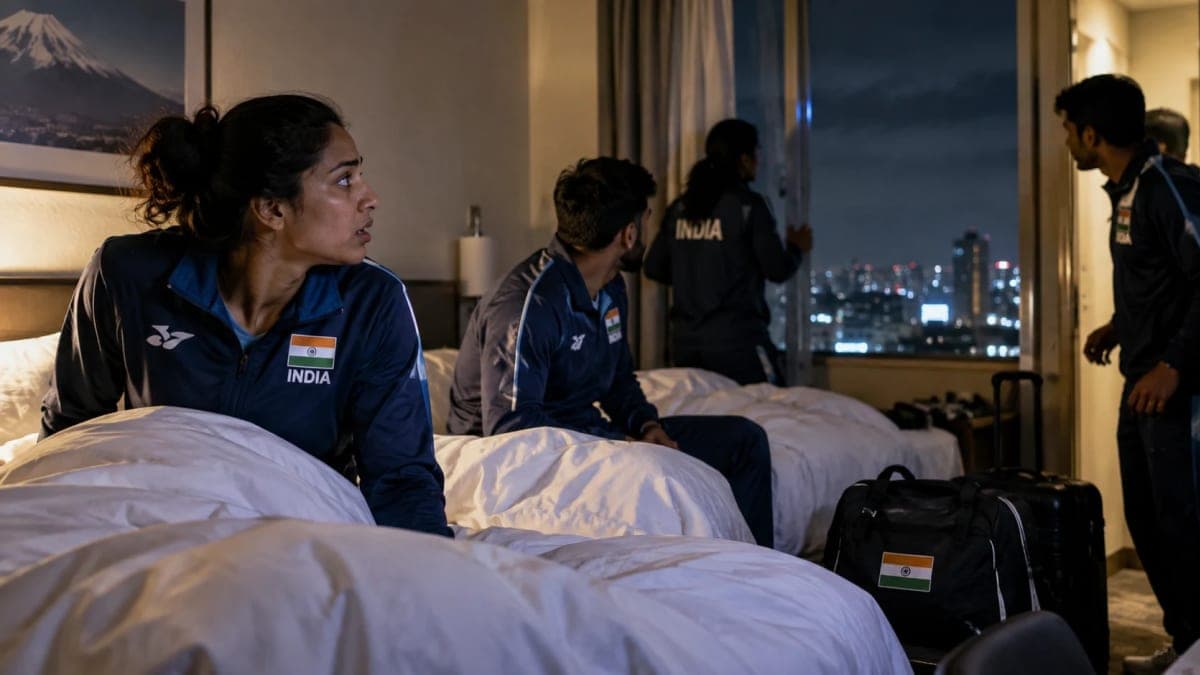
Indian athletes preparing for the 2026 Asian Games had a rather unexpected wake-up call in Japan after an earthquake shook the Tsukuba area shortly after midnight.
Several members of India's track and field contingent were asleep when the tremors were felt. The shaking was strong enough to wake some athletes and bring them out of their rooms, turning what should have been a routine night at their pre-Games training camp into a tense few minutes.
According to the Japan Meteorological Agency (JMA), the earthquake struck at around 12:07 am Japan Standard Time on September 17. Its epicentre was in southern Ibaraki Prefecture, and the quake was recorded at magnitude 4.8, at a depth of roughly 70 kilometres.
The maximum seismic intensity recorded was 3 on Japan's seven-level scale, while Tsukuba experienced an intensity of 2. Importantly, authorities issued no tsunami warning or threat following the earthquake.
For the Indian athletes, there were no reports of injuries or serious damage. Still, being woken in the middle of the night by a shaking room was hardly the kind of experience they expected just before one of the biggest sporting events of the year.
Athletes rush out of their rooms
India's athletics contingent has been based around the University of Tsukuba for a short acclimatisation and training camp ahead of the Asian Games.
According to a Times of India report citing sources with the contingent, several athletes were sleeping when the tremors began. Some apparently took a few moments to understand what was happening. One account suggested athletes initially wondered whether they were dreaming, while others thought somebody was shaking their beds.
Once they realised it was an earthquake, athletes came out of their rooms and gathered in the corridors.
The report quoted sources as saying there was "no damage", despite the tremors being noticeable enough to alarm people inside the hotel.
No injuries involving members of the Indian athletics team have been reported.
That makes the incident more of an unsettling interruption than a serious emergency. Its timing, however, made it particularly memorable. The athletes are in Japan for the final phase of their preparation before heading towards the Aichi-Nagoya Asian Games, which begin on September 19.
Athletics events start later in the Games, giving the track and field squad some additional time to train, recover from travel and adjust to conditions in Japan before competition begins.
Was it a magnitude 5.0 earthquake?
One detail surrounding the incident has caused some confusion.
Some early reports described the earthquake as magnitude 5.0. The latest JMA information, however, records it as magnitude 4.8.
There is a straightforward reason for the difference.
Japan's Earthquake Early Warning system produces rapid estimates immediately after seismic activity is detected. During the first few seconds of this earthquake, those estimates reached magnitude 5.0 as fresh information arrived.
After more seismic data became available, the JMA's earthquake record settled on magnitude 4.8.
For that reason, M4.8 is the more appropriate figure to use when describing the earthquake now. The earlier 5.0 figure was a preliminary estimate rather than the final recorded magnitude.
This distinction is useful because earthquake measurements can change slightly between the first warning and the later assessment. Early warning systems are designed to provide information as quickly as possible, while subsequent calculations benefit from a larger set of observations.
How strong was the shaking in Tsukuba?
Another point that can easily be misunderstood is the difference between an earthquake's magnitude and its seismic intensity.
Magnitude measures the overall size of an earthquake at its source. Seismic intensity, meanwhile, describes how strongly the ground shakes at a particular location.
The September 17 earthquake reached a maximum intensity of 3 in parts of the affected region. In Tsukuba, where the Indian athletes are training, the recorded intensity was 2.
That gives some perspective to what the athletes experienced. The earthquake was noticeable indoors and strong enough to wake people, but Tsukuba did not experience the highest level of shaking recorded during the event.
JMA data show that tremors were felt across several parts of the Kanto region, including locations in Ibaraki, Tochigi, Gunma, Saitama, Chiba, Tokyo and Kanagawa.
For people who live in Japan, earthquakes are a familiar part of life and buildings are designed with seismic risks in mind. For visiting athletes, however, suddenly feeling a hotel room move in the middle of the night can understandably be unsettling.
Why India's athletes are training in Tsukuba
The Indian athletics team's stay in Tsukuba was planned well before the earthquake.
The squad is using the University of Tsukuba for a short training and acclimatisation camp before moving towards the main Asian Games competition venue.
Such camps can be valuable before a major international event. Athletes get time to recover from the journey, adjust to the local time zone and weather, train in nearby facilities and settle into a routine before competition begins.
There is also a broader India-Japan sporting connection behind the arrangement.
Earlier in 2026, the Sports Authority of India entered into an agreement with the University of Tsukuba aimed at creating opportunities for specialised training and exchanges involving Indian athletes, coaches and sports scientists.
The Athletics Federation of India initially named a 77-member athletics squad, including 34 men and 43 women, for the Aichi-Nagoya Asian Games. The team covers a wide range of events, including running, hurdles, jumps, throws, race walking and combined events.
India's overall contingent is considerably larger. According to the Ministry of Youth Affairs and Sports, the country is sending 503 athletes to the Games.
Against that backdrop, the earthquake is unlikely to become more than a brief and unusual episode in India's Asian Games campaign.
No sign that preparations have been affected
The more important question for the Indian team is whether the earthquake has disrupted training or affected preparations for competition.
So far, there is no verified evidence of injuries, damage to the team's accommodation or changes to the athletics squad's training programme because of the tremors.
That is worth stressing because an earthquake naturally sounds alarming, particularly when it happens just days before a major sporting event. In this case, however, the available evidence points to a moderate earthquake that startled the athletes rather than a serious incident involving the team.
Japan also has extensive experience dealing with seismic activity. Tsukuba's official disaster guidance advises people to protect themselves from falling objects while shaking is underway, assess their surroundings once it stops and remain alert for possible subsequent tremors.
For the Indian contingent, attention can now return to the reason they travelled to Japan in the first place.
The athletes still have training sessions to complete, bodies to recover from travel and competition routines to settle into before their Asian Games events begin.
Whether the midnight tremors have any effect beyond a disrupted night's sleep remains to be seen. At the moment, there is nothing to suggest they will.
But for athletes who woke up to moving beds and shaking rooms in a foreign country, their Asian Games trip has already delivered a moment they probably did not expect.