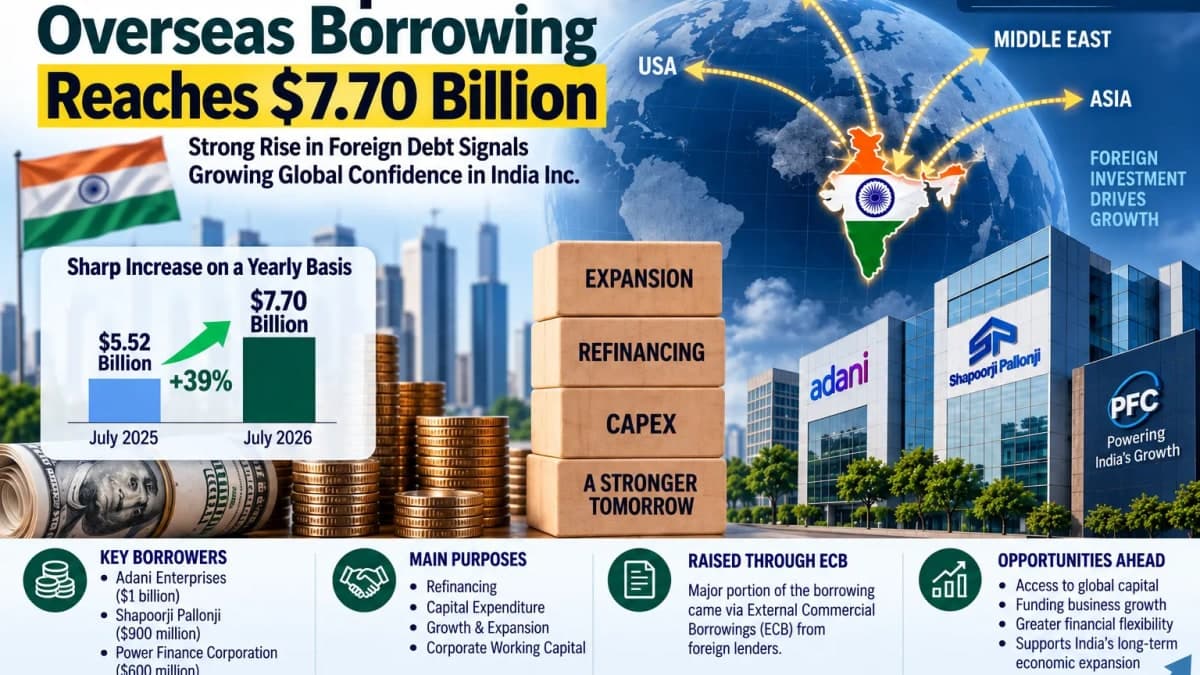
Overseas Borrowing Rises to $7.70 Billion in July
Indian companies stepped up borrowing from international markets in July 2026, highlighting continued corporate demand for foreign capital even as currency movements remain an important consideration for borrowers.
Overseas borrowing by Indian companies reached $7.70 billion during July, compared with approximately $5.52 billion in July 2025, according to reported Reserve Bank of India (RBI) data.
That represents an increase of roughly 39% year-on-year.
The rise reflects companies' continued use of international debt markets alongside domestic financing for purposes ranging from refinancing existing liabilities to funding capital expenditure and business expansion.
External Commercial Borrowings Drive the Funding
A significant portion of overseas fundraising by Indian companies came through External Commercial Borrowings (ECBs).
Under India's regulatory framework, eligible Indian entities can raise commercial debt from recognised overseas lenders, subject to applicable RBI rules.
Depending on the permitted structure, overseas borrowing can include bank loans and other recognised debt instruments.
For companies, international markets can provide access to a broader pool of lenders and help diversify funding sources. However, the headline interest rate alone does not determine whether foreign borrowing is cheaper.
Currency hedging expenses, fees, maturity terms and other financing costs can substantially affect the final cost of an overseas loan.
Adani Enterprises Among Major Borrowers
Several large corporate transactions contributed to July's borrowing figures.
Adani Enterprises raised around $1 billion, with the borrowing reportedly intended to refinance an existing ECB.
Shapoorji Pallonji and Company raised approximately $900 million from overseas sources.
Power Finance Corporation (PFC) was another major borrower during the month, raising about $600 million.
These large individual transactions accounted for a meaningful share of the overall overseas borrowing recorded during July.
Why Refinancing Matters
An increase in overseas borrowing does not necessarily mean that the entire amount is being deployed into new factories, infrastructure or expansion projects.
Companies also use international debt for refinancing.
Refinancing involves raising new debt to repay or restructure existing liabilities. Companies may use it to extend repayment schedules, alter financing terms or manage their maturity profile.
The process can improve a company's debt structure under favourable circumstances, but it does not automatically eliminate financial risk.
The interest rate on the new loan, repayment conditions and exposure to foreign-exchange movements remain important factors.
Foreign Currency Debt Brings Opportunities and Risks
International debt markets can give Indian companies access to substantial pools of capital and a more diversified lender base.
In some market conditions, the stated interest rate on an overseas loan may appear more attractive than domestic borrowing costs.
But foreign-currency debt introduces an additional challenge: exchange-rate risk.
For example, if an Indian company borrows in US dollars but earns most of its revenue in rupees, a weaker rupee can increase the amount of domestic currency required to service the same dollar-denominated debt.
Companies can use hedging instruments to reduce this exposure, but hedging itself carries a cost.
As a result, the effective cost of overseas borrowing can be significantly different from the interest rate quoted when the loan is arranged.
What Does the $7.70 Billion Figure Indicate?
The rise to $7.70 billion demonstrates that Indian companies continue to have access to international debt markets and are actively using them.
However, higher overseas borrowing should not automatically be interpreted as a straightforward measure of stronger corporate confidence.
Companies borrow internationally for different reasons, including new investments, capital expenditure, acquisitions, working capital requirements and refinancing existing debt.
The composition and purpose of the borrowing therefore matter as much as the headline figure.
For investors and policymakers, another important consideration is whether companies taking foreign-currency loans also generate foreign-currency revenue that can provide a natural hedge against exchange-rate movements.
RBI Framework Remains Important
External Commercial Borrowings by Indian entities operate within a regulatory framework set by the Reserve Bank of India.
The framework is intended to provide eligible companies access to global capital while managing risks associated with excessive foreign-currency exposure and external debt.
Rules governing ECBs cover areas including eligible borrowers and lenders, maturity requirements and permitted uses of funds.
The increase in overseas borrowing therefore needs to be viewed not only as a corporate financing trend but also within India's broader external financing environment.
What to Watch Next
The direction of overseas corporate borrowing in the coming months will depend on several factors, including global interest rates, movements in the Indian rupee, hedging costs and companies' capital requirements.
If the effective cost of international funding remains competitive, large Indian businesses may continue tapping overseas lenders.
A sharp depreciation in the rupee or an increase in hedging costs, however, could make foreign-currency borrowing more expensive even when headline dollar interest rates appear attractive.
July's $7.70 billion figure shows that Indian companies remain active participants in global debt markets. The more important question for the months ahead will be how much of that capital supports fresh investment and growth, and how much is being used to refinance existing liabilities.