IRDAI proposes a common information layer for insurance
India's insurance regulator is looking to tackle a problem that affects both customers and companies: crucial information remains scattered across insurers, intermediaries and other institutions that often operate on different systems.
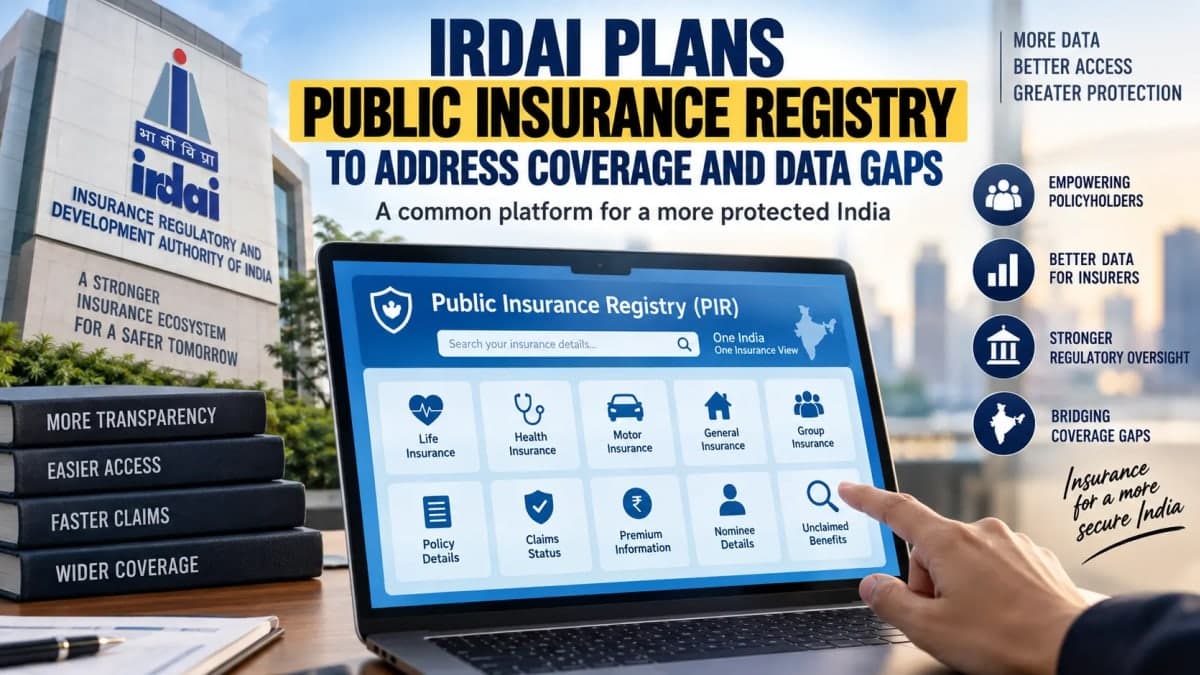
The Insurance Regulatory and Development Authority of India (IRDAI) has proposed a Public Insurance Registry, or PIR, as digital public infrastructure for the sector. The plan is to create a common layer through which authorised participants can discover, verify and exchange insurance information using agreed standards.
IRDAI released a consultation paper on the proposal on September 1. The project is linked to the broader objectives of the Sabka Bima Sabki Raksha (Amendment of Insurance Laws) Act, 2025.
The ambition goes beyond giving customers another place to look up their policies. IRDAI wants the infrastructure to reduce information gaps across the market, improve supervision and help the industry identify people and regions where insurance protection remains inadequate.
The proposal is still at the consultation stage. Its detailed technical and functional specifications will be developed as the project moves towards implementation.
Not a giant central database
One of the most important elements of the proposed architecture is what the registry would not do.
IRDAI does not envisage PIR as a single database containing every customer's insurance records.
Instead, the underlying information would generally remain with the insurer, government body or other institution responsible for maintaining it. PIR would provide a common, interoperable layer through which relevant information could be accessed for an authorised purpose.
This approach, described as "source-system primacy", would preserve the original institution as the authoritative source of a record.
The framework proposes several ways of handling information. PIR could maintain a reference pointing to data held by the original institution, retain a governed copy where a legitimate cross-industry purpose requires it, or use anonymised and aggregated information for broader analysis.
That distinction will be important as IRDAI tries to improve data availability without unnecessarily concentrating sensitive financial and personal information.
What information could be connected?
The potential scope is extensive.
PIR could connect information on insurance products, policies, coverage, premiums, nominees, benefits, claims, grievances, intermediaries and unclaimed amounts.
It could also interact with external databases for specific purposes. The consultation paper identifies possible links with systems covering KYC, vehicles, health, mortality, weather, disasters and court cases.
For example, an insurer assessing a claim could potentially access relevant information held by another insurer when the necessary consent and legal conditions are met. The original documents would remain with the institution responsible for them.
The proposal also calls for common definitions, identifiers and data formats so that information generated by different insurers can be interpreted consistently.
What could change for policyholders?
For consumers, the immediate value could be simpler access to information that is currently spread across several companies.
A person holding life, health, motor or other insurance policies with different insurers could potentially view information about those policies through a more unified framework.
Customers could check policy status, coverage, benefits, premiums, claims and nominee information. The system could also help identify forgotten policies and unclaimed benefits.
Product discovery is another proposed use.
IRDAI wants consumers to have better access to comparable product information and the ability to verify insurers and intermediaries before buying. Easier access to standardised information could reduce dependence on fragmented documentation and make direct purchases more practical.
PIR could also support common service requests across insurers, reducing some of the duplication customers encounter when dealing with multiple providers.
Better data could change underwriting and claims
Insurers stand to gain from a broader view of risk.
Under the proposal, companies could use standardised and appropriately authorised information to improve underwriting, claims assessment and fraud detection. Anonymised industry-wide claims and loss data could also help insurers understand risks that are difficult to identify from their own portfolios alone.
IRDAI has floated the possibility of an Insurance Risk Score, or IRS, that could combine insurance history with information from the Insurance Information Bureau, credit information companies and other permitted sources. Such a score would be consent-based and intended as an input into underwriting rather than a standalone replacement for insurers' risk assessments.
There are more specific applications as well.
For life insurance, cross-insurer information could help with investigations involving high-value claims where an insurer currently has limited visibility into similar policies elsewhere.
In motor insurance, connections with accident, police and transport databases could help insurers track vehicles recovered after theft claims have already been settled.
The registry could also support analysis of motor accident claim settlements and timelines.
A clearer picture of India's protection gaps
The proposal has a wider policy objective beyond making individual transactions more efficient.
Anonymised and aggregated data could give regulators and governments a more detailed picture of where insurance protection is weak.
Instead of relying solely on broad national measures, authorities could potentially examine protection gaps by geography, population segment or type of risk. That could help with the design of insurance programmes, social-security initiatives and disaster-resilience policies.
Reinsurers could similarly use standardised exposure and catastrophe information when assessing capital allocation and risk transfer.
Financial institutions could verify insurance associated with assets used as collateral, while approved researchers could use anonymised information to study industry trends.
In that sense, PIR is being designed as infrastructure for both individual insurance transactions and sector-wide analysis.
Privacy will determine how useful the registry can become
The advantages of connecting more information also create the proposal's most obvious challenge.
Insurance records can contain sensitive financial, health and identity information. A system designed to make such data easier to exchange will therefore depend heavily on how access is controlled.
The proposed framework calls for consent-based access to be specific, informed, revocable and auditable. It also envisages role-based permissions, purpose limitations, data masking and audit trails.
PIR would have to operate within existing laws, including the Digital Personal Data Protection Act, 2023, the Aadhaar Act, 2016 and the Information Technology Act, 2000.
Commercial confidentiality is another consideration. The proposal says insurer-specific information such as proprietary underwriting rules, pricing strategies and product strategies would not be exposed through cross-industry datasets.
The effectiveness of those safeguards will ultimately matter as much as the breadth of information the system can connect.
Implementation is expected to be gradual
IRDAI is not proposing an immediate migration of every historical insurance record into a new format.
New policies and future policy events could begin following common PIR standards from an agreed date, while older records could be incorporated progressively, including when policies are renewed or undergo other significant changes.
Insurers could use mapping systems to connect their existing data formats with the new standards rather than rebuilding their technology infrastructure at once.
For governance, the consultation paper proposes converting the Insurance Information Bureau into a not-for-profit company wholly owned by IRDAI. That entity would establish PIR under a separate regulatory framework.
The regulator has sought feedback on the architecture, identity standards, privacy protections, governance structure and implementation process. Comments are due by September 30, 2026.
The real test will be whether connected data produces better insurance
The Public Insurance Registry is an ambitious attempt to address a structural weakness in India's insurance market: different participants often possess pieces of information that become substantially more useful when they can be verified and exchanged safely.
A successful registry could make it easier for customers to understand what insurance they already have, compare what they might need and pursue claims or unclaimed benefits. Insurers could make decisions using a broader evidence base, while regulators would gain a clearer view of where protection is missing.
But those benefits remain prospective.
PIR is still a proposal, and questions around consent, privacy, data quality, interoperability and implementation will shape what eventually emerges from the consultation process. The significance of the project will depend less on how much information it can connect than on whether that information can be used accurately, securely and in ways that genuinely improve insurance access.