India’s Appetite for Gold Proves Resilient as Record Prices and Higher Duties Test Demand
India has made gold considerably more expensive to buy this year. Consumers, so far, have not responded by abandoning it.
A sharp increase in import duty, record domestic prices and pressure on household budgets have all raised the cost of purchasing the precious metal. The government has also sought to discourage unnecessary buying as it tries to contain imports and protect foreign exchange reserves.
Yet demand has proved harder to dislodge than those pressures might suggest.
Indian consumers spent about $21 billion on gold jewellery in the second quarter of 2026, roughly a third more than a year earlier, according to World Gold Council figures cited in recent reporting. Large jewellery retailers have continued to draw customers, helped by weddings, religious festivals and gold’s longstanding role as both jewellery and a store of wealth.
The picture is not one of uninterrupted growth. Higher prices have reduced the amount of gold some households can afford, and physical demand weakened after the duty increase. What has persisted is the willingness to buy.
Import Duty Jumps From 6% to 15%
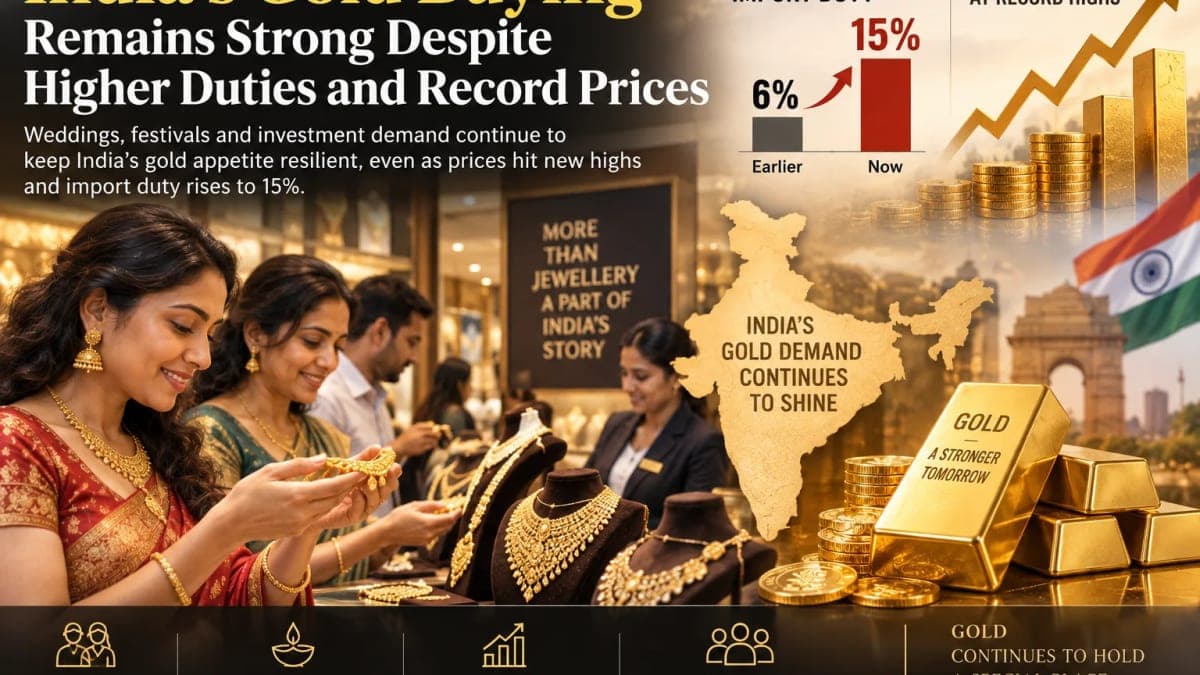
The government delivered one of the biggest shocks to the market in May when it raised the gold import duty from 6% to 15%.
The nine-percentage-point increase, introduced on May 13, was the steepest single rise on record and reversed the substantial duty reduction introduced in July 2024.
The move formed part of a broader attempt to reduce pressure from gold imports at a time when the rupee and India’s foreign exchange position were under strain.
Gold carries unusual weight in the country’s trade accounts. It was among India's five largest imports and represented about 8% of merchandise imports in 2025, according to the World Gold Council.
Prime Minister Narendra Modi has also appealed to Indians to avoid buying gold for a year as the government seeks to restrain demand.
But tax policy has limits in a market where purchases are tied not only to investment decisions but also to weddings, festivals and family savings.
Prices Rise as Rupee Adds Another Layer of Pressure
The duty increase arrived in an already expensive market.
By mid-June, domestic gold prices were about 13.2% higher for the year, even though international prices were broadly flat over the same period. The World Gold Council attributed much of that divergence to the higher import duty and a 5.3% depreciation in the rupee against the US dollar.
Domestic prices initially rose around 4% to 6% following the duty change rather than absorbing the full nine-percentage-point increase immediately.
Part of the reason was an unusual adjustment inside the physical market.
Dealers had inventory imported before the higher tariff took effect, while rising prices encouraged consumers to exchange old jewellery and prompted some investors to take profits. Those additional supplies helped prevent the full duty increase from immediately passing through to retail prices.
Discounts to the official landed price widened dramatically after the policy change, reaching nearly $150 an ounce, compared with an average of about $14 before the increase.
By June 15, the discount had narrowed to roughly $25 an ounce, suggesting that the initial supply imbalance was beginning to ease.
Weddings Continue to Give Jewellery Demand a Floor
High prices are changing how Indians purchase gold rather than eliminating purchases altogether.
Jewellery demand remains particularly resistant because a substantial portion is associated with weddings and other social occasions. Buyers can reduce weight, exchange existing jewellery or adjust designs while still going ahead with a purchase.
The World Gold Council has found jewellery consumption historically less sensitive to changes in import duties than investment demand.
That distinction matters in interpreting the latest market data.
May and early June were relatively weak for jewellery retailers, partly because the period is traditionally quieter and coincided with Adhik Maas, considered an inauspicious period for some purchases. Price volatility also encouraged consumers to delay buying.
The underlying market, however, has remained substantial enough for major organised retailers to continue expanding.
Titan’s Performance Shows Strength at the Organised End
One indication comes from Titan, part of the Tata Group and one of India's largest jewellery retailers.
The company reported a 63% increase in profit in its latest quarter, while store footfall also increased. Jewellery accounts for the majority of Titan's revenue, giving its performance particular relevance as a measure of demand among customers moving toward large branded retailers.
Titan is estimated to account for roughly 10% of India's jewellery market. Its shares have risen nearly 25% in 2026, according to recent reporting.
The performance does not mean every jeweller is benefiting equally.
Large chains generally have stronger inventories, financing options and exchange programmes. Smaller retailers face greater difficulty when high gold prices reduce volumes and tie up more capital in inventory.
The result is a market in which consumer demand can remain resilient even as business increasingly shifts toward larger organised players.
Investors Have Not Walked Away Either
Investment demand has been more volatile.
Indian gold exchange-traded funds recorded ₹7.25 billion ($76 million) of net outflows in May, their first monthly net withdrawal since April 2025 and the largest monthly outflow on record in rupee terms.
Gross redemptions reached ₹33.30 billion.
The timing suggests that investors were using the price jump after the duty increase to book profits rather than simply rejecting gold as an asset.
That interpretation gained support in June.
Between June 1 and June 11, gold ETFs attracted ₹16.31 billion ($171 million) in net inflows, reversing the previous month's withdrawals.
Digital gold showed a similar pattern of moderation rather than retreat. Purchases through UPI fell in May, but estimated volumes of 1.54 tonnes remained above the 16-month average of 1.36 tonnes.
Imports Feel the Effect More Quickly
The clearest impact of the policy shift has appeared in imports.
Gold imports dropped 39% month on month to $3.4 billion in May after the duty increase. Even after that decline, however, their value remained 34% higher than a year earlier.
The World Gold Council estimates that India imported about 25 to 30 tonnes during the month, compared with 46 tonnes in April and a two-year monthly average of 59 tonnes.
That provides an important distinction between import data and underlying consumer demand.
Retailers can temporarily meet demand from existing inventory, recycled jewellery and metal already brought into the country. A decline at the border therefore does not necessarily translate immediately into an equivalent decline at jewellery counters.
High Duties Bring an Old Problem Back Into View
There is another consequence of widening the gap between Indian and international gold prices: smuggling becomes more profitable.
World Gold Council analysis of previous duty cycles found a positive relationship between higher tariffs and unofficial gold inflows.
After duties increased in 2013, estimated unofficial imports rose from around 10 tonnes in the first quarter of 2013 to 70 tonnes by the first quarter of 2014.
A similar pattern followed the 2022 duty increase. Conversely, unofficial inflows dropped sharply after the government reduced the tariff to 6% in July 2024.
That history complicates efforts to control gold imports through taxation alone. Higher duties can suppress some official purchases while simultaneously increasing the financial incentive to bypass official channels.
Resilient Does Not Mean Immune
The strength of India's gold market should not be mistaken for an absence of pressure.
The World Gold Council expects combined jewellery and bar-and-coin demand to decline by roughly 50 to 60 tonnes in 2026, or around 10% from the previous year, partly because of the higher import duty.
Prices, inflation, household incomes and the monsoon could alter that forecast.
What the market has demonstrated so far is something narrower but significant: making gold more expensive does not necessarily remove the reasons Indians buy it.
For an investment buyer, a higher price can postpone a purchase. For a family preparing for a wedding, the response may instead be a lighter necklace, an exchange of old jewellery or a smaller quantity.
That distinction helps explain why record prices and a 15% import duty have changed India's gold market without breaking its underlying demand.