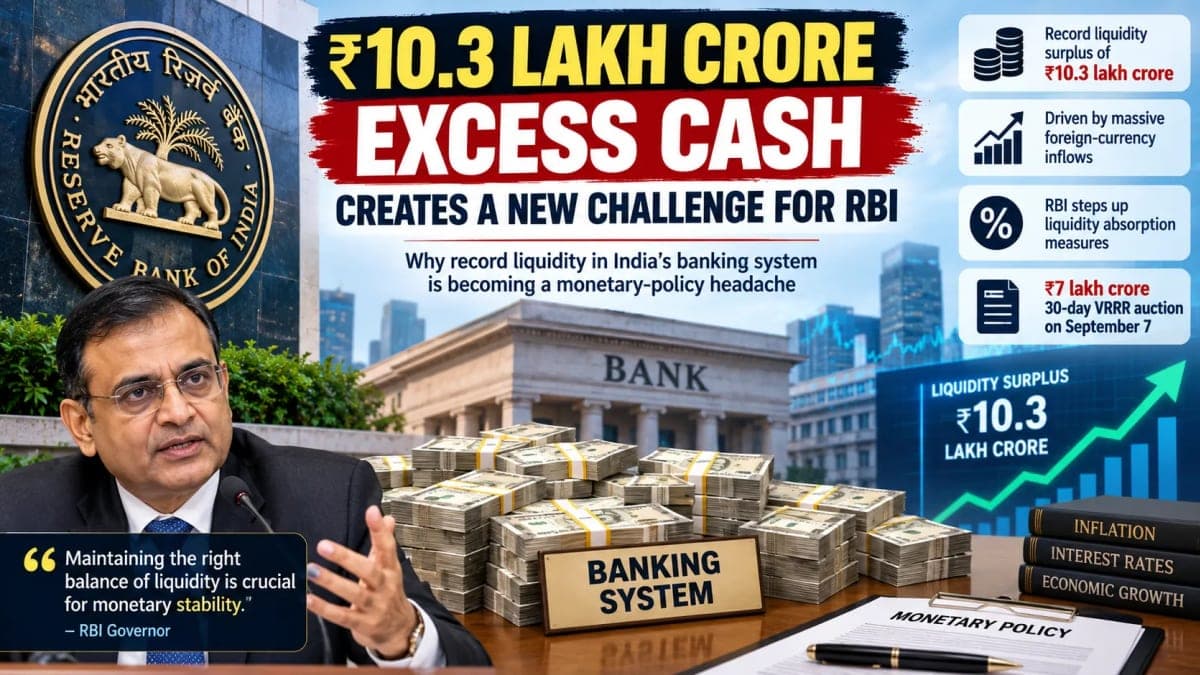
The Reserve Bank of India is confronting an unusual monetary-policy problem: too much money in the banking system.
Surplus liquidity climbed to a record ₹10.3 lakh crore on September 3, according to RBI data reported by Business Standard, following a sharp influx of foreign currency and its conversion into rupees through the central bank's swap arrangements.
The abundance of cash is beneficial for banks in some respects. Funding becomes easier and potentially cheaper. But for the RBI, an exceptionally large and persistent surplus can complicate its effort to keep short-term interest rates aligned with monetary policy.
That challenge has already become visible in the money market.
The weighted average call rate, a key overnight rate and the RBI's operating target, fell to 4.94% — below the 5% Standing Deposit Facility rate and the 5.25% policy repo rate.
The result is a monetary-policy balancing act: the RBI needs to withdraw enough cash to regain control over short-term rates without tightening liquidity so aggressively that it disrupts government bonds, raises funding costs sharply or unnecessarily squeezes credit conditions.
How Did India End Up With So Much Excess Cash?
The origins of the liquidity surge lie partly in measures designed to attract foreign currency into India.
The RBI's special foreign-exchange measures mobilised $136.38 billion by August 31. Of that, $127.23 billion came through Foreign Currency Non-Resident (Bank), or FCNR(B), deposits.
Another $5.26 billion was mobilised through overseas foreign currency borrowings, while external commercial borrowings accounted for $3.89 billion.
As banks raised dollars and exchanged them with the RBI, they received rupees in return. Those rupees entered the domestic banking system, causing liquidity to expand rapidly.
The scale of the increase has been striking.
Banking-system liquidity stood at ₹6.65 lakh crore at the end of August before climbing to ₹7.76 lakh crore and then ₹9.71 lakh crore on September 2. By September 3, the surplus had reached ₹10.3 lakh crore.
That progression explains why what began as a successful foreign-currency mobilisation exercise has turned into a domestic liquidity-management challenge.
Why Excess Cash Can Become a Problem
A liquidity surplus is not automatically bad for the economy.
Banks with plentiful funds have less need to compete aggressively for expensive deposits or raise short-term wholesale funding. That can reduce their cost of funds and potentially improve the availability of credit.
But the equation changes when liquidity becomes exceptionally large.
Banks with more cash than they can immediately deploy have less reason to borrow from each other. Short-term money-market rates consequently begin falling.
That is already happening.
The weighted average call rate settled at 4.94% on September 3, below the RBI's 5.25% repo rate.
For the central bank, this matters because its policy rate is intended to influence financing conditions throughout the economy. If abundant liquidity consistently pushes actual overnight borrowing costs substantially below the repo rate, financial conditions can become easier than the RBI intends.
Inflation Makes the Timing More Complicated
The liquidity surge comes at a particularly sensitive moment.
Excess liquidity can support lending and economic activity, but persistently easy financial conditions can also add to demand and potentially complicate inflation management.
That risk becomes more important when inflation pressures are already increasing.
Higher global crude-oil prices represent another potential source of inflation for India, while minutes from the RBI's August monetary-policy meeting indicated policymakers were already moving toward a tighter stance.
The RBI therefore faces two connected questions: what level of interest rates is appropriate for the economy, and how much liquidity should remain in the banking system for those rates to transmit effectively?
Those questions are related, but they are not identical.
Removing surplus liquidity does not necessarily mean the RBI has decided to raise the repo rate. Liquidity operations can instead be used to ensure that existing monetary-policy settings are transmitted more effectively.
RBI Has Already Started Removing Huge Amounts of Cash
The central bank has responded by increasing its use of variable-rate reverse repo, or VRRR, auctions.
Under a VRRR operation, banks voluntarily park surplus money with the RBI for a specified period in return for interest. This temporarily removes those funds from circulation.
On September 4, the RBI absorbed approximately ₹6.02 lakh crore through two three-day VRRR auctions.
The auctions had a combined notified amount of ₹8.5 lakh crore and received bids of around ₹6.01 lakh crore, with a cut-off rate of 5.24%.
The scale of the intervention illustrates how unusual current liquidity conditions have become.
During the week, the RBI conducted VRRR operations with notified amounts totalling roughly ₹41 lakh crore, while banks submitted bids worth about ₹23.74 lakh crore.
Yet money-market rates remained under downward pressure.
RBI Turns to a Longer 30-Day Operation
The next step is more significant.
The RBI has announced a ₹7 lakh crore 30-day VRRR auction for September 7.
Recent liquidity-absorption operations had generally extended only as far as 15 days. Moving to 30 days allows the central bank to keep a much larger portion of surplus cash outside the banking system for longer.
Banks participating in the auction will also have an option for premature reversal, according to the RBI announcement.
That feature gives lenders some flexibility if their liquidity requirements change before the 30-day period expires.
The operation is still voluntary, however. Its effectiveness will therefore depend partly on how much money banks actually choose to place with the RBI.
Why RBI Cannot Simply Remove All the Money at Once
Absorbing liquidity may sound straightforward, but every major tool available to the RBI carries trade-offs.
The central bank can continue conducting VRRR auctions, but banks must be willing to participate.
It can sell government securities through open-market operations. That removes rupees from the financial system, but large bond sales could push government bond yields higher.
Another possibility is increasing the Cash Reserve Ratio, or CRR — the share of deposits banks must maintain with the RBI.
The CRR currently stands at 3%.
Reuters reported that a 50-100 basis-point increase could potentially absorb around ₹1.4 lakh crore to ₹2.8 lakh crore of liquidity.
But a higher CRR effectively locks away more bank resources without earning interest, which can hurt lenders' margins.
The government and RBI could also consider instruments under the Market Stabilisation Scheme, although those operations carry fiscal costs.
Banks Suggest Another Route: Forex Swaps
Indian lenders have proposed another solution.
At a meeting with the RBI, banks suggested foreign-exchange sell/buy swaps as a way to gradually remove rupee liquidity, according to Reuters, citing three people familiar with the discussions.
Under such an operation, the RBI would sell dollars and receive rupees in the first leg of the transaction before reversing the trade at a predetermined future date.
That would temporarily withdraw rupees from the banking system.
Bank executives reportedly favoured this approach partly because they believe it could drain liquidity without creating the same direct impact on bank margins as a higher CRR.
The RBI had not publicly commented on that proposal in the reporting.
Cheap Money Is Good for Banks — Up to a Point
There is another side to the liquidity story.
The surplus could reduce funding pressure on Indian lenders.
System liquidity averaged ₹3.67 lakh crore in August, compared with ₹1.07 lakh crore in July. With cash becoming more readily available, banks may be able to reduce their dependence on relatively expensive certificates of deposit and high-cost deposits.
Lower funding costs can support margins and provide greater flexibility in lending.
For borrowers, abundant liquidity can also help keep market interest rates lower.
That is precisely why the RBI's job is delicate.
The central bank does not necessarily want to eliminate all surplus liquidity. It needs to prevent the surplus from becoming so large that short-term rates cease reflecting the intended monetary-policy stance.
The Bigger Monetary-Policy Question
The liquidity problem illustrates how one policy success can create a second challenge.
India's foreign-currency mobilisation programme brought in more than $136 billion and helped strengthen the country's external buffer. Foreign-exchange reserves reached a record $740.8 billion as of August 28.
But converting those foreign-currency inflows into rupees released an enormous amount of domestic liquidity.
The RBI must now manage the consequences.
A combination of natural cash demand, tax payments, credit expansion and other flows could eventually absorb part of the surplus. The central bank itself had previously indicated that liquidity generated through the special forex facility would be absorbed over time through factors including higher currency in circulation and maturing forward positions.
The immediate problem, however, is scale.
With the banking system carrying record surplus cash and overnight rates trading below the policy repo rate, temporary VRRR auctions may need to be supplemented by longer-duration or more durable liquidity-management measures.
For the RBI, the objective is not simply to remove money. It is to withdraw enough liquidity to restore effective control over short-term interest rates without turning a problem of excess cash into an unnecessary shortage.