Manual Checks Added to Healthcare Import Clearances
India has introduced an additional layer of scrutiny for imported medicines, medical devices and other regulated healthcare products after a gap emerged in the government's upgraded digital customs clearance system.
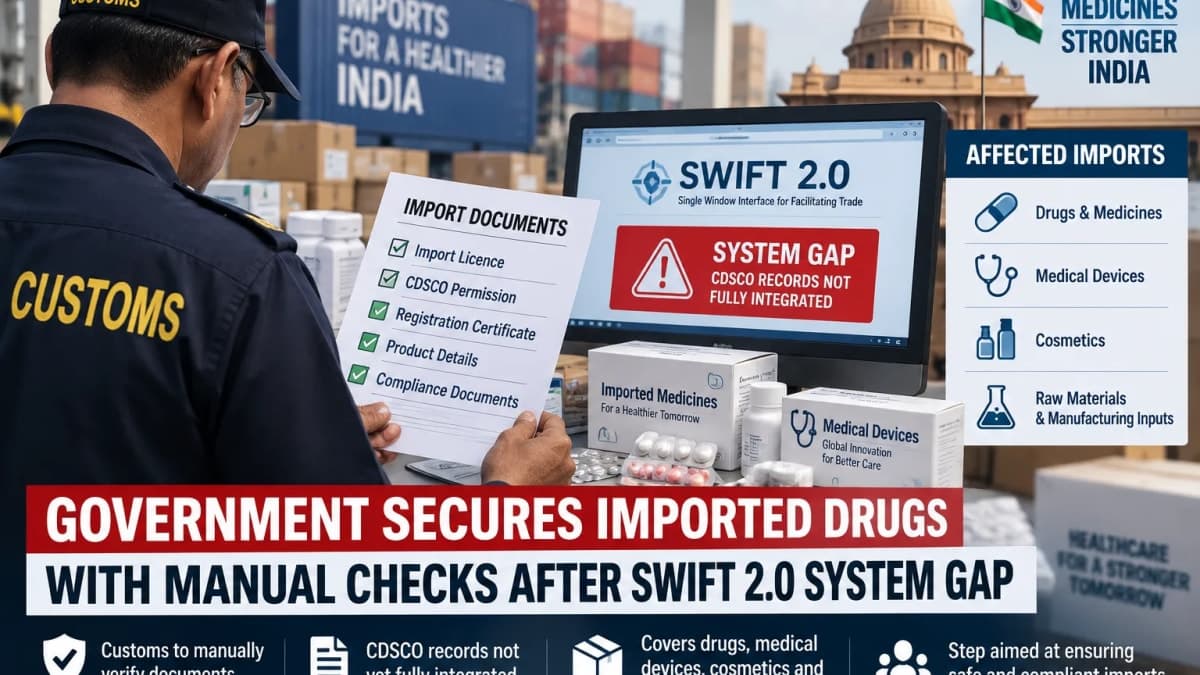
Customs officers must now manually verify licences, permissions and registration certificates before allowing affected consignments to leave customs custody.
The instruction covers drugs, medical devices and cosmetics as well as several categories of raw materials and manufacturing inputs. Importantly, the requirement also applies to consignments that would otherwise qualify for facilitated clearance through the customs risk-management system.
The Central Board of Indirect Taxes and Customs (CBIC) communicated the measure to importers and field formations on September 3.
The intervention is intended to prevent the incomplete integration of regulatory records into SWIFT 2.0 from creating a compliance gap at the border.
What Went Wrong With SWIFT 2.0?
SWIFT, or the Single Window Interface for Facilitating Trade, is designed to reduce the number of separate processes importers must navigate when their consignments require approvals from different government agencies.
Its upgraded version, SWIFT 2.0, is intended to push that process further by handling licences, permits, certificates and other regulatory authorisations through an integrated electronic framework.
The problem in this case concerns records from the Central Drugs Standard Control Organisation (CDSCO), India's national drug regulator. Its relevant regulatory documents have not yet been fully integrated into SWIFT 2.0.
That creates a practical problem at the final stage of customs clearance. A consignment moving efficiently through the electronic system still needs to satisfy the regulatory requirements applicable to the product being imported.
Until the digital integration is complete, customs officers are being asked to perform that verification themselves.
Even Facilitated Imports Will Face Verification
The scope of the instruction is significant because it is not restricted to consignments already selected for detailed examination.
Facilitated Bills of Entry are also covered.
Such consignments may otherwise move through customs with reduced intervention after assessment by the risk-management system. For the healthcare products covered by the latest instruction, that status will not remove the need to verify the relevant CDSCO documentation.
The check must take place before customs grants “out of charge,” the approval that permits an importer to take possession of goods from customs custody.
The arrangement effectively places a manual control around a part of the clearance process that SWIFT 2.0 is ultimately intended to handle electronically.
CDSCO Provides Seven Checklists
To make those checks more consistent, CDSCO has provided customs authorities with seven product-specific checklists.
They cover a broad range of regulated imports, including cosmetics, active pharmaceutical ingredients and finished medicines.
Medicines brought into India for personal use are also covered, along with certain small-quantity imports of new drugs.
Other categories include medical devices, in-vitro diagnostic kits, and raw materials and components used in medical-device manufacturing.
The checklists give customs officers a defined framework for determining which regulatory documents must be present before a shipment can receive final clearance.
Why the Safeguard Matters
The issue is not that India's regulatory requirements for these products have been suspended. The difficulty lies in ensuring that the electronic clearance platform can reliably reflect the licences and permissions issued by the drug regulator.
That distinction matters for products whose compliance requirements have direct implications for patients and consumers.
A faster customs process cannot substitute for a valid drug or device authorisation. The temporary manual check allows trade clearance to continue while retaining a verification step for the regulatory documents that are not yet completely visible through the digital system.
The measure could add an additional administrative step for some importers, including those accustomed to facilitated clearance. The available directive, however, does not establish how much extra processing time individual shipments may face, so any broader claim about delays would be premature.
SWIFT 2.0 Is Part of a Wider Customs Digitisation Push
The current workaround comes as the government continues a broader effort to reduce manual intervention in India's import-clearance system.
An ICEGATE advisory issued in January said a Unified Application Dashboard for CDSCO import no-objection certificates had been deployed across India for interdicted CDSCO Bills of Entry.
The dashboard was designed to allow trade users to submit additional mandatory information, track NOC status, respond to queries, receive inspection notifications and view or download NOC documents through a common interface.
A compliance repository has also been introduced under SWIFT 2.0, with government agencies being added in phases.
Government documents have described full-scale SWIFT 2.0 implementation as a priority under the National Trade Facilitation Action Plan for 2024-2027, with completion expected by the end of 2026.
That wider programme is aimed at moving trade approvals toward end-to-end digital processing and reducing the need for repeated interactions with individual agencies.
A Manual Safeguard During a Digital Transition
The latest direction exposes one of the practical challenges in moving a complex regulatory system onto a common digital platform.
Customs clearance involves more than assessing duties and inspecting cargo. Products such as medicines, diagnostics and medical devices can require approvals from specialist regulators, and the underlying records need to move reliably between those agencies and customs.
For now, CBIC's instruction provides a bridge: importers can continue using the wider electronic clearance framework, but customs officers must independently check the specified CDSCO documents before releasing covered goods.
Once the relevant regulatory records are fully integrated, SWIFT 2.0 is intended to make precisely that kind of manual intervention less necessary.