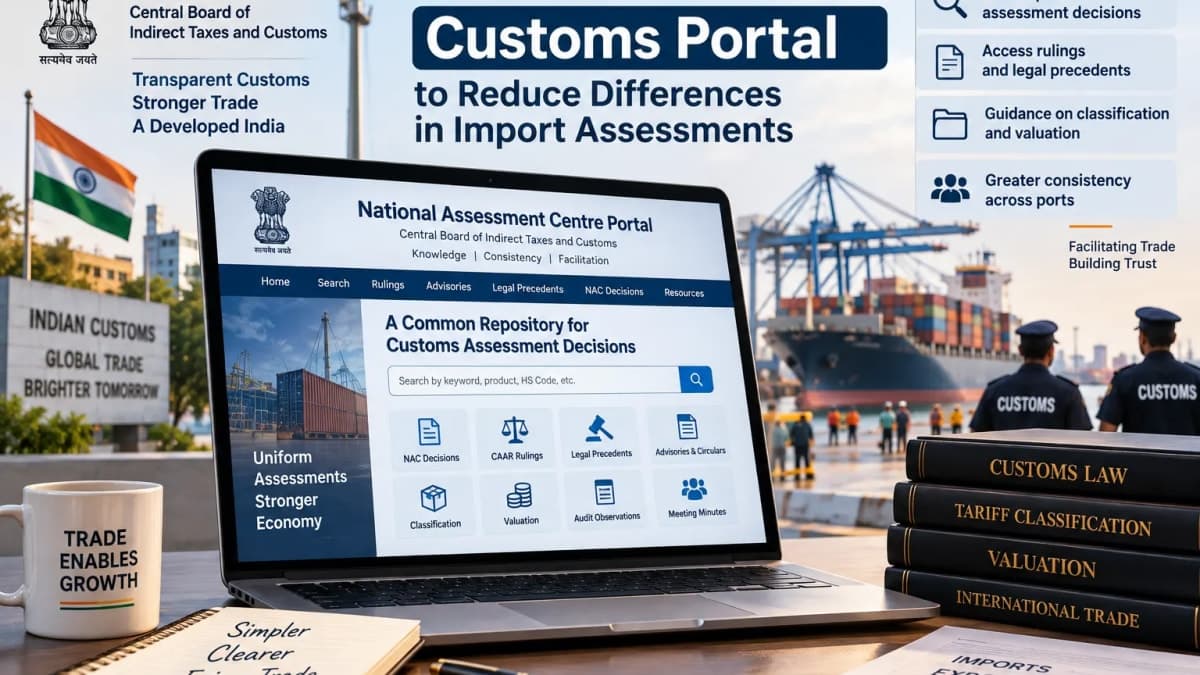
CBIC Launches National Assessment Centre Portal to Make Customs Assessments More Consistent
Introduction
Importers dealing with Indian customs will now have a central repository where they can examine how authorities have handled classification, valuation and other assessment issues in previous cases.
The Central Board of Indirect Taxes and Customs has launched the National Assessment Centre Portal, or NAC Portal, as part of its continuing effort to make customs decisions more consistent across the country. The platform brings together assessment-related material that businesses and officials previously had to locate through multiple sources.
Inaugurated on September 3, the portal builds on India's faceless customs assessment system. Its usefulness will ultimately depend on how comprehensively the database is maintained, but the premise is straightforward: officers and businesses dealing with similar questions should be able to work from the same body of information.
A Common Reference Point for Customs Decisions
Classification disputes can turn on technical distinctions between products. Valuation cases can be equally complicated, particularly where customs authorities need to determine the appropriate value on which duties should be charged.
Differences in interpretation can therefore have direct financial consequences.
The NAC Portal is intended to make previous decisions and guidance easier to find before an assessment reaches that stage. Its repository includes decisions taken by National Assessment Centres, legal precedents and rulings issued by the Customs Authority for Advance Rulings.
Users can also access advisories, audit observations and material covering classification, valuation and other assessment questions.
For customs officials, that provides a reference when dealing with comparable cases. For importers and customs brokers, it offers an opportunity to understand existing positions before filing declarations or responding to an assessment query.
Why Consistency Matters to Importers
Customs classification establishes the tariff heading under which an imported product is assessed. That classification can determine the rate of duty and other regulatory requirements that apply.
Valuation determines the assessable value used for calculating applicable customs duties.
Neither exercise is always straightforward. Modern products can combine technologies or materials that do not fit neatly into a single category, while complex commercial transactions can raise separate valuation questions.
When different customs formations reach different conclusions on comparable goods, businesses face uncertainty over costs and compliance.
The new portal cannot remove the need for judgment in individual cases. The facts of one import may differ materially from another. What it can do is give officers and traders easier access to previous decisions that may be relevant to the issue before them.
Portal Extends India's Faceless Assessment System
The initiative sits within a broader overhaul of the way India handles customs assessments.
CBIC introduced Faceless Assessment across the customs system in 2020. Under that model, assessment work does not necessarily remain with officers located at the port where the goods arrive.
National Assessment Centres were developed around groups of commodities, allowing officials to build specialised knowledge while working toward more uniform treatment of imports across locations.
That system changed where assessments could be conducted. The NAC Portal addresses another problem: how the knowledge generated through those assessments is shared.
Mumbai Customs, Zone-I, at the New Customs House has been entrusted with developing, managing and maintaining the portal for National Assessment Centres across the country.
Importers and Brokers Get Searchable Access
The scope of the platform goes beyond individual assessment orders.
Its database includes rulings from the Customs Authority for Advance Rulings, legal decisions, audit observations, alerts, advisories, circulars, public notices and minutes of National Assessment Centre meetings.
Material concerning issues handled by NACs, including matters that may require policy intervention, can also be included.
Users can search the repository by keyword and download relevant documents.
For businesses, that search function may be one of the portal's most practical features. A customs broker dealing with an unfamiliar product, for example, can look for earlier decisions or guidance concerning comparable goods rather than starting with no central reference.
National Assessment Centres have been tasked with keeping the repository updated, particularly when stakeholders raise commodity-specific questions that require guidance or greater consistency.
Specialist Groups Cover Different Types of Imports
The National Assessment structure divides imported goods among broad commodity groups rather than treating every product through a single general assessment unit.
Those categories cover areas including primary products, mineral products, chemicals, textiles, metals, mechanical machinery, electrical machinery, automobiles and instruments, along with other miscellaneous goods.
The groups correspond to chapters of India's customs tariff.
Specialisation matters because the questions surrounding a chemical import can be very different from those involving electronics, machinery or textiles. Officers working repeatedly with related tariff chapters can develop deeper expertise in the products they assess.
The portal is designed to make the resulting institutional knowledge available more widely instead of leaving it within an individual assessment group or customs formation.
A Useful Tool, but Not a Substitute for Case-by-Case Assessment
For businesses, a central database can improve preparation but should not be confused with a guarantee that an earlier decision will automatically determine the outcome of another import.
Classification and valuation depend on the facts, documentation and characteristics of each transaction. Legal precedents and advance rulings can carry different weight depending on the circumstances.
The more immediate benefit is predictability.
An importer preparing a declaration can search for relevant material before filing. A customs officer examining the same commodity can consult the repository while considering the assessment. Where an established position already exists, both sides have a better chance of identifying it early.
That could reduce avoidable differences between customs locations while also making genuine disagreements easier to define.
Another Step in Customs Digitisation
India has spent years moving customs processes away from paper-heavy and location-dependent systems.
The Indian Customs EDI System supports electronic processing of import and export documentation, while ICEGATE serves as a major digital interface between customs and traders. Faceless Assessment subsequently separated much assessment work from the physical port of arrival.
The NAC Portal tackles a less visible but important part of that digital transition: access to the accumulated knowledge behind assessment decisions.
Electronic filing can make customs processing faster, but speed alone does not give an importer certainty about how a product will be classified or valued.
A searchable repository of decisions, rulings and guidance is intended to improve that second part of the equation. Its impact will depend on the quality and frequency of updates, as well as how consistently officials and businesses use the information it contains.
For companies moving goods through multiple Indian ports, however, the objective is significant: comparable imports should not produce materially different interpretations simply because they enter the country through different customs formations.