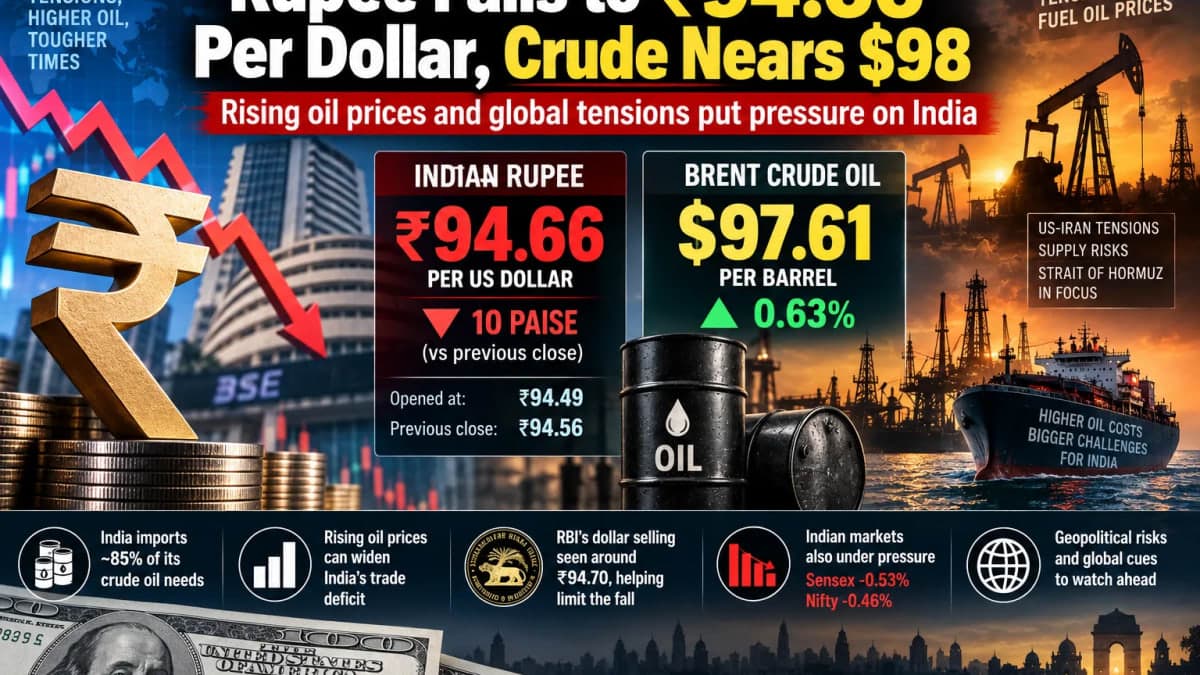
Rupee Weakens to ₹94.66 as Crude Oil Nears $98; Rising Energy Costs Put India Under Pressure
The Indian rupee came under renewed pressure on Tuesday as rising crude oil prices complicated the outlook for one of the world's largest energy importers.
The domestic currency weakened to ₹94.66 against the US dollar in early trade, while global benchmark Brent crude moved closer to the psychologically important $100-a-barrel mark.
At the interbank foreign exchange market, the rupee opened at ₹94.49 before slipping to ₹94.66. That represented a decline of 10 paise from its previous close of ₹94.56.
Brent crude futures, meanwhile, rose about 0.63% to $97.61 per barrel.
For India, the combination matters more than either number in isolation. The country imports most of the oil it consumes, and international crude purchases are largely settled in dollars. When oil rises while the rupee weakens, the cost of those imports can increase from both directions.
Rupee Opens at ₹94.49 Before Slipping to ₹94.66
The currency did not begin Tuesday's session sharply lower.
It opened at ₹94.49 against the dollar but lost ground as trading progressed, touching ₹94.66 in early deals.
The rupee had already weakened by 13 paise in the previous session to close at ₹94.56.
Notably, the pressure on the Indian currency came even as the broader US dollar was softer against major global currencies. The Dollar Index, which measures the greenback against a basket of six currencies, was down about 0.37% at around 98.80.
That divergence suggests domestic and India-specific external pressures, particularly crude oil and geopolitical risk, were playing an important role in the rupee's movement.
Why Is Crude Oil Approaching $98?
The latest rise in oil prices is closely tied to escalating geopolitical uncertainty in the Middle East.
Brent crude was trading around $97.61 a barrel as concerns grew over US-Iran tensions and the potential threat to energy infrastructure and shipping routes in the Gulf.
A key focus for traders is the Strait of Hormuz, one of the world's most important energy transit corridors.
Any serious disruption to shipping through the region could affect global oil supplies. Markets can react even before an actual supply shortage occurs because traders price in the risk of future disruption.
Warnings of retaliation from Iran in the event of further US attacks have added to those concerns.
For now, the oil market is therefore responding not only to physical supply conditions but also to the possibility that the conflict could interfere with future exports.
Why Expensive Oil Creates a Bigger Problem for India
India imports roughly 85% of its crude oil requirements, making the economy particularly sensitive to sustained increases in international energy prices.
A rise in crude can increase the country's oil import bill.
The impact becomes more significant when the rupee weakens at the same time.
Oil transactions in global markets are predominantly denominated in US dollars. If an Indian importer needs more rupees to purchase each dollar, the rupee cost of the same barrel of oil rises even if its international dollar price remains unchanged.
When both the dollar and crude become more expensive simultaneously, that pressure can intensify.
RBI Intervention Appears to Limit the Rupee's Fall
The rupee might have weakened further without support in the foreign exchange market.
Reuters reported, citing two bankers and a forex trader, that state-run banks were seen selling dollars around the ₹94.70-per-dollar level, with market participants attributing the activity to the Reserve Bank of India.
The RBI did not officially confirm that specific intervention.
The reported activity was viewed by traders as part of a broader intervention effort seen over at least the previous two weeks.
India's central bank does not publicly commit to defending a specific exchange rate. It can, however, intervene in the foreign exchange market to curb excessive volatility.
Selling dollars increases their availability in the market and can help reduce immediate downward pressure on the rupee.
Analyst Sees ₹94.00-₹94.75 Range
Anil Kumar Bhansali, Head of Treasury and Executive Director at Finrex Treasury Advisors LLP, projected a trading range of ₹94.00 to ₹94.75 for the rupee.
He said:
“The RBI's intervention has been particularly important in preventing higher oil prices from translating into a weaker rupee.”
According to Bhansali, dollar selling by the central bank and foreign-currency inflows were helping keep the rupee within a relatively narrow range despite elevated crude prices.
That range is an analyst assessment, not a guaranteed forecast. Currency markets can move rapidly in response to oil prices, capital flows, geopolitical developments and monetary-policy expectations.
Indian Stock Market Also Feels the Pressure
The impact of expensive crude and geopolitical uncertainty was not limited to the currency market.
Indian equities also traded lower.
The Nifty 50 was down about 0.46% at 23,668.85, while the BSE Sensex declined roughly 0.53% to 75,727.30, according to Reuters.
Major stocks including HDFC Bank, ICICI Bank and Reliance Industries were among those under pressure.
Persistently high crude prices can create challenges for Indian equities because they can raise input costs for companies, complicate the inflation outlook and affect expectations for economic growth.
Could Higher Crude Push Up Inflation?
If oil remains expensive for an extended period, its impact can spread well beyond petrol and diesel.
Higher transportation and logistics expenses can increase the cost of moving goods. Aviation fuel, petrochemicals, plastics, paints and several industrial inputs are also sensitive to energy prices.
However, a rise in Brent crude does not mean domestic petrol and diesel prices will automatically increase by the same proportion or immediately.
Retail fuel prices are influenced by several additional factors, including taxation, refining margins, oil marketing company pricing decisions and government policy.
The broader inflation impact therefore depends partly on how long international oil prices remain elevated and how much of that increase is ultimately passed through to businesses and consumers.
India's Trade Deficit Could Face Additional Pressure
Higher crude prices can also affect India's merchandise trade balance.
If the country has to spend more dollars to import the same quantity of oil, its overall import bill rises, assuming other factors remain unchanged.
That can widen the trade deficit.
There is also a potential feedback loop.
A larger oil import bill can increase demand for dollars. Greater dollar demand may put additional pressure on the rupee, while a weaker rupee makes imports even more expensive in local-currency terms.
The actual outcome, however, will also depend on exports, foreign investment flows, other imports and the extent of RBI intervention.
Foreign Investors Have Not Turned Entirely Negative
Despite pressure on the rupee and equities, foreign investor activity was not uniformly negative.
Exchange data showed that foreign institutional investors were net buyers of Indian equities worth ₹280.13 crore on Monday.
That makes it difficult to attribute the currency's weakness simply to foreign investors pulling money out of India.
For now, rising crude prices and geopolitical uncertainty in the Middle East remain more visible external risks.
Three Factors Could Determine the Rupee's Next Move
The rupee's near-term direction is likely to depend heavily on crude oil, RBI intervention and global monetary-policy expectations.
Crude will be the first major variable. A sustained move above $100 a barrel, particularly if driven by an actual supply disruption, could increase pressure on India's import bill and currency.
The second factor is the RBI. Continued dollar selling could help contain sharp movements in the exchange rate, although intervention cannot eliminate broader economic pressures indefinitely.
Markets are also watching inflation data in India and the United States, along with the US Federal Reserve's September 16 meeting, for clues about interest rates and global capital flows.
For India, the immediate concern is therefore not simply that the rupee touched ₹94.66 or that Brent crude approached $98.
It is the combination of a weaker currency and more expensive oil that creates the larger economic challenge.