GIFT City Funds See Retail Rush as Indian Investors Look Abroad for Growth
Introduction
Indian retail investors are increasingly looking beyond the domestic stock market, and GIFT City's International Financial Services Centre is emerging as an important gateway for that shift.
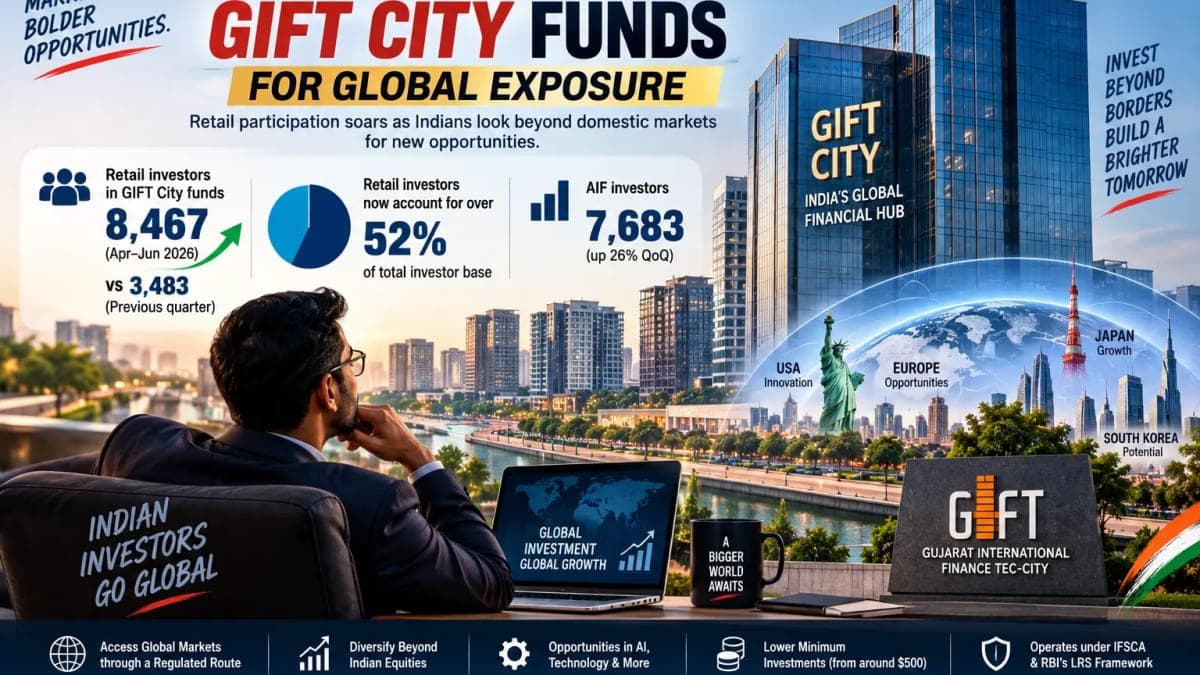
The number of investors in retail schemes at GIFT IFSC climbed to 8,467 in the April-June 2026 quarter, from 3,483 in the preceding quarter, according to data from the International Financial Services Centres Authority (IFSCA).
The increase has changed the composition of GIFT City's fund-management ecosystem. Retail investors accounted for more than 52% of the total investor base, putting them ahead of other investor categories for the first time.
The shift comes as several overseas equity markets have substantially outperformed Indian benchmarks and conventional international mutual fund routes in India have faced investment-cap constraints.
Retail Investor Numbers More Than Double in One Quarter
The jump from 3,483 to 8,467 investors represents an increase of roughly 143% quarter-on-quarter.
More important than the percentage increase is the change in who is using GIFT City's investment infrastructure.
The IFSC was initially associated more closely with institutions, alternative investment funds, wealthy individuals and offshore capital. The latest numbers indicate that retail participation is becoming a much larger part of the ecosystem.
Alternative investment funds, or AIFs, had 7,683 investors in the latest quarter. Their investor count increased 26% from the previous quarter, but their share of the overall fund-management investor base declined from nearly 64%.
Retail investors, meanwhile, moved into the leading position with a share exceeding 52%.
Why Indian Investors Are Looking Overseas
Market performance is one important factor behind the change.
Indian benchmark indices Sensex and Nifty 50 have fallen roughly 8-10% so far in 2026, while markets including the United States, South Korea, Taiwan and Japan have recorded gains ranging from around 10% to 59%.
That performance gap has made international diversification increasingly attractive to investors accustomed to concentrating their portfolios in Indian assets.
Vaibhav Shah, head of products, business strategy and international business at Mirae Asset Mutual Fund, linked the increase in retail participation to the performance of international markets and growing awareness of diversification.
“Global markets have done exceedingly well compared to Indian markets, and Indian investors have understood the importance of global diversification,” Shah said.
That does not mean recent international-market performance will continue. Investors moving overseas after a strong rally can also expose themselves to elevated valuations, currency movements and corrections in sectors that have already recorded substantial gains.
Domestic Mutual Fund Limits Add to GIFT City's Appeal
Market returns are only part of the explanation.
Indian mutual funds face industry-wide restrictions on how much they can invest overseas. The overall limit for the mutual fund industry is $7 billion, while an individual asset management company is subject to a $1 billion ceiling.
Those limits have restricted the ability of some conventional international mutual fund schemes to accept fresh money.
Between July and early August, fund houses operating overseas fund-of-funds schemes stopped accepting fresh investments after the industry approached its overseas investment limit.
That left investors seeking fresh international exposure looking for other routes.
GIFT IFSC funds have consequently gained relevance because they provide another regulated channel through which resident Indians can access international assets.
How Investing Through GIFT City Differs
For a resident Indian, investing through a GIFT City fund is not the same as purchasing units of an ordinary domestic mutual fund.
International Financial Services Centre funds are regulated by the International Financial Services Centres Authority (IFSCA).
Resident Indians investing through eligible GIFT City structures are also subject to the Reserve Bank of India's Liberalised Remittance Scheme (LRS), under which a resident individual can remit up to $250,000 per financial year for permitted transactions.
This annual LRS allowance covers more than investments alone, so investors need to consider any other eligible overseas remittances they make during the same financial year.
The practical advantage is that an investor can obtain professionally managed exposure to overseas assets through a fund operating from India's international financial centre rather than independently selecting and managing individual foreign securities.
Lower Minimums Are Opening the Door to Retail Investors
Product design is also becoming more retail-friendly.
Some GIFT City funds now allow minimum subscriptions of around $500, compared with minimum investments of about $5,000 for certain other products.
That reduction matters because high minimum subscription requirements historically made several international investment structures more suitable for wealthy or sophisticated investors than for ordinary retail participants.
Asset managers are responding to the change in demand.
Fund houses including PPFAS, DSP, Tata Mutual Fund and Edelweiss have launched GIFT IFSC products aimed at Indian retail investors in 2026, while other managers are seeking approval to introduce additional offerings.
AI, Semiconductors and Global Technology Draw Interest
The appeal of GIFT City funds is also linked to what investors can access through them.
Depending on the individual scheme, investors can gain exposure to markets and themes that have relatively limited representation in Indian equity indices.
These include global technology, artificial intelligence, semiconductor companies and data-centre-related businesses.
Different funds take different approaches. Some provide exposure to high-growth Asian markets, while others concentrate on US technology or broader international equities.
For an Indian investor, that can diversify not only geography but also sector exposure.
It can, however, create a different set of risks. A portfolio heavily concentrated in technology or artificial-intelligence-linked companies remains vulnerable to valuation corrections even when it is geographically diversified.
Global Diversification Should Not Become Performance Chasing
The rapid increase in participation comes with an important caveat.
Shweta Rajani, head of mutual funds at Anand Rathi Wealth, attributed the momentum partly to easier access to global investments from India and greater clarity around taxation for retail schemes and ETFs.
She also cautioned against treating GIFT City as a vehicle simply for pursuing whichever international market has recently delivered the strongest returns.
“Investors can view GIFT IFSC as one of the ways to gain international exposure,” Rajani said. “However, they should remember that allocation decisions should be based on long-term strategy, rather than recent performance.”
That distinction is important.
International diversification can reduce a portfolio's dependence on one country or economy, but it does not eliminate investment risk. Overseas funds can expose investors to equity-market volatility, currency fluctuations, geographic risk, changing tax rules and the specific risks associated with the sectors in which a fund invests.
GIFT City's Role in India's Global Investment Architecture Is Expanding
The surge in retail fund participation comes as GIFT IFSC expands across several areas of international finance.
GIFT City was established to bring financial activity that might otherwise take place in offshore centres into an Indian international financial jurisdiction.
Its ecosystem now spans fund management, banking, capital markets, insurance and other international financial services.
The rapid increase in retail participation therefore represents more than a temporary change in investor numbers. It suggests GIFT City is beginning to develop a consumer-facing role alongside its institutional and offshore functions.
For Indian households, that creates another route to international diversification at a time when conventional domestic mutual-fund channels for overseas investing remain constrained.
Whether the current pace of growth continues will depend partly on product availability, investment minimums, ease of remittance and onboarding, regulation and, crucially, how global markets perform after their recent gains.
What is already clear from the latest numbers is that GIFT City's international investment market is no longer dominated solely by institutions and wealthy investors. Retail investors have become a central part of its growth story.