Mrunal Thakur Takes Stand Against AI-Generated Deepfakes
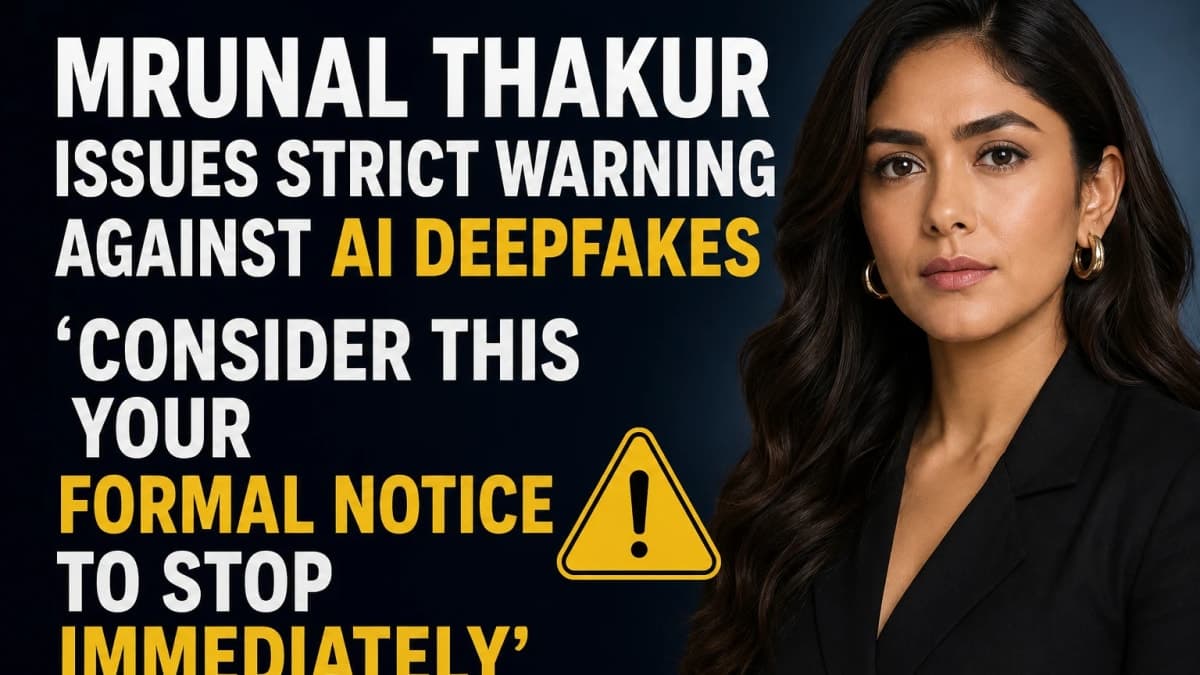
Actor Mrunal Thakur has spoken out against the unauthorized use of her identity in artificial intelligence-generated and deepfake content, delivering a clear warning to those responsible for creating or circulating such material.
Thakur addressed the issue on social media on Tuesday, warning users against making or sharing manipulated material featuring her likeness. She indicated that continued misuse could invite legal consequences.
Her message effectively serves as a public boundary against the unauthorized digital manipulation of her face, image or identity at a time when increasingly sophisticated generative-AI tools have made realistic fabricated content easier to produce and distribute.
‘Formal Notice’ Signals Tougher Approach
Thakur's warning stands out because it goes beyond simply asking social media users to stop sharing misleading material. By raising the prospect of legal action, the actor has signalled that she is prepared to treat unauthorized AI impersonation as a serious misuse of her identity.
For celebrities, deepfakes present a particularly difficult challenge. Their photographs, interviews and videos are widely available online, providing large amounts of source material that can potentially be manipulated using AI tools.
Once fabricated material reaches social platforms, distinguishing genuine footage from sophisticated manipulation can also become difficult for ordinary users.
Why AI Deepfakes Are Becoming a Serious Concern
Deepfake technology can manipulate or synthesize someone's face, voice or movements to create content depicting events that never actually occurred. Although synthetic-media technology has legitimate creative applications, its misuse can create serious privacy, reputational and misinformation risks.
The problem is particularly significant when a person's likeness is used without consent to produce misleading, defamatory, sexualised or otherwise harmful material.
Research has also demonstrated the difficulty people can face in identifying sophisticated synthetic media. For example, research into AI-generated speech has found that human listeners cannot always reliably distinguish artificial voices from genuine recordings.
Thakur's warning therefore highlights a broader issue extending well beyond the entertainment industry: as AI-generated media becomes increasingly convincing, establishing authenticity online is becoming more challenging.
India Has Strengthened Rules Around Synthetic Content
The controversy also comes amid greater regulatory attention to deepfakes in India.
In February 2026, the government strengthened the Information Technology Rules to specifically address harms arising from synthetically generated information, including deepfakes and AI-generated material.
According to the Ministry of Electronics and Information Technology, the framework requires intermediaries to take reasonable technical measures against unlawful synthetic content, including material impersonating individuals. It also introduces requirements concerning identification, labelling and traceable metadata for permissible AI-generated content.
These measures reflect a wider attempt to balance innovation in generative AI with safeguards against impersonation and other forms of misuse.
Why Mrunal Thakur's Warning Matters
Celebrity deepfakes can initially appear to be an entertainment-industry problem, but the underlying technology affects everyone.
The same techniques capable of placing an actor's face into fabricated footage can potentially be used for financial fraud, harassment, misinformation or impersonation of ordinary individuals.
Public figures speaking openly about unauthorized AI content may consequently help increase awareness about consent and digital identity. Their responses may also put greater pressure on technology companies and social platforms to develop stronger detection and removal mechanisms.
A Difficult Balance Between AI Creativity and Consent
Generative AI is increasingly being used legitimately in filmmaking, advertising, visual effects and digital content creation. The technology itself therefore is not necessarily the problem.
The central issue is consent.
AI-generated content that is clearly labelled, authorized and used creatively operates very differently from fabricated material designed to make viewers believe that a real person participated in something they never said or did.
That distinction will become increasingly important as synthetic media improves.
Thakur's warning reflects the growing expectation that an individual's face, voice and identity should not become freely available raw material simply because generative-AI technology makes manipulation technically possible.
What Happens Next?
Thakur's statement puts creators and distributors of unauthorized deepfake material involving her on notice. Whether individual cases eventually lead to legal proceedings will depend on the nature of the content, how it was produced and circulated, and the applicable laws.
More broadly, the episode illustrates how celebrities, governments, technology companies and social-media platforms are being forced to confront questions of identity and consent that were far less urgent before the rapid development of generative AI.
As synthetic content becomes harder to distinguish from authentic media, clear labelling, stronger platform safeguards, responsible AI development and public awareness are likely to become increasingly important.