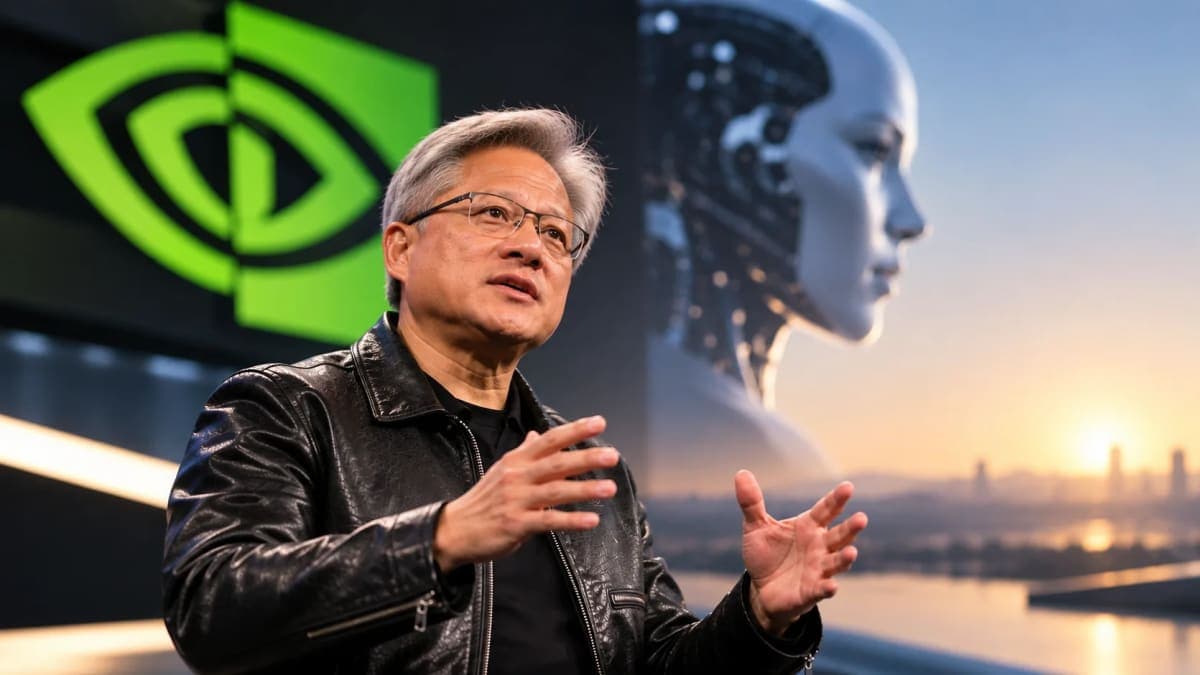
Jensen Huang pushes back on AI doomsday warnings
Nvidia co-founder and CEO Jensen Huang has strongly rejected predictions that rapidly advancing artificial intelligence could lead to human extinction within the next few years, putting himself on one side of an increasingly public debate over the risks of frontier AI.
Speaking to CBS News senior business and technology correspondent Jo Ling Kent in an interview published in September, Huang said: “2030 is not going to be the end of the world. There is 0% chance that's going to be the end of the world.”
He also criticised attempts to frighten the public with near-term extinction scenarios, saying: “Scaring people is unnecessary. It is irresponsible.” Huang argued that such predictions are “not grounded in science.” CBS News
His position is significant because Nvidia is a central supplier of the computing infrastructure used to develop and run modern AI systems. That commercial role also gives the company a direct stake in how quickly AI investment and deployment continue—a point that should be considered when evaluating Huang’s arguments.
What triggered the latest AI-extinction debate?
Huang’s remarks followed comments from Jacob Coxon, a former researcher at Anthropic, who wrote on social media earlier in September that people developing advanced AI believed the technology could potentially kill humanity by the end of the decade.
The comments intensified an already-running disagreement over whether rapidly improving AI capabilities could eventually outpace society’s ability to control them.
Some prominent AI researchers and executives have argued for stronger safeguards or a slower pace of development as systems become more capable. Huang rejects the near-term extinction forecast itself, rather than arguing that AI requires no safety work. CBS News
That distinction is important: whether AI can create serious risks and whether it will cause human extinction by a specific date are separate questions. Huang’s “0% chance” statement represents his assessment; it is not a scientifically established probability.
Huang says AI safety remains essential
Despite dismissing extinction predictions, Huang has not argued that companies should release AI systems without safeguards.
At Salesforce’s Dreamforce conference this month, Huang described safety as “job one” and characterised it as an engineering problem. His position was that developers should move quickly when systems are safe, but hold products back if they are not confident in their functionality or safety. NVIDIA Blog
That creates a more nuanced position than simply describing Huang as dismissive of AI risks.
He supports continued rapid AI development while arguing that safety should be built into the engineering and deployment process.
Why Nvidia has a major stake in this debate
Nvidia sits near the centre of the global AI boom because its accelerated-computing hardware is widely used to train and operate large AI models.
CBS News noted that booming demand for Nvidia’s specialised chips had helped lift the company's market value to around $5.3 trillion at the time of its report. CBS News
Asked why the public should trust his position given Nvidia’s commercial interests, Huang argued that safety is also economically important to the company.
“Our company's success is directly connected to the safe deployment of products and services,” he told CBS News, adding that Nvidia’s value would suffer if the industry failed to maintain safe deployment. CBS News
That does not resolve the wider AI-risk debate, but it clarifies Huang’s argument: he believes commercial incentives, engineering practices and existing legal responsibilities can encourage companies to build safer systems without requiring a broad slowdown in AI development.
Does AI need an entirely new regulatory framework?
Huang has also questioned whether governments need to create sweeping new laws specifically in response to predictions of AI catastrophe.
In the CBS interview, he pointed to existing laws governing areas such as cybersecurity and liability and argued that authorities should apply those rules rather than allowing speculative extinction scenarios to dominate the regulatory discussion. CBS News
This remains a contested policy question.
Supporters of additional AI-specific oversight argue that increasingly autonomous and general-purpose systems can create risks that existing rules were not designed to address. Huang’s position, by contrast, places greater emphasis on enforcing current legal obligations and making developers responsible for the consequences of the systems they deploy.
‘Enough predictions’: Huang challenges probability estimates
Huang has continued challenging numerical predictions about catastrophic AI risk.
Axios reported on September 23 that, during an episode of The Ezra Klein Show, Huang responded to AI pioneer Geoffrey Hinton’s estimate of a 10%-20% chance of AI causing societal collapse.
Huang argued that such a percentage was not grounded in scientific research, telling the programme: “Enough predictions.” Axios
The disagreement illustrates a fundamental difficulty in the AI-safety debate: there is no established empirical method capable of assigning a universally accepted probability to hypothetical human-extinction scenarios involving future AI systems.
Consequently, percentage estimates made by participants on different sides of the debate should be understood as their assessments rather than observed probabilities.
AI safety debate is broader than extinction
Focusing exclusively on whether AI could destroy humanity can obscure more immediate concerns surrounding the technology.
AI developers, governments and researchers are also dealing with questions involving cybersecurity, misinformation, fraud, privacy, employment disruption, autonomous systems, model reliability and the possibility that increasingly capable AI agents could behave in unintended ways.
Huang’s rejection of extinction predictions therefore does not settle these separate questions.
His position is that developers should continue moving rapidly while treating product safety as an engineering requirement. Nvidia’s own account of his Dreamforce remarks summarised that philosophy as pursuing innovation, speed and safety simultaneously rather than treating them as mutually exclusive goals. NVIDIA Blog
Why Huang’s comments matter
The dispute carries unusual weight because Nvidia supplies much of the computing infrastructure powering the current generation of AI development.
Faster progress in advanced AI can drive demand for GPUs, networking equipment and data-centre systems—the areas in which Nvidia has built a dominant business.
At the same time, researchers and executives warning about extreme AI risks are themselves participants in the industry and bring their own assumptions and institutional interests to the debate.
For readers, the important distinction is therefore between verified developments, such as improvements in AI capabilities or documented safety incidents, and forecasts about future outcomes, particularly predictions extending years into the future.
The bigger picture
Huang’s latest comments sharpen a divide within the technology industry rather than ending the argument over AI safety.
On one side are researchers and industry figures who believe increasingly powerful systems justify stronger precautions and, in some cases, slower development. On the other is Huang’s view that near-term extinction forecasts lack a sufficient scientific basis and that AI can continue advancing quickly while safety is handled through engineering discipline and existing legal accountability. CBS News
What is confirmed is that AI systems are becoming more capable and attracting enormous investment. What remains uncertain—and heavily disputed—is how those capabilities will develop over the coming years and what level of risk they will ultimately create.
For that reason, Huang’s declaration of a “0% chance” of a 2030 AI apocalypse is best understood as his stated assessment in an ongoing debate, not an established scientific finding.
Source
Primary source: CBS News interview with Nvidia co-founder and CEO Jensen Huang
Additional sources: Nvidia, Bloomberg, Reuters, Axios


