OpenAI and Anthropic Highlight Advanced AI Math Performance
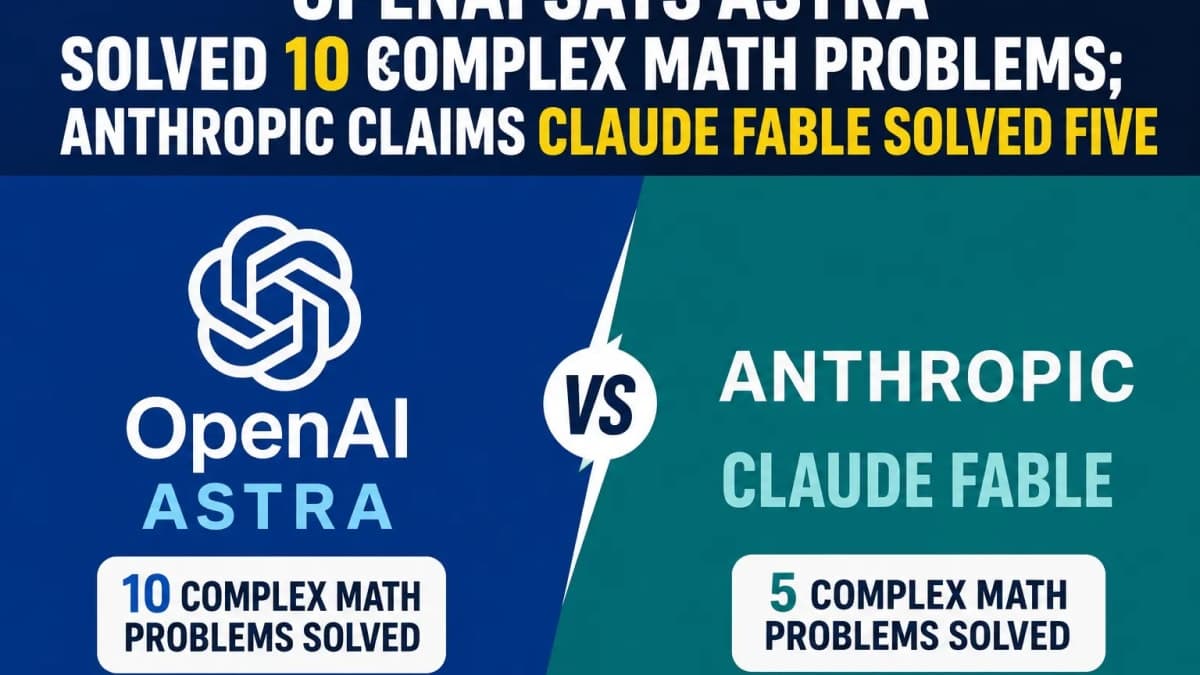
Competition in advanced artificial intelligence has moved further into complex mathematical reasoning, with OpenAI claiming that its next-generation Astra model solved 10 difficult mathematics problems while Anthropic says Claude Fable successfully solved five.
The results, as presented by the companies, put renewed attention on the reasoning capabilities of increasingly sophisticated AI models.
However, the numbers alone should not automatically be interpreted as a direct 10-versus-five performance comparison. Without information about the problems, evaluation methodology, testing conditions or scoring criteria, it cannot be established from the supplied facts whether both models were evaluated on precisely the same basis.
OpenAI Claims Astra Solved 10 Problems
According to the claim, OpenAI's next-generation Astra model managed to solve 10 complex mathematics problems.
If validated under rigorous testing conditions, strong performance on difficult mathematical tasks could indicate progress in an area considered important for the development of more capable AI systems.
Mathematics requires more than producing fluent language. Complex problems can demand multiple stages of reasoning, consistency across calculations and the ability to identify an appropriate approach before reaching a final answer.
This makes mathematical problem-solving one of several ways researchers can examine the reasoning abilities and limitations of advanced models.
Anthropic Says Claude Fable Solved Five
Anthropic, meanwhile, says its Claude Fable model successfully solved five complex mathematics problems.
As with OpenAI's claim, the significance of the result depends heavily on the evaluation framework.
The difficulty of individual problems can vary considerably. A simple count of successfully solved questions therefore provides limited information unless the underlying problems and testing conditions are also understood.
This is particularly important when comparing models developed by different companies.
Why Complex Mathematics Matters for AI
The ability to solve difficult mathematical problems has become an increasingly visible measure of progress in artificial intelligence.
Advanced mathematics can require models to maintain logical consistency across long chains of reasoning. Errors introduced during an early stage can affect every subsequent step, making these problems useful for exposing weaknesses that may not be apparent during ordinary conversational tasks.
Improved mathematical reasoning could eventually have implications beyond mathematics itself.
AI systems capable of reliably handling complicated reasoning may become more useful in scientific research, engineering, software development, data analysis and other technical fields.
However, success on selected mathematics problems does not necessarily mean a model can reason reliably across every domain.
AI Competition Is Moving Toward Reasoning
The generative AI industry initially attracted widespread consumer attention through systems capable of producing natural-sounding text, answering questions, writing software and generating creative content.
The competitive focus has increasingly expanded toward reasoning.
Developers are working on models designed to spend more computational effort analysing complicated tasks, checking intermediate steps and arriving at more reliable solutions.
OpenAI and Anthropic are among the companies competing in this broader push toward increasingly capable AI systems.
The reported Astra and Claude Fable results illustrate how mathematical performance is becoming part of the industry's efforts to demonstrate progress.
Why Raw Scores Need Context
A headline comparison of 10 solved problems against five can appear straightforward, but AI benchmarking is rarely that simple.
The number of questions in a test, their relative difficulty, the amount of computing available to each model, prompting methods, time limits and rules governing external tools can all influence performance.
There is also an important distinction between company-reported results and independently reproduced evaluations.
For this reason, the claims provide an indication of what OpenAI and Anthropic say their respective systems can achieve, but additional information would be necessary to make a rigorous head-to-head assessment.
Beyond Benchmark Performance
Benchmark results can help researchers track improvements, but the practical usefulness of an AI model depends on more than its ability to solve a limited collection of difficult problems.
Reliability, cost, speed, factual accuracy, safety and consistency are also important.
A highly capable system that reaches correct answers only under specific testing conditions may perform differently when confronted with unpredictable real-world tasks.
For businesses and researchers evaluating advanced AI, repeatability and reliability may ultimately matter as much as headline benchmark scores.
Balanced Analysis: Does 10 vs Five Mean Astra Is Better?
Based solely on the supplied numbers, it would be premature to conclude that Astra is twice as capable as Claude Fable.
That interpretation would require evidence that both models attempted the same questions under comparable conditions and that every problem carried similar difficulty and scoring weight.
Without such information, the results are best understood as separate performance claims made by the respective companies.
Nevertheless, both claims point toward the same broader trend: leading AI developers are placing increasing emphasis on models capable of performing complex reasoning rather than simply generating convincing language.
The Bigger AI Race
The competition between advanced AI developers is increasingly becoming a contest over reasoning capability.
Companies that can build models capable of solving difficult mathematical, scientific and technical problems could unlock new applications far beyond consumer chatbots.
The reported results for Astra and Claude Fable therefore matter not merely because of the numbers attached to them, but because they represent the direction in which frontier AI development appears to be moving.
Whether those advances translate into consistently reliable real-world reasoning will remain a much more important test than any single set of mathematics problems.