Supreme Court Ends Decades-Old Peerless Ownership Fight, Leaving NCLAT Ruling Intact
A corporate battle that began over share transactions in the late 1980s has run out of legal road.
The Supreme Court has dismissed an appeal by Bhagwati Developers Private Limited (BDPL) in its long-running dispute with Peerless General Finance and Investment Company Limited (PGFI), declining to interfere with an appellate tribunal judgment that went in Peerless’s favour earlier this year.
The order leaves the Roy family’s control of the Kolkata-based Peerless group undisturbed and closes litigation that began in 1991.
For the company, the significance lies in finality. The underlying transactions took place almost four decades ago, but challenges to them survived through successive changes in company law, judicial forums and the wider financial sector.
How a Share Transaction Became a Decades-Long Dispute
The case traces its origins to 1987-88, when Peerless was seeking to strengthen its capital base.
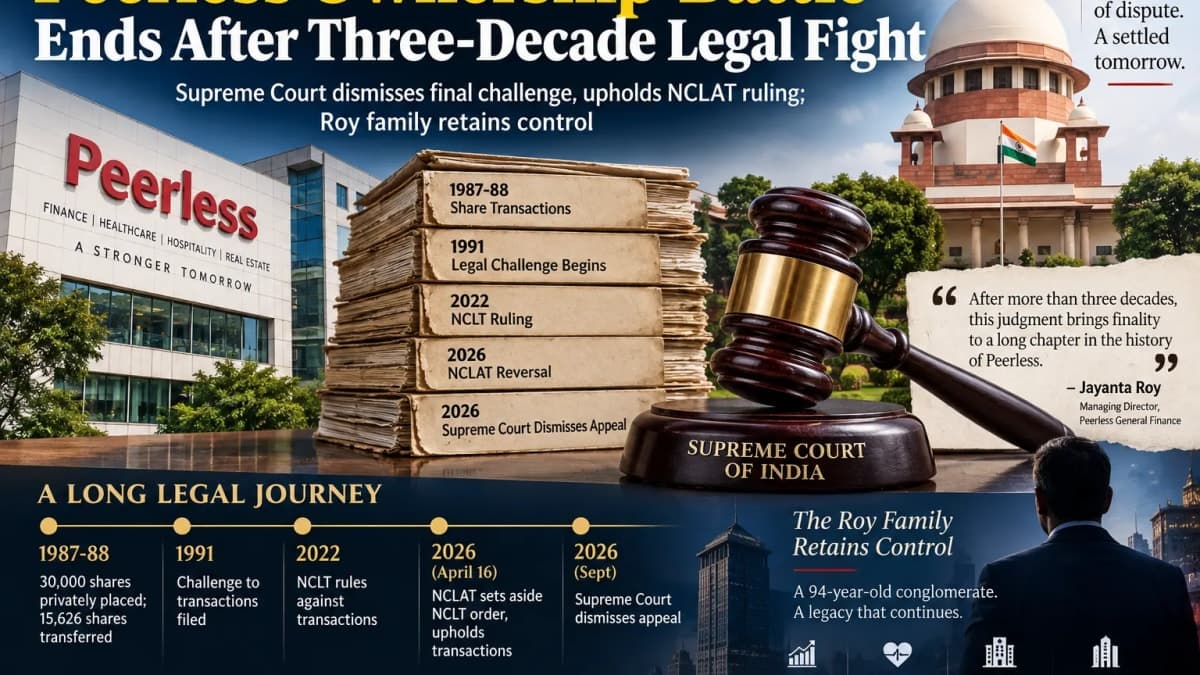
The company privately placed 30,000 equity shares during that period. Another 15,626 existing shares were transferred in transactions that later became central to the ownership dispute.
Those challenging the transactions alleged that they had been structured in a way that strengthened the Roy family’s position in Peerless. Questions were also raised over the use and movement of company funds.
Peerless rejected those allegations. Its position throughout the litigation was that the transactions had a legitimate commercial purpose and were completed through valid corporate processes.
Proceedings challenging the decisions were initiated in 1991.
The distinction between the allegations and the eventual legal outcome is important. The challengers’ claims formed the basis of the dispute, but they were not ultimately sustained by the appellate tribunal whose judgment the Supreme Court has now allowed to stand.
NCLT Decision Put the Transactions in Jeopardy
For years, the dispute moved through different stages of litigation without producing a definitive conclusion.
A major development came in July 2022, when the Kolkata bench of the National Company Law Tribunal ruled against the contested transactions.
The tribunal found against the promoters on the disputed share purchases and issued directions affecting the shares and benefits arising from them.
That judgment created potentially serious consequences for the ownership structure that had developed at Peerless since the transactions took place.
The company challenged the order before the National Company Law Appellate Tribunal.
NCLAT Reverses Course
The appellate proceedings produced the opposite result.
On April 16, 2026, the NCLAT set aside the NCLT judgment after examining the historical records surrounding the share transactions and the corporate decisions behind them.
The appellate tribunal rejected the case that the transactions amounted to oppression or were legally invalid. In doing so, it restored the position defended by Peerless and the Roy family.
Bhagwati Developers then approached the Supreme Court, giving the dispute one final opportunity for judicial review.
That challenge has now failed.
A Supreme Court bench comprising Justices P S Narasimha and Alok Aradhe declined to interfere with the NCLAT decision and dismissed BDPL’s appeal.
The legal effect is straightforward: the April 16 appellate judgment remains in force.
What the Supreme Court Decision Means
The Supreme Court order does not represent a fresh trial of every allegation raised during the long history of the case.
Instead, by refusing to disturb the NCLAT judgment, the court has left the appellate tribunal’s conclusions intact.
That distinction matters when assessing the outcome. The immediate consequence is not a new transfer of Peerless ownership or a restructuring of the company. It is the end of a challenge to transactions that helped shape the group’s existing control structure.
The Roy family therefore retains its position without the uncertainty created by the litigation hanging over those transactions.
Senior advocate Harish Salve, assisted by advocates Arunabha Deb and Ashika Daga, appeared for Peerless. Senior advocate Gopal Subramaniam, assisted by advocate Faraz Anees, represented Bhagwati Developers.
Peerless Welcomes Finality After Long Legal Fight
Peerless General Finance managing director Jayanta Roy framed the ruling primarily as an end to years of uncertainty.
“After more than three decades, this judgment brings finality to a long chapter in the history of Peerless,” Roy said.
“We are grateful that the validity of the company’s decisions, taken in good faith and in the interests of the institution, has ultimately been upheld.”
For Peerless, removing that uncertainty is significant because the company involved in the original dispute sits at the centre of a much broader business group.
The 94-year-old Peerless conglomerate has interests spanning financial services, healthcare, hospitality and real estate. A case concerning shares issued and transferred in the 1980s therefore remained relevant because of its implications for control of an established business group.
A Case That Outlived the Corporate System It Started Under
The length of the dispute also tells a broader story about Indian corporate litigation.
When proceedings began in 1991, the modern NCLT and NCLAT system did not exist. The dispute originated under an older company-law framework and continued as India changed the institutions through which corporate conflicts are heard.
It also survived the economic liberalisation of the 1990s, substantial changes in financial regulation and the eventual replacement of the Companies Act, 1956, with a new statutory framework.
That history is part of what makes the case unusual.
The Supreme Court’s latest order does not rewrite Peerless’s ownership structure. Instead, it removes a legal question that had followed the company for much of its modern history.
Transactions completed in 1987-88, challenged in 1991 and still being litigated in 2026 can now be treated, from the standpoint of this case, as settled.