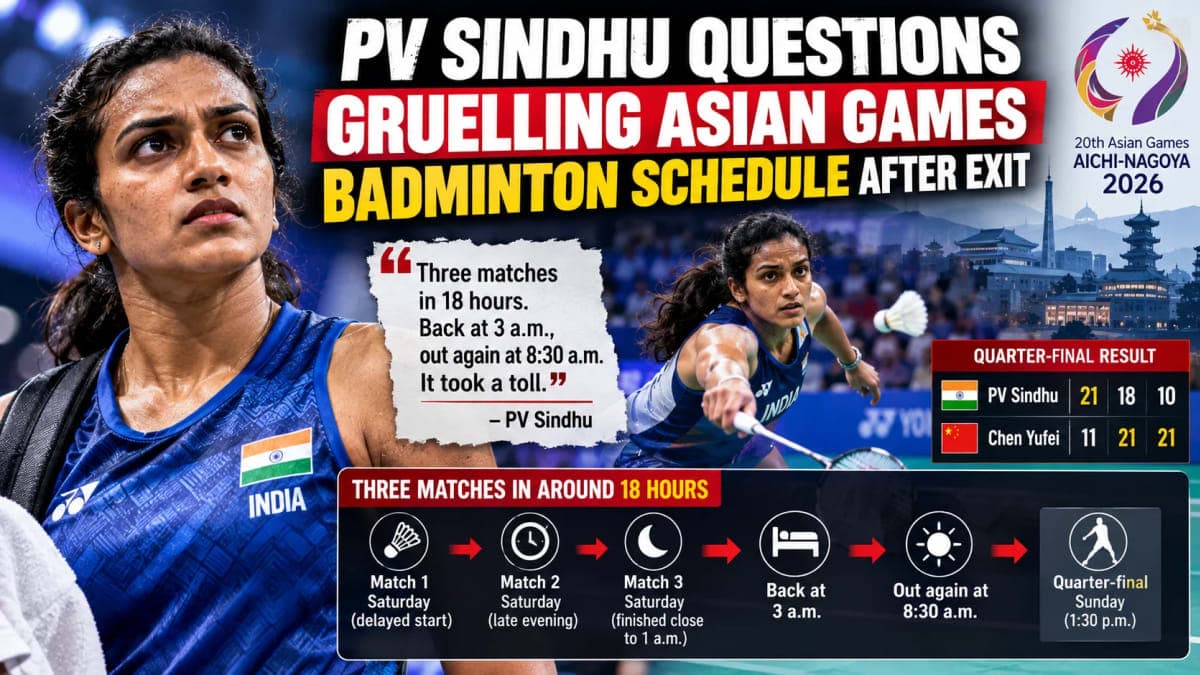
PV Sindhu’s bid for another Asian Games individual medal ended in a demanding women’s singles quarter-final against China’s Chen Yufei on Sunday, September 27.
Sindhu made an impressive start and took the opening game 21-11. She was also within three points of closing out the second game, but Chen fought back to take it 21-18 before dominating the deciding game 21-10.
The final score was 21-11, 18-21, 10-21 in Chen’s favour.
For Sindhu, however, the discussion after the defeat was not limited to the result. She also raised questions about the demanding turnaround between her matches.
Three matches in around 18 hours
Sindhu's schedule became particularly taxing on Saturday.
According to The Indian Express, her first match began after a delay, while her next match was shifted from Court 1 to Court 2. Her third-round contest eventually finished close to 1 am.
She returned to her hotel at around 1:30 am. After dinner and her recovery routine, Sindhu said she was able to sleep only around 3 am.
She was then up again on Sunday morning to prepare for her 1:30 pm quarter-final against Chen.
Sindhu later summed up the turnaround in a social-media post:
“Three matches in 18 hours. Back at 3 a.m., out again at 8:30 a.m. It took a toll.”
She nevertheless made clear that she still believed she could have won the quarter-final.
‘Scheduling was not really well organised’
Speaking to reporters following the defeat, Sindhu questioned whether the competition schedule provided enough recovery time for singles players.
When asked whether she had previously experienced two matches in a day at a major championship, Sindhu said:
“The scheduling was not really well organised is what I feel.”
She emphasised that recovery was not simply about being mentally ready for another match. Physical recovery was equally important when athletes were being asked to compete again after only a short turnaround.
Sindhu explained that fatigue can become particularly noticeable during long rallies, when an athlete may know what movement is required but the body does not respond as quickly.
She nevertheless described the match itself positively and said scheduling “should have been a bit better.”
Sindhu does not blame schedule alone for defeat
An important distinction in Sindhu's comments is that she did not attribute her quarter-final defeat entirely to scheduling.
In her subsequent statement, she focused heavily on the opportunity she had allowed to slip away.
Sindhu said she kept returning mentally to the three points that separated her from closing out the second game. She acknowledged that she had an opportunity and expressed disappointment at failing to convert it.
That distinction matters: the demanding schedule is a documented circumstance and Sindhu said it affected her recovery, but it should not be presented as an independently established explanation for why Chen ultimately won the match.
Unnati Hooda also raises scheduling concern
Sindhu was not the only Indian player to question the timetable.
Unnati Hooda, who also exited in the women’s singles quarter-finals, said the schedule could have been managed better.
Hooda lost a three-game contest against Japan’s Akane Yamaguchi, 16-21, 21-14, 17-21.
Importantly, Hooda also stopped short of blaming the schedule for her defeat, saying:
“I will not blame my loss to that.”
Her comments reinforce the distinction between concerns about tournament organisation and the sporting result itself.
Players from other countries also complained
The concerns extended beyond the Indian contingent.
The Indian Express reported that Japan’s Kodai Naraoka, Indonesia’s Jonatan Christie and Thailand’s Ratchanok Intanon also spoke about fatigue or scheduling difficulties.
Christie's third-round match reportedly ended around 2 am. He went to sleep around 3:30 am, woke at 9 am and then had to prepare for his next match.
He publicly criticised the organisers after his defeat.
Intanon similarly said she had not properly recovered after playing twice the previous day, while Naraoka described the adjustment to playing multiple matches in one day as challenging.
These accounts provide broader context to Sindhu's complaint: the recovery issue was raised by players from several delegations rather than by one athlete alone.
Schedule had already been revised before competition
There is also relevant organisational context.
According to The Indian Express, the Aichi-Nagoya organising committee had announced changes to several competition sessions on September 17, citing changes in the number of participating athletes.
Badminton's September 26 programme was among those altered, with the mixed doubles second round moved out of that session.
However, The Indian Express reported that there had been no official explanation responding specifically to the players' scheduling complaints at the time of its September 27 report.
That distinction is important: organisers had previously revised the programme, but the available reporting did not establish an official admission that the later turnaround times were inappropriate.
Sindhu also questions lack of Hawk-Eye
Scheduling was not Sindhu's only concern.
Her quarter-final was played on Court 4 at Ichinomiya Gymnasium Hall, where the Hawk-Eye review system was unavailable. According to the Times of India, the technology had been installed only on show courts 1 and 2.
Sindhu said she believed two or three close shots had landed on the line and argued that a quarter-final at the Asian Games should have camera review available.
This was Sindhu's assessment of the disputed line calls; without Hawk-Eye, those particular calls cannot simply be reported as having been incorrect.
Asian Games medal opportunity slips away
The defeat also ended Sindhu's attempt to add another individual Asian Games medal to her career record.
She won women’s singles bronze at Incheon 2014 and silver at Jakarta 2018. Her 2026 quarter-final defeat meant there would be no third individual Asian Games medal this time.
Sindhu, now 31, nevertheless rejected the idea that one result should define her broader journey.
Reflecting on four Asian Games appearances over 12 years, she wrote that there was still “room for pride” and made clear she intended to continue competing.
Her closing message was concise:
“I’ll go again.
India finishes badminton campaign with one medal
India's badminton campaign ended shortly after Sindhu and Hooda were eliminated.
According to The Indian Express, India finished the Asian Games badminton competition with one medal — bronze in the men's team event — and failed to win an individual badminton medal for the first time since 2014.
That outcome adds sporting significance to Sindhu's quarter-final. She was not merely chasing another medal for herself; her defeat also removed one of India's remaining opportunities for an individual badminton podium finish.
What the scheduling controversy actually establishes
The available evidence supports three separate conclusions.
First, Sindhu faced an unusually compressed schedule involving three singles matches within roughly 18 hours and said the limited recovery time affected her physically. Second, several other international players independently raised concerns about demanding turnaround times. Third, Sindhu did not claim scheduling alone caused her defeat; she acknowledged that she had a genuine opportunity to close out the match against Chen.
Those distinctions are important because they allow legitimate questions about athlete recovery and tournament scheduling to be examined without diminishing Chen Yufei's comeback or treating fatigue as a proven single cause of the result.


