Advertisement
हिंदी में पढ़ें —JantaScope हिंदी
Finance

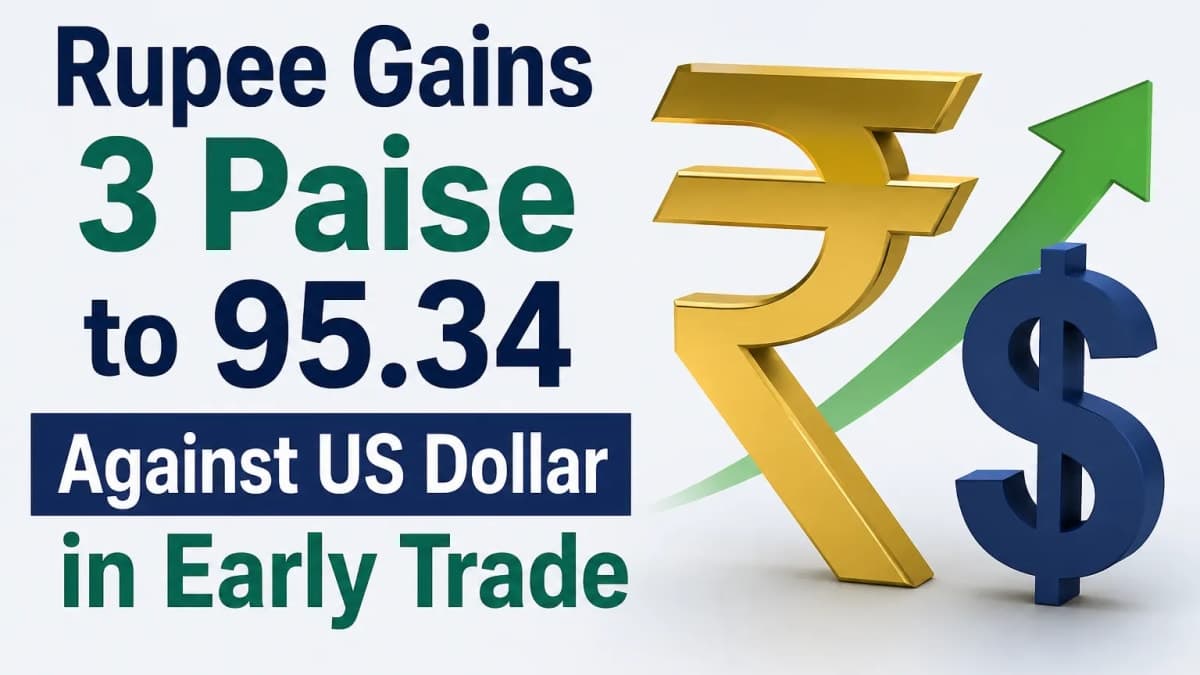
Rupee Gains 3 Paise to 95.34 Against US Dollar in Early Trade

The Indian rupee opened on a firmer note against the US dollar, gaining 3 paise to trade at 95.34 in early dealings. The modest appreciation reflects an early improvement in the domestic currency, while traders continue to assess broader global currency movements and financial-market conditions

Rupee Gains 3 Paise to 95.34 Against US Dollar in Early Trade
Advertisement

By Jeet Nirmal

Source: Deccan Chronicle

Rupee Strengthens in Early Trade

The Indian rupee recorded a marginal gain against the US dollar during early trading, strengthening by 3 paise to 95.34.

Although the movement was limited, even small fluctuations in the rupee are closely monitored because the dollar-rupee exchange rate can influence import costs, corporate expenses, overseas investments and broader market sentiment.

The early gain represents a modest improvement for the domestic currency. However, an opening movement alone does not necessarily indicate how the rupee will perform throughout the trading session.

Why the Rupee-Dollar Exchange Rate Matters

The rupee's value against the US dollar has significant implications for India's economy because a substantial share of international trade and commodity transactions is conducted in dollars.

A weaker rupee can make dollar-denominated imports more expensive in local-currency terms. This is particularly relevant for businesses that depend on imported commodities, machinery, electronics, components or other overseas supplies.

Conversely, a stronger rupee can provide some relief to importers by reducing the amount of domestic currency required to purchase the same quantity of dollars.

Currency movements can also have different consequences for export-oriented companies. Businesses earning a significant portion of their revenue in foreign currencies may benefit from a weaker rupee when overseas earnings are converted into Indian currency, although the actual impact depends on costs, hedging strategies and individual business models.

What Influences the Indian Rupee?

Foreign-exchange markets respond to a wide range of domestic and international developments. The rupee can be influenced by movements in the US dollar, global interest-rate expectations, crude oil prices, foreign investment flows and broader investor appetite for emerging-market assets.

India's dependence on imported energy makes international crude oil prices particularly relevant to the currency market. Changes in global financial conditions can also affect demand for dollars and other major currencies.

However, without additional trading data, the rupee's 3-paise early gain cannot reliably be attributed to any single factor.

A Small Gain, but an Important Market Indicator

A movement of 3 paise is relatively modest and should be viewed in the context of normal foreign-exchange market fluctuations.

Still, the rupee-dollar rate remains an important indicator for businesses, investors and policymakers. Sustained currency movements can eventually affect import bills, inflationary pressures, corporate profitability and investment decisions.

For consumers, exchange-rate changes can indirectly influence the cost of imported products and overseas expenses. Travellers and students paying fees abroad can also be affected by significant changes in the value of the rupee.

Balanced Analysis

The rupee's rise to 95.34 in early trade provides a mildly positive opening signal for the domestic currency, but it is too early to interpret the move as evidence of a sustained strengthening trend.

Foreign-exchange markets can change direction quickly as traders respond to international developments, capital flows and shifts in demand for the US dollar.

The more meaningful indicator will therefore be whether the rupee can maintain its early improvement as trading progresses.


Advertisement

Related

More stories

Unified Pension Scheme Draws Over 1.18 Lakh Central Government Employees; Centre Rules Out Changes

More than 1.18 lakh Central government employees have opted for the Unified Pension Scheme (UPS), marking a significant level of participation in the pension framework. At the same time, the Centre has indicated that no changes to the scheme are currently under consideration, signalling its intention to continue with the existing structure.

1 day ago|Finance

Unified Pension Scheme Draws Over 1.18 Lakh Central Government Employees; Centre Rules Out Changes

India Launches Biggest LIC Stake Sale Since IPO, Targets Up to $3.3 Billion

The Indian government has launched its largest stake sale in Life Insurance Corporation of India (LIC) since the insurer’s landmark 2022 stock-market debut. The transaction could raise as much as $3.3 billion, while increasing public ownership in the state-controlled insurance giant.

1 day ago|Finance

India Launches Biggest LIC Stake Sale Since IPO, Targets Up to $3.3 Billion

Oil-Sensitive Stocks Rally as Crude Tumbles 6%; IndiGo, BPCL, IOCL, IGL and Adani Total Gas Lead Gains

Oil-sensitive stocks moved sharply higher after crude oil prices fell around 6%, improving sentiment toward companies whose costs or margins are closely linked to energy prices. IndiGo, BPCL, IOCL, IGL and Adani Total Gas were among the prominent gainers as investors assessed the potential benefits of cheaper crude.

2 days ago|Finance

Oil-Sensitive Stocks Rally as Crude Tumbles 6%; IndiGo, BPCL, IOCL, IGL and Adani Total Gas Lead Gains

Stock Market Close: Sensex Ends 544 Points Higher, Nifty Gains 391 Points After New Closing Auction Session

Indian equities finished the trading session firmly higher, with the Sensex gaining 544 points and the Nifty advancing 391 points. The gains came as the market experienced a new closing auction session, putting the spotlight on both the strong finish and the evolving mechanism used to determine closing prices.

2 days ago|Finance

Stock Market Close: Sensex Ends 544 Points Higher, Nifty Gains 391 Points After New Closing Auction Session

India’s Manufacturing Activity Slips to Near Five-Year Low in July but Still Signals Solid Growth

India’s manufacturing activity slowed in July to a level close to a five-year low, but the sector continued to signal solid growth. The contrasting picture suggests that while the pace of expansion has weakened, manufacturing activity remains resilient, keeping attention on whether the slowdown is temporary or develops into a broader trend.

2 days ago|Finance

India’s Manufacturing Activity Slips to Near Five-Year Low in July but Still Signals Solid Growth

Market Cap of 9 Most Valued Firms Jumps ₹2.51 Trillion; Bajaj Finance Emerges Biggest Winner

Nine of the most valued companies recorded a combined increase of ₹2.51 trillion in market capitalisation, with Bajaj Finance emerging as the biggest winner. The rise highlights an improvement in investor valuation across several of the country's largest listed businesses.

3 days ago|Finance

Market Cap of 9 Most Valued Firms Jumps ₹2.51 Trillion; Bajaj Finance Emerges Biggest Winner
Advertisement