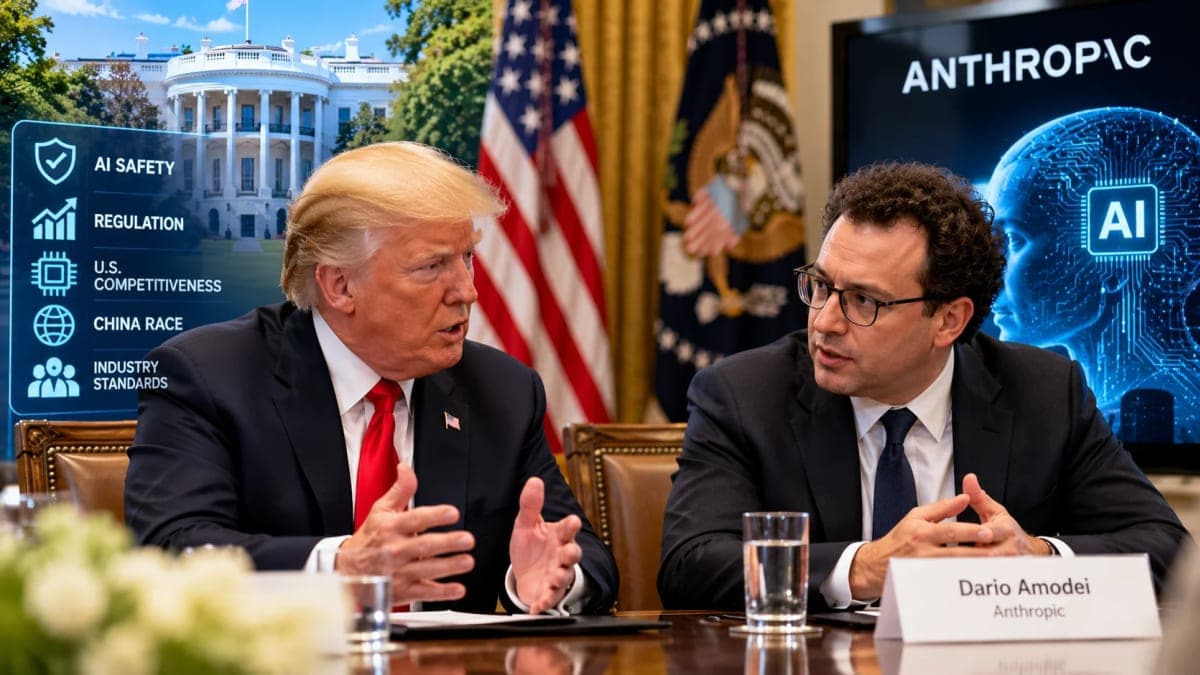
Anthropic CEO Dario Amodei met U.S. President Donald Trump for a private dinner at the White House on Sunday, September 27, marking their first reported one-on-one meeting after months of disagreements between the administration and the artificial-intelligence company.
The meeting comes at a consequential moment for the U.S. AI industry. Amodei has recently advocated a more cautious approach to frontier AI development and stronger independent safety evaluation, while Trump has argued that slowing American AI development could allow China to close the technological gap.
First One-on-One Meeting Between Trump and Amodei
Axios first reported that Trump planned to host Amodei for dinner. The Wall Street Journal subsequently reported that the private dinner took place Sunday evening.
The meeting is notable because relations between Anthropic and the Trump administration have been strained.
Anthropic has repeatedly emphasised potential risks from increasingly capable AI systems and pushed for greater oversight. The administration, meanwhile, has made maintaining U.S. leadership in artificial intelligence a central economic and national-security priority.
Axios described the dinner as a possible indication of improving relations between the two sides, although a single meeting does not establish that their underlying policy disagreements have been resolved.
Amodei Has Called for Slower, More Carefully Evaluated AI Development
The immediate backdrop is a renewed debate over whether frontier AI companies should deliberately moderate the pace at which increasingly powerful systems are developed.
Earlier in September, Amodei proposed measures including independent third-party safety evaluators, common safety standards among democratic countries and eventually international coordination over highly capable AI systems.
His argument is that AI capabilities could advance faster than researchers' ability to understand and control them.
Amodei has not proposed that Anthropic simply halt development on its own. His approach instead focuses on coordinated measures designed to prevent competitive pressures from encouraging companies to sacrifice safety in the race to develop more capable systems.
Other prominent AI executives have also publicly supported elements of the discussion around stronger safety evaluation and pacing frontier development.
Trump: US Cannot Afford to Lose Its AI Lead
Trump has taken a different position on slowing AI development.
Speaking around the time of his meeting with Amodei, Trump argued that reducing the pace of American development could create an opportunity for China.
“We’re about maybe a year and a half up on China.”
Trump also pointed to large-scale U.S. investment in AI infrastructure and asked:
“We’re leading, and we’re building tremendous, trillions of dollars’ worth of places. And why should we give that up?”
Those statements represent Trump's assessment of the U.S.-China AI competition; the claimed 18-month lead should not be treated as an independently established measurement of the countries' overall AI capabilities.
The disagreement illustrates the central policy tension: how the United States can address potentially serious risks from advanced AI without undermining its position in an international technology race.
Anthropic's Pentagon Dispute Adds Another Layer
The meeting also occurred against the backdrop of a separate dispute involving Anthropic and the U.S. Department of Defense.
Two days before the dinner, a federal appeals court upheld the Pentagon's designation of Anthropic as a “supply chain risk,” which prevents the U.S. military from using its models. Anthropic has challenged the decision.
The dispute has been tied to disagreements over restrictions Anthropic sought to place on uses of its AI technology.
That issue is distinct from the broader question of whether the AI industry should slow frontier development, but together the disputes demonstrate how AI safety policies are increasingly intersecting with government procurement, national security and technology policy.
The China Question Sits at the Centre of the Debate
Both sides acknowledge that international competition matters, but they emphasise different risks.
Trump has repeatedly framed U.S. AI leadership as a strategic competition with China and argues that excessive restrictions could weaken America's technological advantage.
Amodei has also acknowledged the China problem. His position is not simply that the United States should slow down regardless of what other countries do.
In his recent safety proposal, Amodei warned that unilateral restraint could itself create geopolitical risks if China continued developing advanced AI while U.S. companies significantly limited themselves. His longer-term approach therefore envisages international coordination rather than relying entirely on unilateral restrictions.
That shared concern—but different proposed response—is important for understanding the disagreement.
AI Companies Have Discussed Common Safety Standards
The debate extends beyond Anthropic.
The Washington Post reported earlier this month that Anthropic, OpenAI and Google had discussed the potential creation of an industry body to establish common safety standards for frontier AI.
The discussions could eventually provide a mechanism for companies to coordinate safety practices without relying solely on government regulation. They remain discussions rather than an established regulatory regime.
The industry debate therefore involves at least three possible approaches: voluntary safeguards adopted by individual companies, industry-wide standards and formal government regulation.
Exactly how those approaches should interact remains unresolved.
Why the Trump-Amodei Meeting Matters
The White House dinner does not by itself indicate a policy agreement.
Instead, its significance lies in direct dialogue between a president prioritising rapid American AI development and the chief executive of one of the world's leading AI laboratories arguing that increasingly powerful systems require stronger safeguards.
It also comes as AI policy moves beyond Silicon Valley into questions of national security, military procurement, international competition and government oversight.
Trump and House Speaker Mike Johnson were also expected to meet executives from major AI companies at the White House on Tuesday, placing the Amodei dinner within a wider round of discussions between Washington and the technology industry.
For now, the fundamental disagreement remains: how much caution is appropriate when slowing down could carry strategic costs, but moving too quickly could introduce risks that developers themselves say are difficult to predict or control.