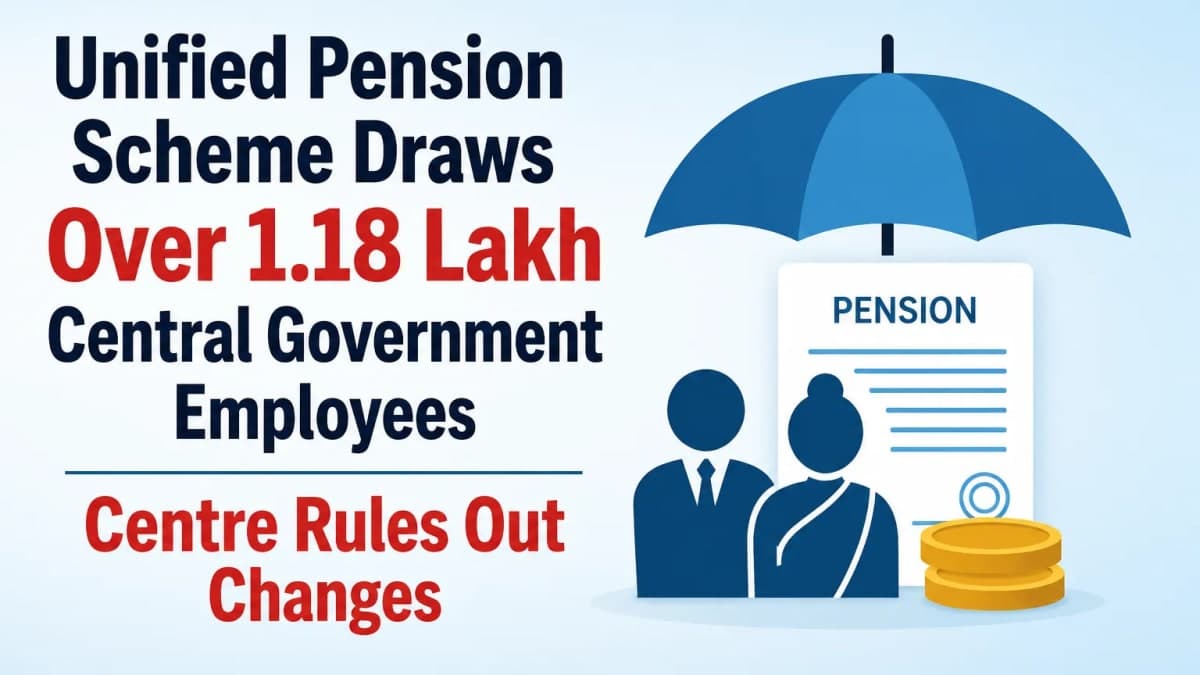
Unified Pension Scheme Records Over 1.18 Lakh Opt-Ins
The Unified Pension Scheme has crossed an important participation milestone, with more than 1.18 lakh Central government employees choosing to opt into the pension framework.
The figure offers an early indication of employee participation in the scheme as the government seeks to provide a pension arrangement combining retirement-income predictability with the broader contributory pension framework.
Alongside the participation numbers, the Centre has ruled out changes to the UPS at present. The position suggests that the government intends to maintain the current framework rather than revise its key provisions in the immediate future.
What Is the Unified Pension Scheme?
The Unified Pension Scheme was introduced as a retirement-benefit option for eligible Central government employees covered under the National Pension System (NPS).
The UPS framework was designed to address concerns around post-retirement income security while retaining a contributory structure. Its introduction created an additional pension option for eligible employees, making the choice of retirement framework an important long-term financial decision.
For employees, pension arrangements can affect not only income after retirement but also financial planning during their working years. This makes participation levels in the UPS closely watched by employees, policymakers and retirement-planning experts.
Why the 1.18 Lakh Figure Matters
More than 1.18 lakh employees opting for the scheme represents a notable milestone, but the number should be viewed in the context of the wider eligible Central government workforce.
Participation figures can help indicate how employees are evaluating the benefits, conditions and long-term implications of the new pension option.
At the same time, an opt-in number alone does not establish whether the scheme has achieved universal acceptance. Employees may weigh several factors before choosing a pension arrangement, including expected retirement income, contribution requirements, service tenure and individual financial circumstances.
Centre Rules Out Changes to UPS
The government's decision to rule out changes is significant because pension policies have long-term fiscal and financial consequences.
Maintaining the existing UPS structure provides policy continuity and gives employees greater certainty about the framework under which they are making retirement decisions.
However, the government's position also means employees seeking revisions to particular provisions should not expect immediate modifications.
Pension Policy Remains an Important Employee Issue
Government pension policy has undergone major changes over the past two decades. The shift from the traditional Old Pension Scheme (OPS) to the National Pension System significantly changed the way retirement benefits were structured for many government employees.
The UPS emerged against this broader debate over how governments can balance predictable retirement benefits for employees with the long-term financial sustainability of public pension obligations.
That balance remains central to the policy discussion.
Balanced Analysis: Participation Is Important, but Long-Term Impact Will Matter More
The crossing of 1.18 lakh opt-ins provides a measurable indicator of employee interest in the Unified Pension Scheme. For the government, growing participation can strengthen confidence in the implementation of the new framework.
For employees, however, the more important test will be how the scheme performs over the long term and whether its retirement benefits meet expectations.
The Centre's decision not to alter the framework may provide stability, but continued communication about eligibility, contributions and retirement benefits will remain important so employees can make informed choices.
Ultimately, the success of the Unified Pension Scheme will be judged not simply by the number of employees opting in, but by its ability to deliver sustainable and predictable retirement security over time.
Conclusion
With more than 1.18 lakh Central government employees opting for the Unified Pension Scheme, the pension framework has reached a notable participation milestone. The Centre's decision to rule out changes also signals policy continuity for employees evaluating their retirement options.
As implementation progresses, participation trends and the scheme's long-term retirement outcomes will determine its broader significance within India's government pension system.