New Zealand coach keen to test Sooryavanshi in home conditions
Indian teenage sensation Vaibhav Sooryavanshi could face one of the most intriguing challenges of his young international career when India travel to New Zealand for their upcoming white-ball assignment.
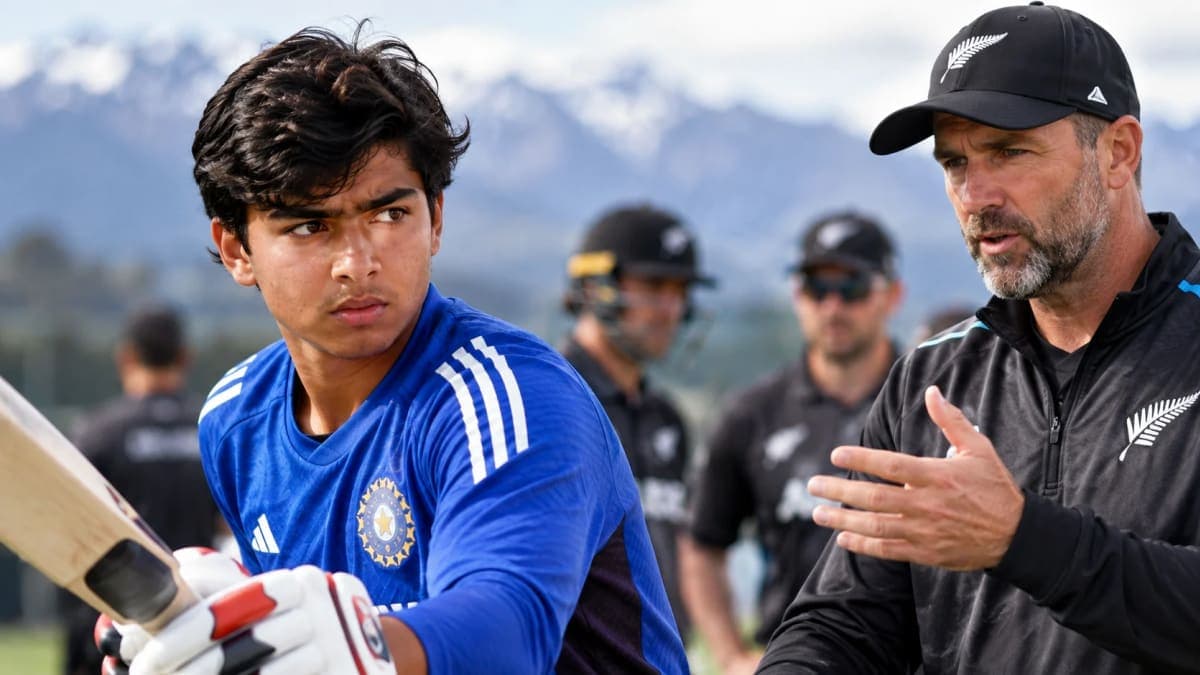
New Zealand head coach Rob Walter has expressed particular interest in seeing how the 15-year-old batter responds to the extra pace and bounce that could be available in New Zealand conditions.
Sooryavanshi has already built a reputation as an explosive top-order batter, particularly through his performances in the Indian Premier League and age-group cricket. But Walter believes playing in a different environment could offer another measure of the youngster’s adaptability.
“Yes, I’d love to see him on some pace in bouncy wickets and see how different that looks,” Walter said while discussing the Indian batter.
He also acknowledged what Sooryavanshi has already demonstrated against high-quality opposition, adding that the bigger question is how those skills translate when the conditions change.
“But he’s an exciting player. You’ve seen him dominate against the world’s best bowlers in the IPL. I think the challenge is always to see how that translates to different conditions and also how do we bowl to him in our conditions,” Walter said.
Why New Zealand could present a different challenge
The discussion around Sooryavanshi is not simply about his ability to score quickly.
New Zealand conditions can require visiting batters to make technical and tactical adjustments, particularly when seamers are able to extract pace, bounce and movement. For an attacking batter, that can affect shot selection, timing and the areas in which boundaries are available.
That makes the potential contest particularly interesting: Sooryavanshi’s natural instinct is to attack, while New Zealand will have the opportunity to construct bowling plans specifically for him in familiar home conditions.
Walter suggested that seeing players placed under pressure is also valuable from a coaching perspective.
“Again, secretly as a coach, you always want to see your players under a little bit of pressure and how we respond to that,” Walter said.
However, the New Zealand coach also acknowledged that Sooryavanshi’s participation cannot simply be assumed, pointing to the depth available to India.
“So looking forward to it, if that is the case. If he’s not here, they do have a lot of very good players other than him,” Walter added.
Sooryavanshi waiting for another opportunity with India
Despite the attention surrounding him, Sooryavanshi has recently had to wait for opportunities in India’s playing XI.
The teenager made his senior T20I debut against England in July 2026 and later registered two half-centuries during the Zimbabwe series.
More recently, however, he was not selected in the playing XI during India’s 3-0 T20I series victory over Afghanistan. He was also part of the Indian squad around the one-off T20I against Japan but did not feature in the match.
India head coach Gautam Gambhir has publicly called for patience around the teenager.
Speaking after the Afghanistan series, Gambhir stressed the importance of competition for places and consistent performances, while making it clear that Sooryavanshi would receive opportunities as his career develops.
The situation adds another dimension to the New Zealand series: before the teenager can answer questions about adapting to New Zealand conditions, he first needs an opportunity in India’s XI.
IPL success has raised expectations
Much of the fascination surrounding Sooryavanshi comes from how quickly he has progressed.
His aggressive performances in the IPL, combined with his displays at Under-19 level, accelerated his rise into the senior India setup. His approach has shown that he is willing to attack accomplished bowlers rather than simply survive against them.
Walter’s comments recognise that success while raising a natural question faced by any emerging international batter: can the same methods work consistently across countries and conditions?
New Zealand could provide useful evidence.
Rather than simply measuring how many runs Sooryavanshi scores, his response to short-pitched bowling, higher bounce and different lengths could reveal how effectively his attacking game adapts away from familiar environments.
India-New Zealand rivalry resumes after T20 World Cup final
The upcoming series also carries wider significance for both teams.
India and New Zealand met in the T20 World Cup final earlier in 2026, with India defeating the BlackCaps in Ahmedabad to claim the title.
New Zealand’s upcoming T20I assignment against India will be their first in the format since that World Cup final.
Mitchell Santner is set to lead New Zealand in the five-match T20I series, while Walter and his coaching staff will have the advantage of preparing their bowling plans around home conditions.
For Sooryavanshi, should he get his opportunity, the tour could represent another important stage in a remarkably fast rise.
The teenager has already demonstrated that he possesses exceptional attacking ability. The next question being posed from the New Zealand camp is more specific: what happens when that aggression meets pace, bounce and a bowling attack operating on familiar ground?
That answer will ultimately come only if Sooryavanshi gets his chance in the middle.