India’s services sector gained some momentum in August 2026, with business activity expanding at a faster pace and companies stepping up hiring even as the broader growth environment remained softer than historical norms.
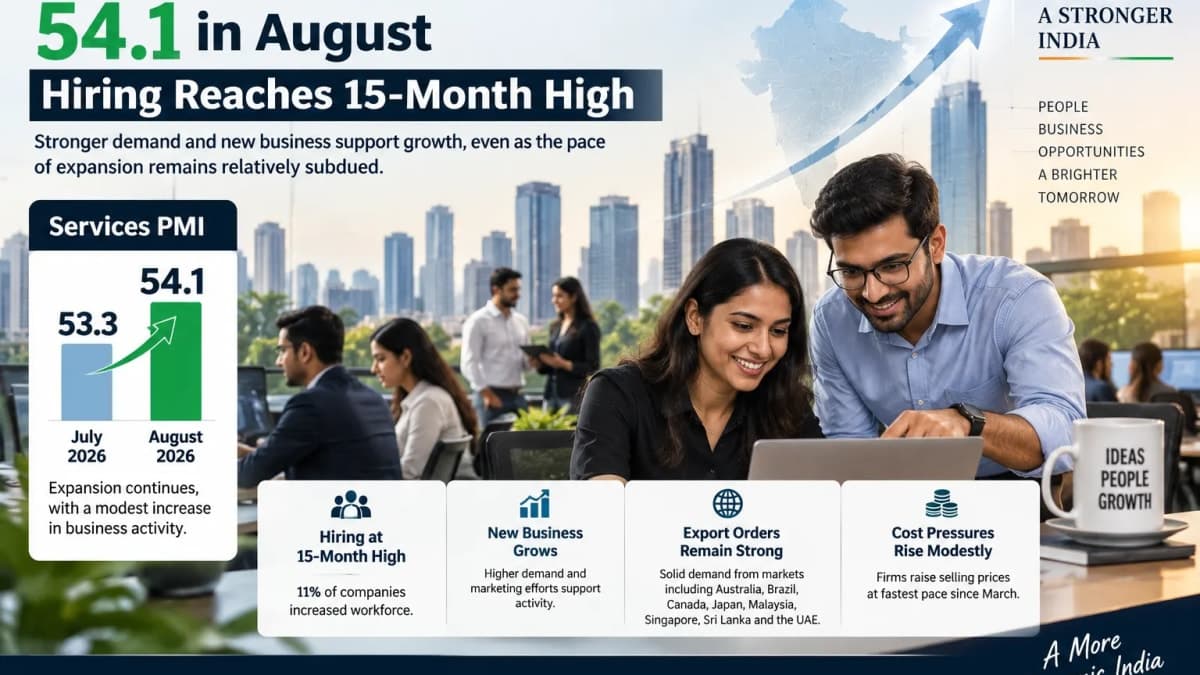
The seasonally adjusted HSBC India Services PMI Business Activity Index increased to 54.1 in August from 53.3 in July, according to the latest survey compiled by S&P Global.
Any PMI reading above 50 signals an expansion in activity, while a figure below 50 indicates contraction.
The improvement was supported by higher output, continued growth in new business and resilient demand. But the headline number remained below the survey’s long-run average of 54.5 and was the second-weakest reading since March 2022.
That combination makes August’s data notable: services activity improved from July, but the sector has yet to return to the much stronger expansion rates seen during previous periods.
Services PMI Rises From 53.3 to 54.1
The August reading marked an improvement of 0.8 points from July.
Service providers reported that favourable demand conditions and additional new business helped support activity during the month.
Marketing initiatives and improved customer demand were among the factors cited by surveyed companies as contributing to growth.
Despite that improvement, some firms continued to report challenges including subdued bookings, competitive pressures and reduced transport activity.
The final August PMI of 54.1 was also below the preliminary reading of 54.5, indicating that activity was somewhat weaker than suggested by the earlier estimate.
Hiring Reaches 15-Month High
One of the strongest signals in the August survey came from employment.
Services companies increased staffing at the fastest rate in 15 months, even though the overall pace of business expansion remained relatively modest.
Around 11% of surveyed firms reported increasing their workforce.
Companies linked the additional hiring to requirements in areas including customer service, sales and digital operations.
HSBC Chief India Economist Pranjul Bhandari said:
“Employment increased at a marked rate, with job creation reaching a 15-month high.”
The hiring data provides an important counterpoint to the relatively subdued headline PMI. It suggests that some companies are increasing their capacity despite the slower overall pace of growth.
Export Orders Continue to Support Services
International demand remained another source of support for India's service providers.
New export business increased solidly during August, with the pace of expansion broadly similar to July.
Survey participants reported stronger demand from customers across several overseas markets, including Australia, Brazil, Canada, Japan, Malaysia, Singapore, Sri Lanka and the UAE.
The continued rise in export orders matters because India's services industry has a significant international presence, particularly across technology, business services and other professional activities.
Sustained overseas demand can therefore help offset weaker conditions in individual parts of the domestic market.
New Business Grows, but Momentum Remains Relatively Soft
New business volumes continued to increase during August, helping drive the rise in output.
However, the pace of overall services expansion remained among the weakest recorded in more than four years.
This distinction is important when interpreting the headline number.
A PMI reading of 54.1 does not mean services activity declined. It indicates that activity continued to expand compared with the previous month.
What has changed is the speed of expansion.
The sector grew faster than it did in July, but remained considerably less buoyant than during many earlier periods.
That means August's data points to improvement rather than a dramatic acceleration.
Price Pressures Rise Only Modestly
Inflationary pressures also remained an important part of the August survey.
Input cost inflation edged higher, although the increase was relatively modest.
Companies nevertheless raised their own selling prices at the fastest rate since March as some firms passed higher operating expenses on to customers.
Bhandari said price pressures “picked up only modestly.”
The relationship between input costs and selling prices will remain important because persistent increases in service-sector prices can contribute to broader inflationary pressure.
For businesses, the challenge is balancing higher operating expenses against the risk that aggressive price increases could weaken customer demand.
Composite PMI Holds at 54.3
The HSBC India Composite PMI Output Index stood at 54.3 in August, unchanged from July.
The composite index combines activity across India's manufacturing and services sectors.
The unchanged reading masks contrasting developments beneath the headline number.
Faster services growth helped compensate for weaker manufacturing momentum during August.
Manufacturing PMI fell to 52.8 from 53.5 in July, its weakest level in five years.
The contrast therefore reinforces the importance of services in supporting India's overall private-sector expansion during the month.
Services Hiring Offsets Manufacturing Weakness
The divergence was particularly visible in employment.
While service providers accelerated recruitment, manufacturing employment declined marginally.
Across the two sectors combined, employment nevertheless increased at its fastest pace in 14 months, as stronger services hiring more than compensated for the decline among manufacturers.
This is significant because employment trends can provide additional information beyond headline output numbers.
Companies generally expand their workforce when they believe current or expected demand justifies additional capacity.
However, one month of stronger hiring does not by itself establish a lasting employment trend, making subsequent PMI releases important for determining whether the improvement continues.
Why the 54.1 PMI Reading Matters
India's services sector plays a central role in the economy, covering industries ranging from information technology and financial services to transportation, communications, hospitality and professional services.
That makes the Services PMI a closely watched high-frequency indicator of business conditions.
August's reading presents a mixed but broadly positive picture.
Activity is expanding. New business continues to increase. International demand remains supportive. And companies are hiring workers at the strongest pace in more than a year.
At the same time, overall growth remains close to its weakest levels since 2022.
The result therefore suggests resilience rather than a return to rapid expansion.
What to Watch Next
The next few PMI readings will help determine whether August represents the beginning of a stronger recovery in services or simply a modest improvement within a slower growth phase.
Three indicators will be particularly important: new orders, employment and prices.
A sustained acceleration in new business would provide stronger evidence that underlying demand is recovering.
Continued hiring would suggest companies remain confident enough to expand capacity.
And developments in input and selling prices will provide clues about whether inflationary pressures are becoming more significant.
For now, August's 54.1 reading shows that India's services engine is still expanding—and doing so slightly faster than in July—but the strength of that expansion remains well below some of the levels recorded in recent years.