India Could Record $60–65 Billion Balance of Payments Surplus in FY27, HDFC Bank Says
India's external finances could look considerably stronger by the end of FY27 than they did at the start of the year.
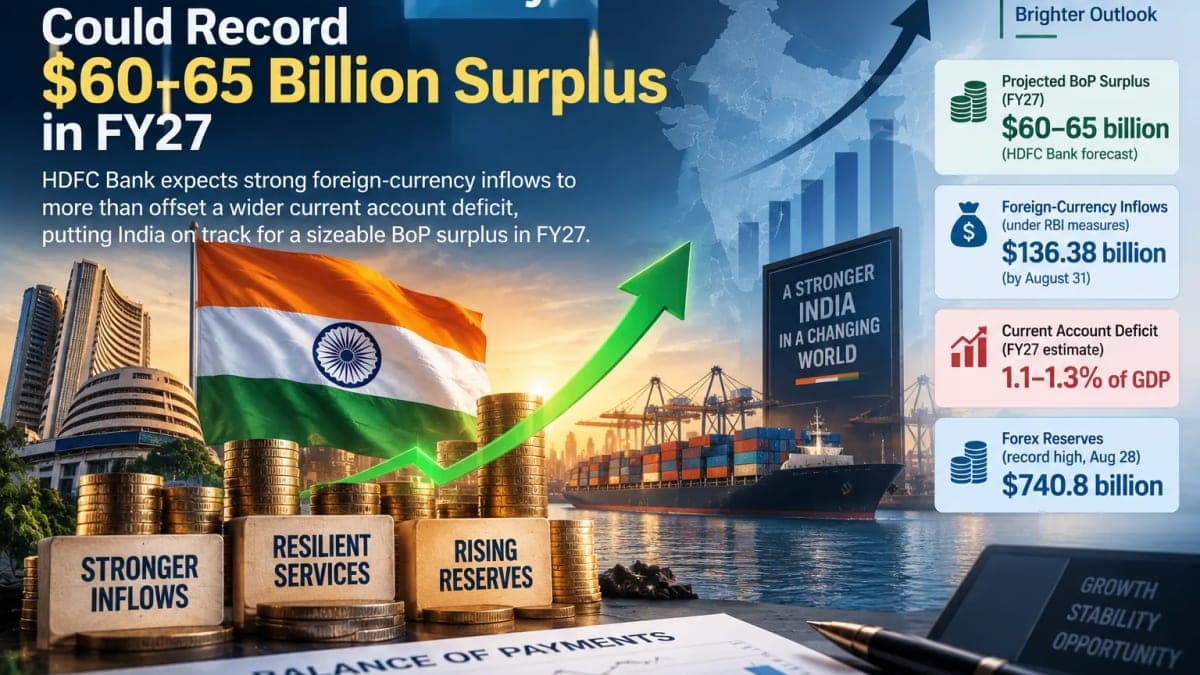
HDFC Bank expects the country's balance of payments to post a surplus of $60–65 billion, with the possibility of a higher figure if foreign-currency inflows remain strong. The forecast is notable because it comes against a less favourable backdrop for India's trade balance and conventional foreign capital flows.
The projected surplus is not an official Reserve Bank of India estimate. It is HDFC Bank's assessment, built largely around the scale of foreign currency raised through measures introduced by the central bank.
Those inflows could more than compensate for a wider current account deficit and the weakness seen in capital flows during the opening quarter.
More Than $136 Billion Changes the External Balance
The biggest factor behind the forecast is the volume of dollars mobilised through the RBI's special measures.
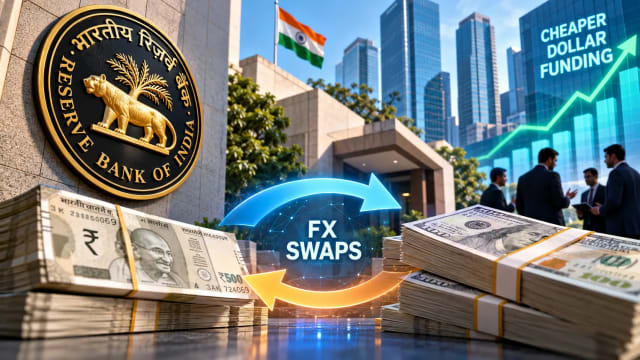
Foreign-currency inflows under the central bank's dollar-rupee swap facility had reached $136.38 billion by August 31.
The bulk came from Foreign Currency Non-Resident (Bank), or FCNR(B), deposits, which accounted for $127.23 billion. Overseas foreign-currency borrowings added $5.26 billion, while another $3.89 billion came through external commercial borrowings.
For the balance of payments, the scale of these flows matters more than the headline alone suggests.
India began FY27 with an $8.1 billion BoP deficit in the April-June quarter, reversing a $4.5 billion surplus in the same period a year earlier. Without the subsequent surge in foreign-currency mobilisation, that weak opening would have left the external position more exposed to the widening merchandise trade gap and volatile portfolio investment.
“The large inflows mobilised under the RBI's FCNR(B) deposit and overseas borrowing measures are likely to more than compensate for the weak capital flows recorded in Q1 and support an overall BoP surplus in FY27,” HDFC Bank said.
Current Account Is Still Under Pressure
The expected BoP surplus should not be confused with an improvement across every part of India's external accounts.
The current account is moving in the opposite direction.
India recorded a current account deficit of $4.2 billion, equivalent to 0.5% of GDP, in April-June. A year earlier, the deficit was a revised $3.4 billion, or 0.4% of GDP.
HDFC Bank expects the CAD to widen to around 1.1–1.3% of GDP for FY27. The pressure could be more pronounced in the second quarter, when the bank sees the deficit reaching 1.5–1.7% of GDP.
Much of that strain comes from merchandise trade.
The merchandise deficit expanded to $86.1 billion in the first quarter, from $68.9 billion a year earlier. Imports climbed 20% to $218 billion, with crude oil and precious metals contributing to the larger bill.
That leaves India with an unusual combination: a weakening current account but the possibility of a substantial overall BoP surplus because financial inflows are large enough to offset it.
Services and Remittances Absorb Part of the Trade Shock
India's external position would be considerably weaker without its services industry and remittance flows.
Net services receipts increased 7.8% from a year earlier to $52 billion during the first quarter. Net transfer receipts, which are supported heavily by money sent home by Indians overseas, rose by roughly $10 billion to $41 billion.
These inflows routinely offset a sizeable portion of India's merchandise trade deficit.
Their role becomes more important when commodity prices rise because India remains dependent on imported energy. A larger oil bill can quickly widen the goods deficit, while services exports and remittances provide a more stable counterweight.
HDFC Bank expects that support to continue even as the merchandise deficit stays elevated.
Portfolio Money Remains a Weak Spot
Foreign investment flows tell a less comfortable story.
India's capital account posted a $5.5 billion deficit in the first quarter, while foreign portfolio investors were net sellers to the tune of $9.6 billion.
That weakness matters because portfolio capital can be particularly sensitive to changes in global interest rates, risk appetite and expectations for the rupee.
Ordinarily, a wider current account deficit accompanied by foreign portfolio outflows would leave the currency and foreign-exchange reserves facing greater pressure.
The unusually large FCNR(B) and borrowing inflows have altered that equation for FY27.
They also explain why the composition of any eventual $60–65 billion surplus deserves attention. Such a figure would represent a substantial external cushion, but it would not mean that India's trade deficit had narrowed or that foreign investors had returned to domestic markets in force.
Forex Reserves Reach a Record
The influx of foreign currency is already visible in the RBI's reserves.
India's foreign-exchange reserves reached a record $740.8 billion in the week ended August 28, extending their rise to nine consecutive weeks.
A larger reserve stock gives the RBI more room to respond when currency markets become volatile. It does not require the central bank to defend a particular exchange rate, but it increases its capacity to smooth disruptive moves and meet external financing requirements.
There is another side to the inflows, however.
The surge in foreign currency has contributed to exceptionally high liquidity in India's banking system. The RBI has consequently used liquidity-absorption operations to prevent excess cash from pulling short-term interest rates too far away from its intended monetary stance.
The same inflows strengthening the external account are therefore creating a separate domestic liquidity-management challenge.
Oil Could Change the Calculation Quickly
HDFC Bank's projection assumes an average crude oil price of $85 a barrel during FY27.
For India, that assumption is crucial.
A sustained rise above that level would increase the cost of imports and could widen the current account deficit beyond the bank's current estimates. Geopolitical instability in West Asia therefore represents more than an inflation risk; it can feed directly into India's external financing requirements.
Global interest rates are another variable. Higher developed-market yields can encourage investors to move capital away from emerging markets, potentially adding to portfolio outflows and pressure on the rupee.
Those risks explain why a strong headline BoP forecast does not remove the need to watch the underlying flows.
Rupee May Not Gain From the Surplus
Record reserves and a potential $60–65 billion BoP surplus might appear to point towards a stronger currency, but HDFC Bank expects a more complicated outcome.
The bank sees the rupee at 95–97 against the US dollar by the end of December.
Its assessment reflects several competing forces. Large foreign-currency inflows improve India's external buffer, but elevated global yields, uncertainty over monetary policy in major economies and the possibility of higher oil prices could continue to weigh on the currency.
That distinction is important. A balance of payments surplus measures the net outcome of India's transactions with the rest of the world; it does not determine the rupee's direction on its own.
Currency markets respond to the composition and timing of those flows as well as expectations about inflation, interest rates, oil and global risk.
A Strong Headline With Important Qualifications
If HDFC Bank's projection is realised, India will have moved from an $8.1 billion first-quarter BoP deficit to a full-year surplus potentially exceeding $60 billion.
The turnaround would give the country a substantial buffer at a time of uncertain oil prices and global capital flows.
But the source of that improvement matters.
India is not arriving at the projected surplus through a narrowing trade deficit or a surge in portfolio investment. The merchandise gap has widened, the current account is under pressure and foreign investors were net sellers during the first quarter.
Instead, more than $136 billion of foreign currency mobilised through RBI-backed measures has changed the arithmetic.
That leaves policymakers with a stronger external position, but also one whose durability will depend on what happens after those exceptional inflows fade. The next test will be whether services exports, remittances and more conventional capital flows can provide enough support once the effect of the special measures becomes less dominant.