India’s Growth Numbers Draw Fresh Scrutiny
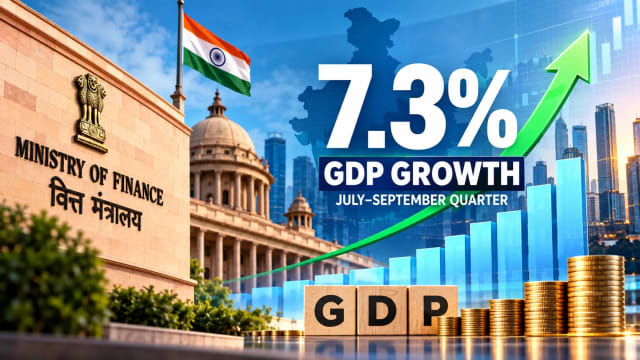
India’s economy continues to expand at a pace that stands out among major economies. The strength of the latest GDP numbers would ordinarily make for a straightforward story about resilience and growth.
Instead, they have revived a more complicated argument over measurement.
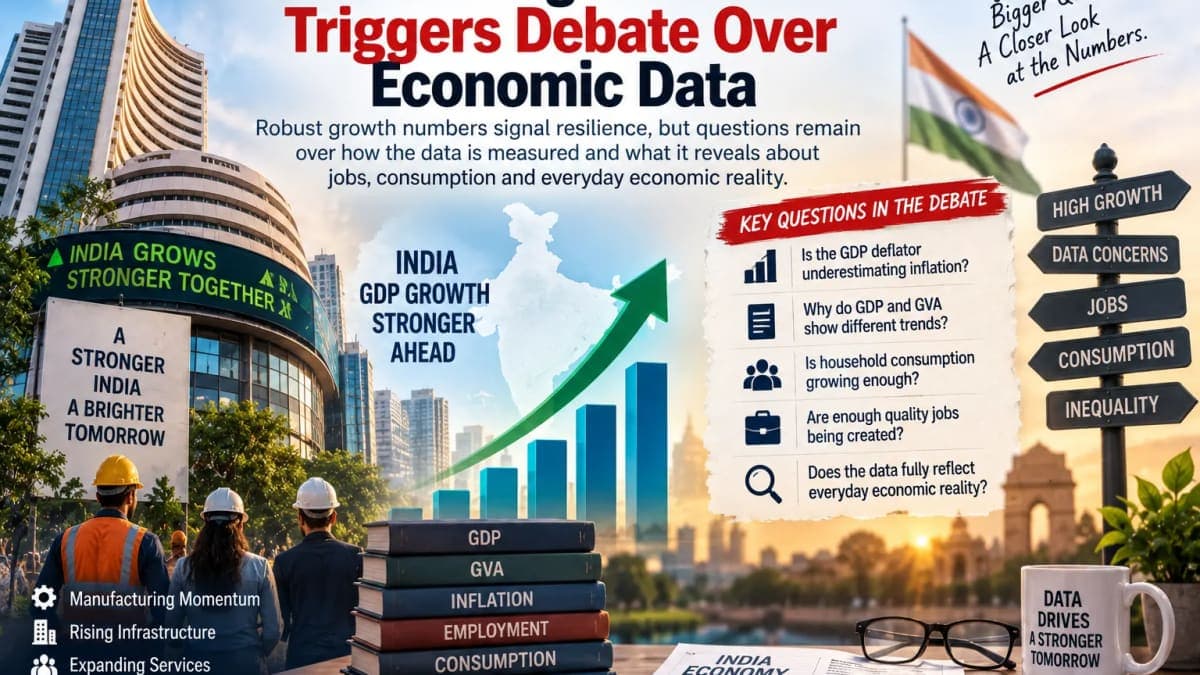
The dispute is not simply about whether India is growing. The economy has expanded significantly, and official data points to continued strength across major sectors. The sharper question is how the headline growth rate should be interpreted alongside other indicators of economic activity.
That distinction matters because GDP answers a specific question: how much economic output is being produced. It does not, on its own, measure whether household incomes are rising at the same pace, whether enough good jobs are being created or how evenly the gains are distributed.
Why Real GDP Is at the Centre of the Discussion
Much of the current argument begins with the difference between nominal and real GDP.
Nominal GDP records output at current prices. Real GDP attempts to strip out the effect of price changes so that economists can estimate how much actual production has increased.
That adjustment is made using price measures known as deflators.
When price growth is subdued, nominal GDP does not need to rise dramatically for real GDP growth to remain strong. There is nothing inherently unusual about that relationship. But when the difference between nominal and real growth attracts attention, so does the method used to adjust for inflation.
That has put India’s GDP deflator back under scrutiny.
Some economists have questioned whether the price measures used in parts of the national accounts can produce unusually strong real growth estimates when wholesale and consumer prices move differently.
The counterargument is equally important: GDP covers far more than household purchases, so simply applying consumer inflation to the entire economy would not produce an appropriate measure of real output.
The debate is therefore about methodology and interpretation, not proof that the published GDP number is false.
Consumer Inflation Cannot Simply Be Substituted for the GDP Deflator
The Consumer Price Index tracks changes in the prices households pay for a defined basket of goods and services. It is an important measure of inflation, particularly when assessing household purchasing power.
The GDP deflator serves a different purpose. It reflects price movements across domestically produced output represented in GDP.
Because the two indicators measure different things, they can move differently.
Wholesale prices can also play a role in estimating prices in parts of the national accounts. When wholesale inflation is weak while consumer inflation remains higher, the resulting calculations can become more difficult for the public to reconcile with everyday experience.
That does not settle the methodological argument. It explains why the issue has become prominent.
GDP and GVA Offer Different Views of the Economy
Economists examining the headline figure also look closely at Gross Value Added.
GVA measures the value generated by producers across agriculture, manufacturing, construction and services. GDP incorporates that production and adjusts for taxes on products and subsidies.
Changes in net indirect taxes can therefore cause GDP and GVA growth to diverge.
Neither measure makes the other redundant.
GDP remains the standard broad measure of the economy, while GVA can provide a useful view of what is happening at the producer and sector level. A meaningful assessment of growth usually requires looking at both rather than treating the headline GDP rate as a complete economic diagnosis.
The Harder Question Is How Growth Feels Outside the Headline Number
Part of the scepticism surrounding strong GDP figures comes from a familiar disconnect. Macroeconomic data can look robust while some households and businesses describe much less comfortable conditions.
That does not necessarily mean one side is wrong.
GDP was never designed to measure financial wellbeing. An economy can grow rapidly because of investment, construction, government expenditure or strong performance in particular industries even if wage growth or consumption remains uneven elsewhere.
The composition of growth therefore matters.
Private consumption is especially important in India because household spending represents a large part of economic activity. Investment matters for a different reason: sustained capital formation can expand the economy’s future productive capacity.
A period led heavily by investment can look and feel different from one driven by broad-based increases in household income and consumption, even when both produce healthy GDP growth.
Jobs Remain a Critical Test of India’s Expansion
India’s demographic scale makes employment impossible to separate from the growth discussion.
Millions of people entering working age need productive jobs, not simply a rising aggregate GDP figure. For that reason, economists look beyond the unemployment rate to labour-force participation, wages, job quality, hours worked and the degree of formal employment.
Those distinctions matter in an economy with a substantial informal sector.
A worker can technically be employed while earning little or working irregular hours. Conversely, greater formalisation can improve the quality and visibility of employment without immediately producing dramatic changes in headline job statistics.
The durability of India’s economic expansion will depend partly on whether higher output translates into sustained gains in productivity, employment and real incomes.
India’s Informal Economy Complicates Measurement
Measuring an economy as large and varied as India’s is difficult even before political arguments enter the picture.
A substantial amount of activity takes place outside large formal companies. Statisticians therefore cannot measure every part of the economy using corporate accounts or direct administrative records.
National accounts combine multiple datasets and estimation techniques to fill those gaps.
Critics of India’s GDP methodology have long focused on how activity in less formally measured parts of the economy is estimated, particularly when formal and informal businesses may be experiencing different conditions.
Supporters of the official framework point to expanding tax records, corporate filings and other administrative datasets that have improved the information available to statisticians.
Both arguments lead to the same practical challenge: India’s economy is changing quickly, and the statistical system has to keep pace.
Politics Has Made a Technical Argument More Contentious
The GDP debate has inevitably moved beyond economists.
Opposition leaders have cited methodological concerns and weaker-looking indicators to challenge the government’s presentation of economic performance. The government has defended the official statistics and rejected allegations that growth is being artificially inflated.
Those claims should be treated separately from the underlying data.
Methodological criticism does not establish political manipulation. At the same time, the existence of strong official growth figures does not make questions about methodology illegitimate.
National statistical systems are routinely revised. Estimates change as better information becomes available, industries evolve and statisticians update the assumptions used to measure them.
The more useful question is whether the methodology is transparent, consistent and capable of reflecting the economy it is supposed to measure.
A New GDP Series Could Change the Conversation
India is working on an updated framework for its national accounts, an important exercise given how much the economy has changed.
Periodic rebasing allows statisticians to update the reference year and incorporate newer information about production, consumption and the structure of industries.
India has undergone substantial economic changes since the existing series was introduced. Digital payments and e-commerce have expanded, more businesses have entered formal tax and corporate systems, and new administrative datasets provide information that was previously difficult to collect.
Updating the GDP series offers an opportunity to capture those changes more accurately.
It will also attract close examination. A new series can alter estimates of the size and growth of different sectors and may revise the historical picture of the economy.
Such revisions are not, by themselves, evidence that earlier numbers were fabricated. They are part of maintaining national accounts as economic structures and available data evolve.
What the Headline GDP Number Cannot Answer
The intensity of the argument partly reflects a tendency to ask GDP to do too much.
No single statistic can determine whether an economy is performing well for everyone.
For a broader reading of India’s economy, GDP needs to be considered alongside GVA, household consumption, investment, real wages, employment, inflation, credit growth, corporate earnings, exports and government finances.
Those indicators do not always move together.
When they diverge, the divergence itself can be informative. Strong investment alongside weaker consumption tells a different economic story from simultaneous strength in wages, household spending and private investment.
The objective should not be to find one number that validates a predetermined view of the economy. It should be to understand why the numbers differ.
India Can Be Growing Strongly While the Data Is Still Debated
The current controversy is often presented as a choice between accepting India’s strong growth story and questioning its statistics. That is unnecessarily binary.
Both can be true.
India can record genuinely rapid economic expansion while economists continue to debate how particular sectors, prices and informal activity are measured. Households can also face pressure even when national output is rising strongly.
Those are different observations about different parts of the economy.
For policymakers, businesses and investors, the credibility of the statistics matters because major decisions depend on them. Fiscal policy, interest-rate decisions, investment plans and international comparisons all require reliable measures of economic activity.
India’s strong GDP numbers are therefore important. So is the scrutiny surrounding them.
The most useful reading of the economy will come not from accepting or dismissing one headline figure, but from seeing how GDP fits with the broader evidence on production, investment, consumption, jobs, wages and prices.