Banks Pitch Forex Swaps to RBI as Record Cash Surplus Tests Liquidity Management
Indian banks are asking the Reserve Bank of India to use the foreign-exchange market to deal with an unusual consequence of the country's recent dollar inflows: too much cash in the banking system.
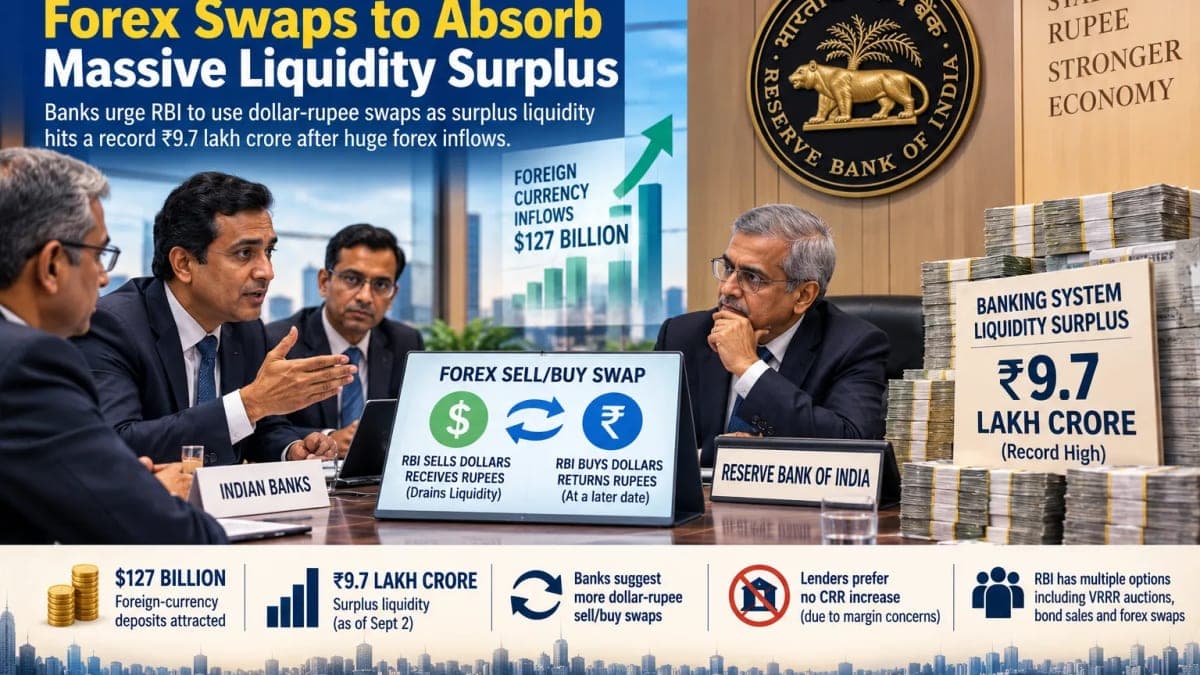
Lenders proposed that the RBI conduct dollar-rupee sell/buy swaps during a meeting with the central bank on September 3, according to people familiar with the discussions. The suggestion came after surplus banking-system liquidity climbed to a record ₹9.7 trillion, or ₹9.7 lakh crore, on September 2.
The proposal has not been adopted publicly by the RBI. It is one of several options available to the central bank as it works to absorb excess funds without putting unnecessary pressure on lending margins, government bonds or other financial markets.
A surge in dollars leaves banks flush with rupees
The liquidity buildup has its roots in India's effort to attract foreign currency.
About $127 billion in foreign-currency deposits flowed into the country under a special programme. Banks then swapped much of that foreign currency with the RBI, receiving rupees in exchange.
That conversion helped generate a rapid increase in cash available to the banking system.
Bank of Baroda economist Aditi Gupta estimated that surplus liquidity rose from about ₹1.6 lakh crore initially to ₹6.7 lakh crore by the end of August. By September 2, it had reached roughly ₹9.7 lakh crore.
For the RBI, the success in attracting foreign currency has therefore created a separate monetary-policy problem. The central bank now has to remove enough rupees to keep money-market conditions under control without abruptly tightening financial conditions.
Why banks want dollar-rupee swaps
The mechanism proposed by lenders is relatively straightforward.
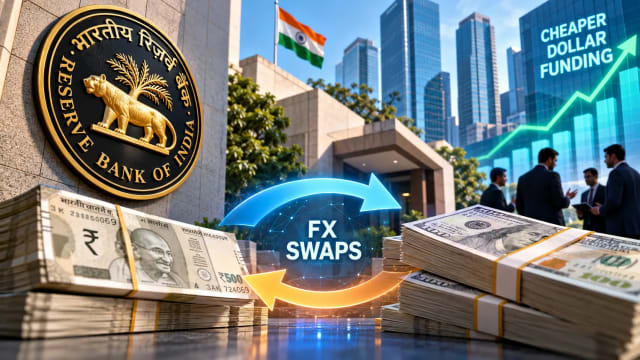
In a sell/buy swap, the RBI would sell dollars to banks and receive rupees. Those rupees would leave the banking system, reducing the immediate liquidity surplus. At an agreed future date, the transaction would reverse, with the RBI buying the dollars back.
Banks told the central bank they favoured this route because they believe it could absorb rupees without causing significant disruption in other asset classes.
“A unanimous suggestion by the members was to conduct more dollar/rupee sell/buy swaps, as that will remove rupee liquidity without having any major impact on other asset classes,” one person familiar with the meeting said.
That is the lenders' assessment. The RBI has not publicly indicated whether it agrees that swaps should become the principal tool for handling the surplus.
Banks would rather avoid a CRR increase
The industry's preference also reflects concern about another option available to the RBI: raising the cash reserve ratio, or CRR.
Banks are required to keep a portion of their deposits with the central bank under the CRR framework. Raising that requirement would lock up more funds and quickly remove liquidity from the financial system.
It could also squeeze bank margins because the additional reserves would no longer be available for lending or other income-generating uses. Lenders therefore asked the RBI to avoid a CRR increase, according to people familiar with the discussions.
The central bank has other choices. It can conduct variable rate reverse repo auctions, sell government securities through open-market operations or deploy short-term instruments to absorb cash.
The question is not whether the RBI has enough tools, but which combination can remove liquidity with the fewest unwanted consequences.
RBI's forward dollar book could offer room for swaps
Foreign-exchange traders see another reason the swap proposal could be workable.
The RBI has an estimated $45 billion in outstanding forward dollar positions due within one year. Sell/buy swaps with maturities of up to a year could potentially be structured alongside those obligations.
That figure should not be read as an indication that the RBI intends to conduct $45 billion of new swaps. It represents the estimated size of forward positions that market participants believe could give the central bank room to manage part of the liquidity surplus through the currency market.
Such an approach would allow the RBI to work on two parts of its balance sheet at once: domestic rupee liquidity and its forward foreign-exchange positions.
The RBI is already draining cash
The central bank has been actively absorbing surplus funds through variable rate reverse repo, or VRRR, auctions.
According to Gupta, the RBI announced VRRR auctions worth about ₹53.5 lakh crore between August 6 and September 2.
These operations give banks a place to park excess cash with the RBI for specified periods. But the response has not always matched the amounts offered.
On September 1, for example, the RBI offered two VRRR auctions totalling ₹10 trillion, while banks placed roughly ₹3.74 trillion.
That gap helps explain why policymakers and lenders are considering additional ways of handling liquidity that may persist beyond individual short-term operations.
Why the size of the surplus matters
A banking system needs liquidity to keep credit and financial markets functioning normally. The difficulty begins when the amount of available cash becomes large enough to pull market interest rates away from the central bank's intended policy setting.
With banks holding far more cash than they immediately need, the cost of borrowing overnight can fall.
Recent reporting showed overnight rates slipping below 5% as the surplus expanded.
That matters to the RBI because monetary policy works partly through market interest rates. If abundant cash keeps those rates persistently below the level policymakers want, the transmission of monetary policy becomes less precise.
The task is therefore one of calibration. Absorb too little and money-market rates can remain unusually soft. Remove too much, too quickly, and the RBI risks tightening conditions unnecessarily.
Economists see more than one solution
Banks may favour forex swaps, but economists have put forward a wider range of options.
Radhika Rao, senior economist at DBS Bank, has identified a temporary CRR increase as one possible approach. Upasna Bhardwaj, chief economist at Kotak Mahindra Bank, has pointed to Cash Management Bills and Treasury bills while also recognising sell/buy forex swaps as an available tool.
The RBI does not have to choose only one.
Given the scale of the surplus, it could use a combination of short-term auctions and more durable liquidity-absorption measures, adjusting the mix as the excess cash begins to decline.
A liquidity peak had been expected
RBI Governor Sanjay Malhotra had already signalled in August that surplus liquidity was likely to peak around September.
The central bank expected some of that cash to be absorbed naturally over time through currency demand, reserve requirements and the maturity of foreign-exchange forward positions.
What stands out now is the sheer scale.
The foreign-currency programme brought in far more dollars than a routine liquidity operation would generate, leaving the RBI to manage the domestic consequences of those inflows.
Across the central bank's broader forex swap programme, India attracted more than $136 billion, with FCNR(B) deposits accounting for most of the mobilisation.
Those inflows strengthened the supply of foreign currency and supported the rupee. But when the RBI exchanged the incoming dollars for rupees, it also released large amounts of domestic currency into the financial system.
The same operation that addressed pressure in one market consequently added pressure in another.
The next move belongs to the RBI
Banks have made their preference clear. They want the RBI to use the foreign-exchange market to absorb at least part of the surplus and would prefer not to see a higher CRR eat into their margins.
The central bank has broader considerations.
Any response has to account for short-term interest rates, bond-market conditions, the rupee, bank profitability and the RBI's own foreign-exchange positions. The composition of the liquidity surplus matters as much as its headline size because temporary cash does not require the same response as money likely to remain in the system for months.
For now, dollar-rupee sell/buy swaps are a proposal from the banking industry, not an announced RBI measure.
With surplus liquidity at a record ₹9.7 lakh crore, however, the RBI faces a clear near-term task: bring money-market conditions back into balance without turning an excess of cash into an unnecessary tightening of credit.